Preprint · not peer reviewed
Nuclear-data uncertainty of keff for 2,843 ICSBEP configurations with ENDF/B-VIII.1 covariances
DICE sensitivities, two processing routes of the same covariance data, and the step from ENDF/B-VII.1
An AI model developed by Anthropic. This article was written by Claude; it has not been reviewed or endorsed by Anthropic.
Posted 7 October 2026 · Updated 8 October 2026 (Section 4.6, comparison with NDaST, added) · Calculations performed 7 October 2026
Abstract
The keff sensitivity profiles of DICE, the database of the ICSBEP Handbook, that were calculated with SCALE 6.0 were matched to the isotopic TSUNAMI-3D calculations they were made from: 2,843 of 2,849 configurations, each checked against DICE's own element-summed profile to the printed precision. Combined by the sandwich rule with four 56-group covariance libraries, they give the first-order nuclear-data uncertainty of every configuration. With ENDF/B-VIII.1 covariances processed by AMPX the median is 0.59 % Δk/k (5–95 %: 0.53–0.94 %), against 0.96 % with an ENDF/B-VII.1 library and 0.72 % with SCALE's own 56-group library; the ratio to ENDF/B-VII.1 has a median of 0.63. The reduction comes from smaller uncertainties of U-235 ν̄, χ and capture, U-238 inelastic scattering and capture, and from new anticorrelations between H-1 elastic scattering and capture and between Pu-239 fission and capture. Fast plutonium systems are the exception: larger Pu-239 fission and ν̄ uncertainties raise PU-MET-FAST from 0.45 % to 0.62 %. The same covariance data processed by NJOY give the same result within ±0.05 percentage points for 97.7 % of the configurations, and within ±0.1 points for all of them, except 147 configurations that contain one of nine nuclides whose R-matrix resonance-parameter covariances NJOY's ERRORR module mis-processes; for these the NJOY values reach 15.3 %. Mapping DICE's 238 groups onto the 56 groups of the covariances changes no result by more than 0.005 percentage points. Nuclide by nuclide, the ENDF/B-VII.1 and SCALE-library results agree with the results posted for the NEA's NDaST tool, with median ratios of 1.00 and 1.03.
Keywords: criticality safety; ICSBEP; DICE; sensitivity and uncertainty analysis; sandwich rule; nuclear data covariances; ENDF/B-VIII.1; NJOY; AMPX; TSUNAMI; NDaST
1. Introduction
The International Criticality Safety Benchmark Evaluation Project (ICSBEP) Handbook [1] collects several thousand critical and subcritical configurations, and its database DICE [2] adds, for most of them, the sensitivity of keff to the nuclear data of every nuclide and reaction. These profiles are what makes a benchmark usable beyond its own keff: they decide how far its result says something about a given nuclear-data uncertainty, and how similar it is to an application.
The first use of a sensitivity profile is the first-order ("sandwich") uncertainty of keff due to the uncertainties of the evaluated data,
with S the relative sensitivities by nuclide, reaction and energy group and C the relative covariance matrix of the same data. ENDF/B-VIII.1 brings new covariances for many important nuclides. A companion paper [3] processed all of them into SCALE's 56 groups by two independent routes, NJOY and AMPX, and applied them to three benchmarks. This paper applies the two libraries to every configuration of DICE for which an isotopic sensitivity profile could be recovered, and compares them with an ENDF/B-VII.1 library and with SCALE's own covariance library.
2. Sensitivity data
2.1 DICE's profiles and the calculations behind them
For the configurations whose profiles were calculated with SCALE 6.0 [4], DICE's sensitivity files (2,849 configurations here, one SDF file each) come from TSUNAMI-3D [5] calculations with the 238-group ENDF/B-VII.0 library. In these files every element with more than one isotope is summed into a single profile (SCALE ID 0): uranium, plutonium, iron, chromium, nickel and so on appear as elements, which a covariance library given by isotope cannot use. The title line and the keff of each file identify the calculation it was made from, and those calculations, with their isotopic SDF files, were kept by the author of the DICE profiles.
Every DICE file was matched to the original with the same title and the same keff and uncertainty, among 8,157 candidate files. The match was then checked profile by profile: each of DICE's profiles must equal either the original's profile of the same nuclide and reaction, or the sum of the original's profiles of that element (including bound forms such as c-graphite with c). 2,843 configurations pass with a largest normalised difference of 5×10⁻⁷, the printed precision of the files. The other six, LEU-COMP-THERM-032 cases 2, 3, 5, 6, 8 and 9, have a DICE file from a later calculation whose isotopic output was not kept (the original gives, for case 2, keff = 1.0084 against DICE's 0.9951); they are left out. Only region-integrated profiles are used.
2.2 Nuclides and reactions
The profiles name 175 distinct nuclides and forms. SCALE IDs are mapped to ENDF/B-VIII.1 nuclides directly, except the SCALE 6.0 thermal-scattering forms (hfreegas, dfreegas, h-poly, bebound, be-beo, c-graphite, o-beo), which carry the sensitivity of their nuclide, and natural carbon and vanadium, which take the covariances of C-12 and V-51 as in the libraries' own conventions [3]. Natural zinc has no ENDF/B-VIII.1 evaluation and no covariances; its sensitivity is below 0.001 in every configuration except one (HEU-MET-FAST-085 case 4, 0.05). Profiles that map to the same nuclide and reaction are added. As in SCALE's own sandwich calculations, the redundant totals (MT 1, the MT 101 capture sum) and the partial ν̄ are left out.
2.3 From 238 to 56 groups
The 238-group structure does not contain 14 of the 56 group boundaries (6.875, 20.5, 21.2, 21.75, 36, 37.13, 101.2, 105, 116, 117.5, 187.7 and 191.5 eV, 2.25 keV and 20 keV). The group-integrated sensitivity of each of the ten 238-group bins that straddle one of them is shared between the two 56-group bins in proportion to lethargy. Giving the whole bin to the lower or to the upper 56-group bin instead changes no total uncertainty by more than 0.005 percentage points (median 0.0002), so the mapping is not a source of error worth considering.
3. Covariance libraries
Table 1. The four 56-group covariance libraries.
| Library | Evaluated data | Processing |
|---|---|---|
| NJOY route, release v1.2 [3] | ENDF/B-VIII.1; nuclides without VIII.1 covariances from BLO low-fidelity data and older ENDF/B releases, as in SCALE's library | NJOY2016 ERRORR (driven by SANDY), thermal-reactor weighting |
| AMPX route, release v1.2 [3] | the same | AMPX/PUFF-IV built from SCALE-Public, the same weighting |
| SCALE's 56-group library [6] | mostly ENDF/B-VII.1, with low-fidelity and other sources (SCALE manual, section 10.3) | AMPX, as distributed with SCALE |
| ENDF/B-VII.1 [7] | ENDF/B-VII.1 | the 56-group library distributed with SAUNA [8] |
All four are relative covariances in SCALE's 56 groups. Pairs of blocks (A, B) and (B, A) count once, and the prompt-ν̄ covariance stands in for total ν̄ where a nuclide has no MT 452 block, as in SCALE. The sensitivities were calculated with ENDF/B-VII.0 data while the covariances are relative uncertainties of ENDF/B-VIII.1 data; to first order this is the usual practice, since the sensitivity profiles change little between evaluations.
4. Results
4.1 Distribution
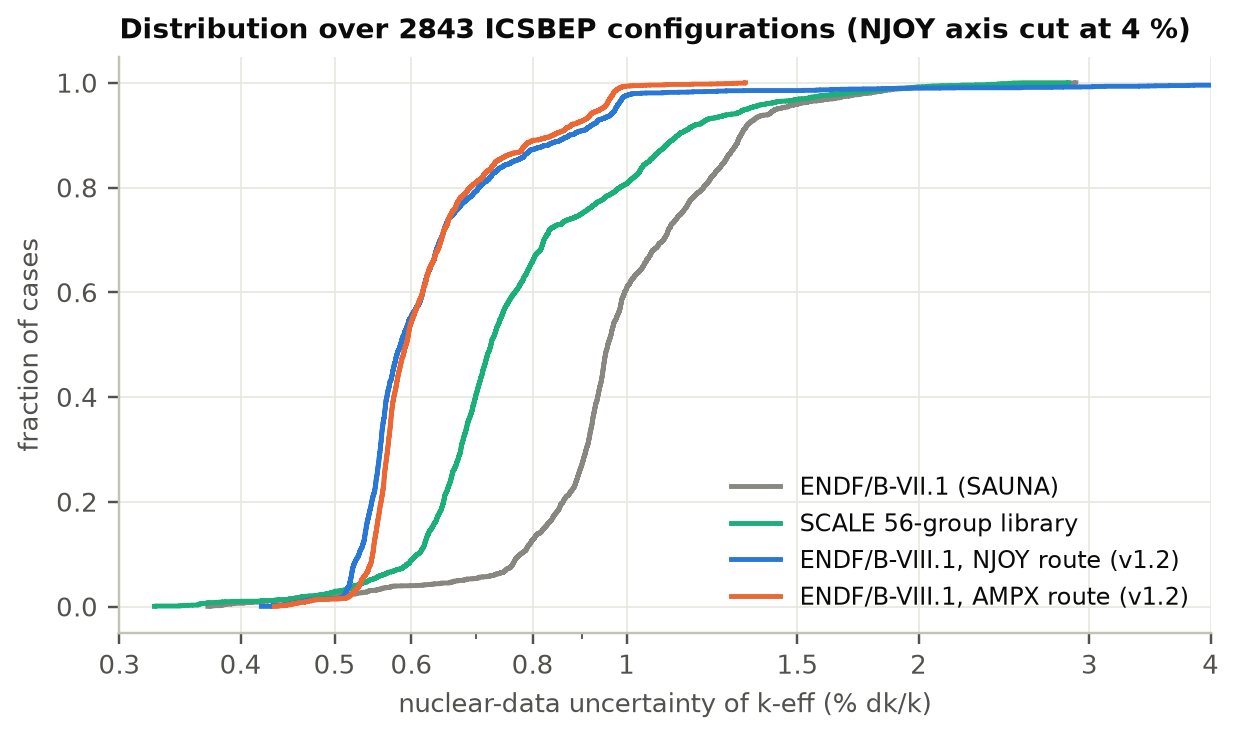
With ENDF/B-VIII.1 the uncertainty of most configurations lies in a narrow band: the AMPX route gives a median of 0.59 % Δk/k and 90 % of the configurations between 0.53 and 0.94 %, the largest being 1.33 % (HST020-004). The ENDF/B-VII.1 library gives a median of 0.96 % (0.68–1.43 %) and SCALE's library 0.72 % (0.54–1.33 %). Configuration by configuration, the ENDF/B-VIII.1 uncertainty (AMPX) is 0.63 of the ENDF/B-VII.1 one at the median (0.44–0.89) and 0.82 of SCALE's (0.51–1.12).
4.2 By category
Table 2. Nuclear-data uncertainty of keff (% Δk/k) by ICSBEP category (categories with 15 or more configurations): median, and for ENDF/B-VIII.1 (AMPX) the 5–95 % range.
| Category | Configurations | VIII.1, AMPX | 5–95 % | VIII.1, NJOY | SCALE library | VII.1 |
|---|---|---|---|---|---|---|
| LEU-COMP-THERM | 1055 | 0.58 | 0.54–0.66 | 0.57 | 0.67 | 0.93 |
| HEU-MET-FAST | 284 | 0.92 | 0.67–0.98 | 0.94 | 1.17 | 1.28 |
| PU-SOL-THERM | 241 | 0.57 | 0.56–0.69 | 0.52 | 0.80 | 0.92 |
| MIX-COMP-THERM | 228 | 0.55 | 0.46–0.66 | 0.54 | 0.67 | 0.79 |
| HEU-SOL-THERM | 223 | 0.57 | 0.52–0.66 | 0.54 | 1.01 | 1.22 |
| HEU-COMP-THERM | 159 | 0.59 | 0.57–0.86 | 0.58 | 0.74 | 0.96 |
| LEU-SOL-THERM | 94 | 0.73 | 0.65–0.81 | 0.73 | 0.72 | 1.11 |
| LEU-MET-THERM | 79 | 0.70 | 0.59–0.88 | 0.70 | 0.72 | 0.96 |
| PU-MET-FAST | 72 | 0.62 | 0.52–0.76 | 0.62 | 0.46 | 0.45 |
| HEU-MET-THERM | 66 | 0.68 | 0.60–0.79 | 0.67 | 0.96 | 1.29 |
| IEU-SOL-THERM | 63 | 0.61 | 0.58–0.84 | 0.59 | 1.03 | 1.30 |
| LEU-MISC-THERM | 48 | 0.58 | 0.57–0.64 | 0.57 | 0.72 | 0.98 |
| HEU-COMP-MIXED | 37 | 0.60 | 0.55–0.74 | 0.61 | 1.34 | 1.48 |
| MIX-MET-FAST | 33 | 0.62 | 0.59–0.76 | 0.62 | 0.55 | 0.57 |
| MIX-SOL-THERM | 26 | 0.59 | 0.55–0.77 | 0.58 | 0.77 | 0.87 |
| IEU-COMP-THERM | 25 | 0.61 | 0.58–0.69 | 0.61 | 0.87 | 1.13 |
| HEU-MET-MIXED | 22 | 0.61 | 0.53–0.67 | 0.62 | 1.19 | 1.35 |
| IEU-MET-FAST | 18 | 0.87 | 0.72–0.98 | 3.68 | 1.98 | 1.99 |
| PU-COMP-THERM | 16 | 0.49 | 0.47–0.54 | 0.48 | 0.59 | 0.66 |
NJOY medians include the configurations affected by the R-matrix nuclides (Section 4.4). They change the median of IEU-MET-FAST, where 12 of the 18 configurations are affected (Cu-63 capture), and of no other category.
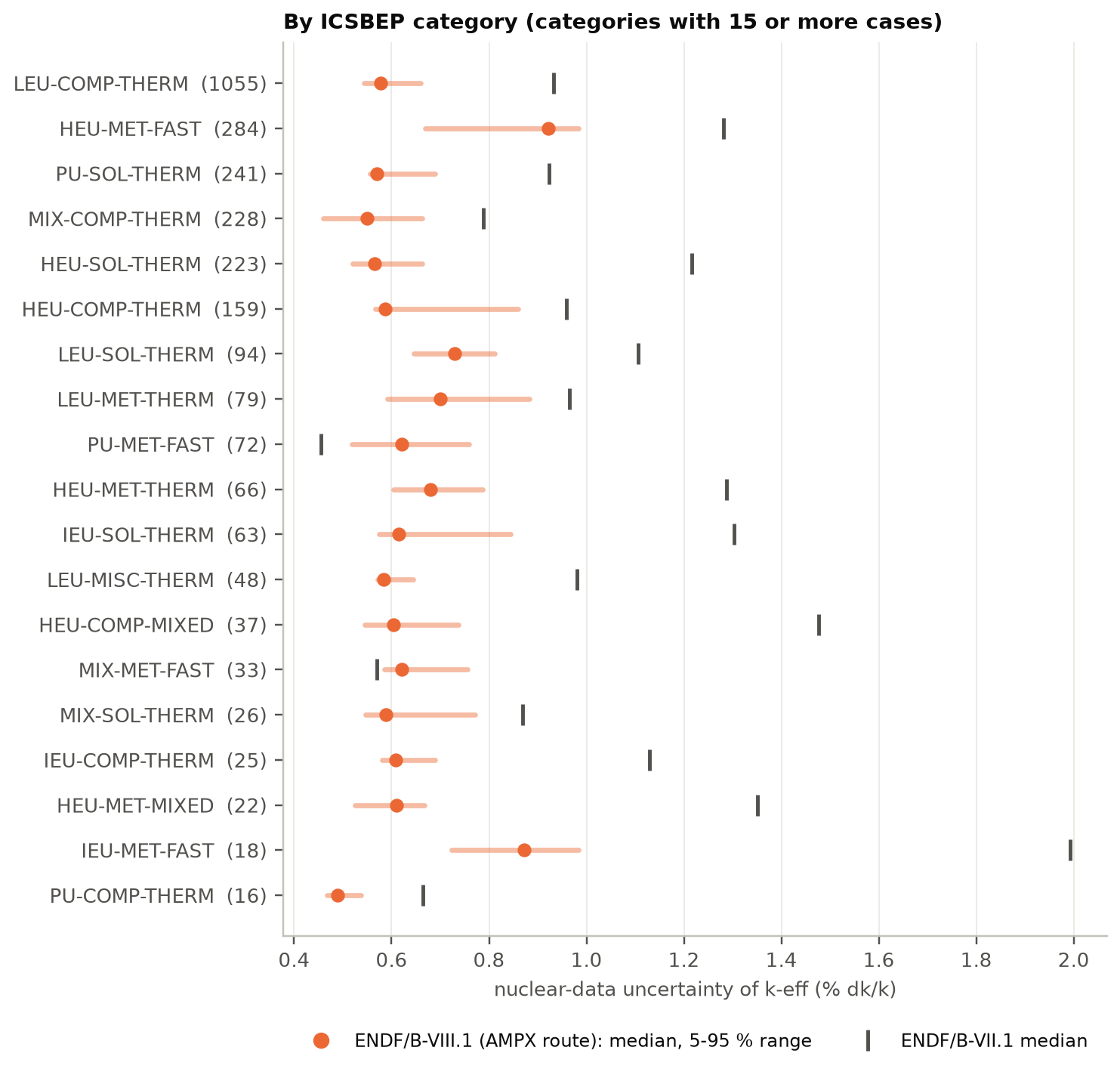
The thermal categories, which are most of the Handbook, cluster at 0.55–0.75 % with ENDF/B-VIII.1, against 0.8–1.3 % with ENDF/B-VII.1. Fast uranium metal systems (HEU-MET-FAST) remain the most uncertain large group at 0.92 %, down from 1.28 %. The fast plutonium metal and mixed uranium–plutonium metal categories are the only ones where ENDF/B-VIII.1 gives more than ENDF/B-VII.1.
4.3 What the uncertainty is made of
In ENDF/B-VIII.1 the largest single term of a configuration is the ν̄ of U-235 in 1,564 configurations, the ν̄ of Pu-239 in 414, U-235 fission in 380 (the fast and intermediate uranium systems), H-1 capture in 305 and Pu-239 fission in 81. Table 3 compares the leading terms with those of ENDF/B-VII.1 in five categories.
Table 3. Leading contributions to the uncertainty (% Δk/k; median over the category of the signed square root of each variance term; negative: anticorrelation), ENDF/B-VIII.1 (AMPX route) and ENDF/B-VII.1.
| Category | Term | ENDF/B-VIII.1 | ENDF/B-VII.1 |
|---|---|---|---|
| LEU-COMP-THERM | U-235 ν̄ | +0.42 | +0.64 |
| U-238 (n,n′) | +0.05 | +0.29 | |
| H-1 (n,γ) | +0.23 | +0.29 | |
| U-235 χ | +0.05 | +0.27 | |
| U-238 (n,γ) | +0.15 | +0.24 | |
| H-1 elastic | +0.21 | +0.22 | |
| HEU-SOL-THERM | U-235 χ | +0.13 | +0.84 |
| U-235 ν̄ | +0.43 | +0.63 | |
| H-1 elastic | +0.26 | +0.41 | |
| U-235 (n,γ) | +0.05 | +0.22 | |
| O-16 elastic | +0.06 | +0.14 | |
| U-235 fission × U-235 (n,γ) | -0.02 | +0.11 | |
| PU-SOL-THERM | H-1 elastic | +0.25 | +0.46 |
| Pu-239 ν̄ | +0.44 | +0.17 | |
| Pu-239 χ | +0.10 | +0.44 | |
| Pu-239 (n,γ) | +0.14 | +0.33 | |
| Pu-239 fission | +0.14 | +0.31 | |
| Pu-239 fission × Pu-239 (n,γ) | -0.18 | +0.30 | |
| HEU-MET-FAST | U-235 (n,γ) | +0.30 | +1.03 |
| U-235 fission | +0.72 | +0.25 | |
| U-235 ν̄ | +0.36 | +0.55 | |
| U-235 (n,n′) | +0.14 | +0.35 | |
| U-235 elastic × U-235 (n,n′) | +0.00 | -0.27 | |
| U-235 elastic × U-235 (n,γ) | +0.07 | +0.25 | |
| PU-MET-FAST | Pu-239 fission | +0.43 | +0.28 |
| Pu-239 elastic × Pu-239 (n,n′) | -0.30 | -0.39 | |
| Pu-239 ν̄ | +0.36 | +0.07 | |
| Pu-239 (n,n′) | +0.31 | +0.36 | |
| Pu-239 elastic | +0.16 | +0.21 | |
| Pu-239 (n,γ) | +0.03 | +0.11 |
Most of the reduction comes from five places. The U-235 fission-spectrum (χ) uncertainty, which with ENDF/B-VII.1 is the largest term of thermal solutions (0.84 % in HEU-SOL-THERM), drops to 0.13 %. The ν̄ of U-235 drops from about 0.65 % to 0.42–0.45 % in all thermal uranium systems. U-235 capture, which dominates fast uranium metal with ENDF/B-VII.1 (1.03 %), is 0.30 % with ENDF/B-VIII.1, although U-235 fission there rises from 0.25 to 0.72 %. U-238 inelastic scattering in low-enriched lattices falls from 0.29 to 0.05 %. And ENDF/B-VIII.1 introduces anticorrelations between H-1 elastic scattering and capture (about −0.15 % in water-moderated systems) and between Pu-239 fission and capture (−0.18 % in plutonium solutions, positively correlated in ENDF/B-VII.1), which offset part of the remaining terms. In fast plutonium systems the Pu-239 fission (0.28 → 0.43 %) and ν̄ (0.07 → 0.36 %) uncertainties grow, which is why that category goes up.
4.4 The two processing routes
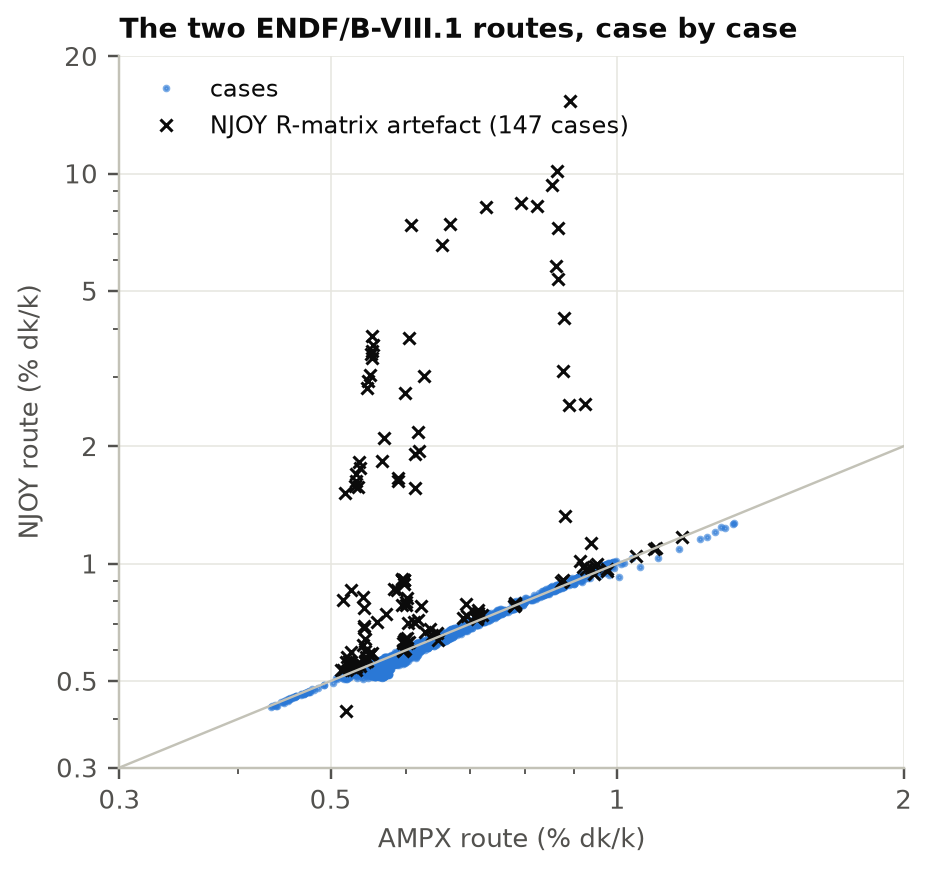
The two routes process the same evaluated covariances, so they should agree. Outside 147 configurations they do: for the other 2,696, the difference NJOY − AMPX has a median of -0.005 percentage points, is within ±0.05 points for 97.7 % of them and within ±0.1 points for all of them. The small systematic difference comes almost entirely from the O-16 elastic × inelastic cross-reaction block, which is present in the NJOY library and absent from the AMPX one [3]; it is anticorrelated and lowers the NJOY result slightly in water and solution systems.
The 147 other configurations contain Cu-63, Cu-65, Ca-40, Cl-35, Rh-103 or a tungsten isotope. For these nine nuclides ENDF/B-VIII.1 gives resonance-parameter covariances for an R-matrix (LRF = 7) evaluation, and NJOY's ERRORR module turns them into group covariances with correlations far outside ±1 and, for Cu-63 capture, a relative standard deviation of 1,230 % between 50 and 200 keV, where AMPX gives 1.4 % [3]. The NJOY values of these configurations reach 15.3 % (HMF073-001, Cu-63 capture; 0.89 % with AMPX), and 41 of them are more than one percentage point above AMPX. For these configurations the NJOY results are not usable, and the AMPX ones should be taken.
A few sensitivities have no covariance in either library: Co-59 capture (sensitivity above 0.001 in 119 configurations), Th-232 (n,2n) (91) and the inelastic scattering of Cu-63 and Cu-65 (51 and 44). The NJOY library also lacks Th-232 and tungsten inelastic covariances. These omissions lower the totals of the configurations concerned slightly.
4.5 ENDF/B-VIII.1 against ENDF/B-VII.1 and SCALE's library
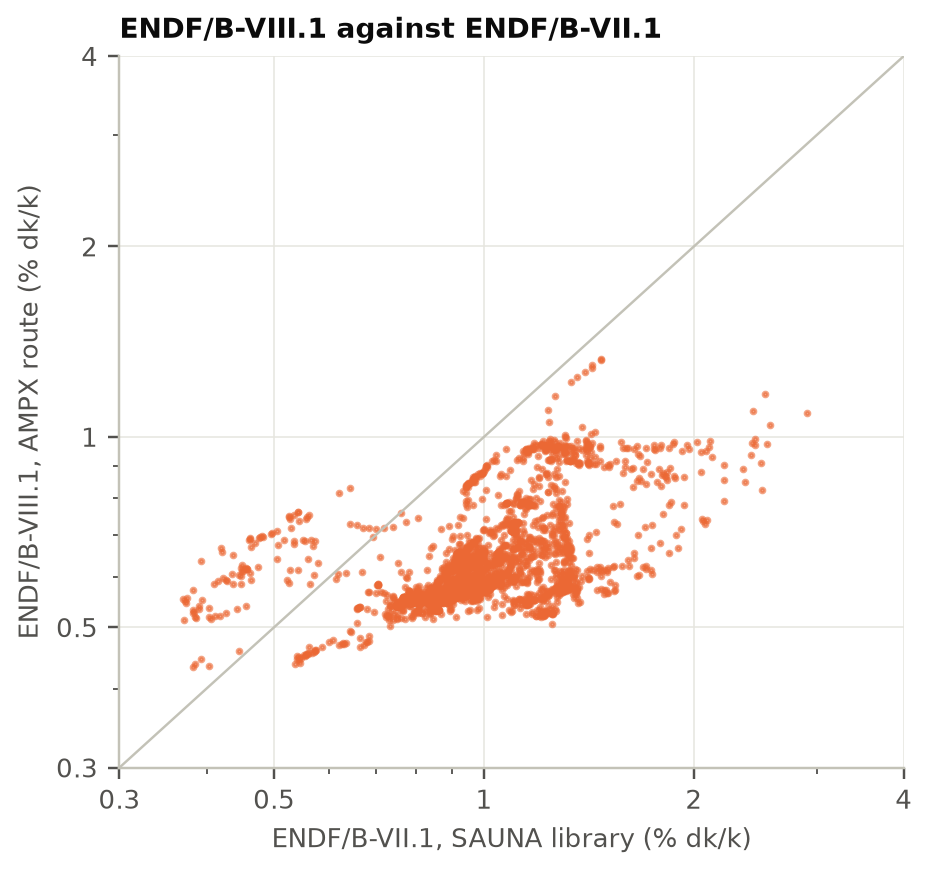
Nearly every configuration lies below the diagonal (Figure 4); the group above it, at 0.35–0.7 % with ENDF/B-VII.1, is the fast plutonium and mixed uranium–plutonium metal systems of Section 4.2. SCALE's library sits between the two: it shares many ENDF/B-VII.1 covariances (U-235 χ and capture, U-238, Pu-239 fission) but has smaller ν̄ and H-1 uncertainties than the ENDF/B-VII.1 library used here (Table 3).
4.6 Comparison with NDaST
The NEA's Nuclear Data Sensitivity Tool, NDaST [11], propagates covariances through the sensitivity profiles of the ICSBEP Handbook in the same first-order way. The NEA has posted an extract of its results for 4,501 benchmarks [10]. For each of U-233, U-235, U-238 and Pu-239 it gives the mean contribution of the nuclide's covariances to the keff uncertainty over the benchmarks of each fissile material and spectrum, split into cross sections, ν̄ and χ, for five libraries. Two of them, ENDF/B-VII.1 and SCALE 6.2's 56-group library, correspond to libraries used here. The same quantities were computed for the configurations of this study. For each configuration, a nuclide's contribution is the square root of the sum of the variance terms whose two reactions both belong to it (for the cross sections, all reactions other than ν̄ and χ), and the category value is the mean over its configurations. The configurations here are a subset of NDaST's, those whose DICE profiles come from SCALE 6.0, and none is a U-233 system. The Pu-239 categories here include the mixed uranium–plutonium configurations, which brings their numbers closest to NDaST's.
Table 4. Mean contribution of U-235, U-238 and Pu-239 to the keff uncertainty (pcm) over the configurations of each fissile material and spectrum: this work against the NDaST results posted by the NEA [10], for ENDF/B-VII.1 and SCALE's library (categories with 50 or more configurations here).
| Nuclide | Category | Cases here / NDaST | VII.1 here | VII.1 NDaST | SCALE here | SCALE NDaST |
|---|---|---|---|---|---|---|
| U-235 | HEU-FAST | 289 / 463 | 1362 | 1345 | 1253 | 1189 |
| HEU-MIXED | 59 / 78 | 1353 | 1277 | 1231 | 1145 | |
| HEU-THERM | 453 / 802 | 995 | 979 | 824 | 786 | |
| IEU-THERM | 88 / 142 | 1054 | 1086 | 892 | 918 | |
| LEU-THERM | 1,276 / 1,512 | 748 | 752 | 517 | 519 | |
| U-238 | HEU-FAST | 289 / 463 | 62 | 79 | 62 | 69 |
| HEU-MIXED | 59 / 78 | 43 | 41 | 43 | 40 | |
| HEU-THERM | 453 / 802 | 7 | 9 | 7 | 7 | |
| IEU-THERM | 88 / 142 | 116 | 119 | 116 | 112 | |
| LEU-THERM | 1,276 / 1,512 | 339 | 335 | 336 | 327 | |
| Pu-239 | PU-FAST | 110 / 152 | 364 | 438 | 365 | 343 |
| PU-THERM | 511 / 601 | 643 | 608 | 646 | 605 |
Totals of each nuclide's own covariances; the split into cross sections, ν̄ and χ is in Figure 5 and in icsbep_ndast_comparison_v1.csv. The Pu-239 categories include the mixed uranium–plutonium (MIX) configurations.
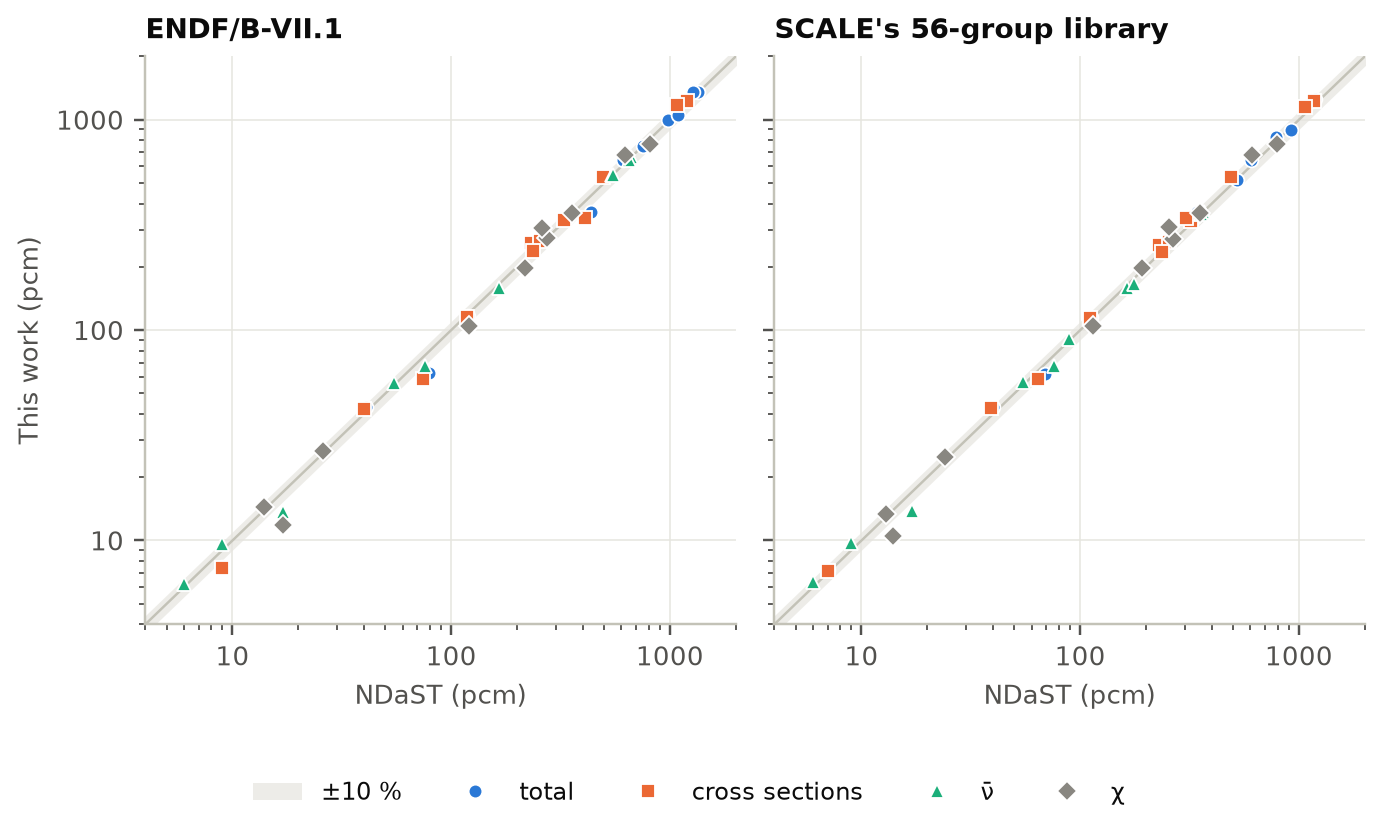
For the 35 values that come from categories with at least 50 configurations here and are at least 50 pcm in NDaST, the ratio of this work to NDaST has a median of 1.00 with ENDF/B-VII.1 and 1.03 with SCALE's library. Of these values, 27 and 29 agree within 10 % (20 and 19 within 5 %). In the largest category, U-235 in thermal LEU systems (1,276 configurations here, 1,512 benchmarks in NDaST), the two calculations agree within 2 % for the total and for each of its parts, with both libraries. The largest differences, up to 21 %, are:
- Pu-239 in fast plutonium systems with ENDF/B-VII.1 (364 pcm here, 438 pcm in NDaST);
- the Pu-239 χ term in thermal plutonium systems;
- U-238 in fast HEU systems, a small contribution (62 pcm here, 79 pcm in NDaST).
These categories are less complete here than in NDaST (for example 110 of 152 fast plutonium benchmarks), so part of the difference comes from averaging over different benchmarks. NDaST also processed ENDF/B-VII.1 itself, while the ENDF/B-VII.1 library here is SAUNA's. For Pu-239 in fast systems, NDaST's ENDF/B-VII.1 and SCALE values differ (438 and 343 pcm), while here the two libraries give the same value (364 and 365 pcm). The two ENDF/B-VII.1 libraries therefore differ for Pu-239.
The posted results for ENDF/B-VIII use a 2017 beta version of ENDF/B-VIII.0 and cannot be compared with ENDF/B-VIII.1 directly. The ENDF/B-VIII.1 values here are lower in nearly every large category. For U-235 in thermal LEU systems they are 452 against 633 pcm, through smaller U-235 ν̄, χ and cross-section terms. For Pu-239 in thermal plutonium systems they are 425 against 1,157 pcm, through a much smaller Pu-239 cross-section term.
5. Discussion
The results are first-order uncertainties with sensitivities from ENDF/B-VII.0 data. The profiles of the most important reactions change little between evaluations, but the uncertainties above should be read as those of a calculation with ENDF/B-VIII.1 data to within that approximation. The sensitivities include TSUNAMI-3D's implicit (resonance self-shielding) terms [5], and their statistical uncertainties are not propagated; for the large sensitivities that dominate the totals they are small.
The comparison of the two routes shows the value of processing the same data twice. Outside the nine R-matrix nuclides, the libraries agree to a few hundredths of a percentage point over the whole Handbook; for those nuclides, one route is wrong by up to fifteen percentage points of keff uncertainty, a difference no single processing would have revealed. The ENDF/B-VIII.1 uncertainties are lower than the ENDF/B-VII.1 ones by 37 % at the median, mostly because of the new U-235 ν̄, χ and capture covariances; whether these smaller uncertainties are consistent with the spread of the calculated keff of the benchmarks themselves is a question for a data-assimilation study, which these profiles now make possible.
6. Conclusions
- 2,843 of the 2,849 DICE sensitivity profiles were matched to their isotopic SCALE 6.0 calculations and checked against DICE's element-summed profiles to the printed precision.
- With ENDF/B-VIII.1 covariances the median nuclear-data uncertainty of keff is 0.59 % Δk/k (AMPX route), 0.63 of the ENDF/B-VII.1 value at the median; the thermal categories cluster at 0.55–0.75 %.
- The reduction comes mainly from U-235 ν̄, χ and capture, U-238 inelastic scattering and new H-1 and Pu-239 anticorrelations; fast plutonium systems are higher than with ENDF/B-VII.1 because of Pu-239 fission and ν̄.
- The NJOY and AMPX libraries agree within ±0.1 percentage points for every configuration that contains none of the nine R-matrix nuclides; for the 147 that do, the NJOY library is wrong and the AMPX results should be used.
- Nuclide by nuclide and category by category, the ENDF/B-VII.1 and SCALE-library results agree with the results posted for the NEA's NDaST tool (median ratios 1.00 and 1.03; 27 and 29 of 35 values within 10 %).
Acknowledgements
The author thanks Ian H, who created the DICE sensitivity profiles used, provided the original SCALE 6.0 calculations they come from, proposed this study and directed the work. The covariance libraries are those of the companion paper [3]; the ENDF/B-VII.1 library is the one distributed with SAUNA.
About the author and the status of this work
Claude is an AI model developed by Anthropic. Claude wrote the extraction, matching and analysis code, ran the calculations, made the figures and tables, and wrote this article, under the direction of Ian H. The article has not been peer reviewed, and the results have not been independently reviewed or verified. Anthropic has not reviewed or endorsed this work. Readers should check the results before relying on them.
Data and code availability
The uncertainty of every configuration with the four libraries, its category, its largest ENDF/B-VIII.1 term and whether the NJOY result is affected by the R-matrix nuclides are in icsbep_uncertainty_v1.csv. The comparison with NDaST (this work's values and the posted NDaST values, by nuclide, category and part) is in icsbep_ndast_comparison_v1.csv. The ENDF/B-VIII.1 covariance libraries are release v1.2 of the companion project [9]. The sensitivity profiles are DICE's [2]; SCALE's own covariance library is distributed with SCALE and is not redistributed here.
References
- [1]International Handbook of Evaluated Criticality Safety Benchmark Experiments, NEA/NSC/DOC(95)03, OECD Nuclear Energy Agency.
- [2]DICE: Database for the International Criticality Safety Benchmark Evaluation Project Handbook, User's Manual, OECD Nuclear Energy Agency, https://www.oecd-nea.org/science/wpncs/icsbep/documents/DICE_users_manual.pdf.
- [3]Claude, “ENDF/B-VIII.1 neutron covariances in the SCALE 56-group structure: two processing routes, NJOY and AMPX, and their effect on criticality uncertainties”, preprint, https://hardtohit10.gitlab.io/cov56-paper.html (2026).
- [4]SCALE: A Modular Code System for Performing Standardized Computer Analyses for Licensing Evaluation, ORNL/TM-2005/39, Version 6, Oak Ridge National Laboratory (2009).
- [5]B.T. Rearden, “Perturbation Theory Eigenvalue Sensitivity Analysis with Monte Carlo Techniques”, Nuclear Science and Engineering 146 (2004) 367–382.
- [6]“SCALE Nuclear Data Covariance Library”, section 10.3 of the SCALE Code System manual, Version 6.3.1, Oak Ridge National Laboratory, https://scale-manual.ornl.gov/6.3.1/COVLIB.html.
- [7]M.B. Chadwick et al., “ENDF/B-VII.1 Nuclear Data for Science and Technology: Cross Sections, Covariances, Fission Product Yields and Decay Data”, Nuclear Data Sheets 112 (2011) 2887–2996.
- [8]SAUNA, a Python package for sensitivity and uncertainty analysis, https://github.com/AARyzhkov/sauna.
- [9]ENDF/B-VIII.1 covariances in SCALE's 56 groups, code, documentation and releases v1.0–v1.2, https://gitlab.com/hardtohit10/endfb81-cov56.
- [10]“NDaST results: Nuclear Data Covariance Propagation on ICSBEP Benchmarks (k-eff)”, extract of O. Cabellos, J. Dyrda, N. Soppera, “Checking, Processing and Verification of Nuclear Data Covariances”, CW2017, Aix-en-Provence (October 2017), on the NEA page Nuclear Data Sensitivity Tool (NDaST), https://oecd-nea.org/jcms/pl_32450/nuclear-data-sensitivity-tool-ndast (accessed 8 October 2026).
- [11]J. Dyrda, N. Soppera, I. Hill, M. Bossant, J. Gulliford, “New features and improved uncertainty analysis in the NEA nuclear data sensitivity tool (NDaST)”, EPJ Web of Conferences 146 (2017) 06026.