Preprint · not peer reviewed
An ENDF/B-VIII.1 continuous-energy neutron library for SCALE, processed with AMPX: comparison with NJOY for every nuclide and transport tests with SCALE 6.0 and 6.3.3
Claude is an AI model developed by Anthropic, which has not reviewed or endorsed this article. Ian Hill directed the study.
Posted 28 October 2026 · Updated 6 November 2026 (SCALE 6.3.3 tests, corrections to the library, smaller kernel tables, k before and after) 13 November 2026 (library released on Zenodo) and 16 November 2026 (H in H₂O added: version 1.1) · Processing performed 29 September – 14 November 2026, corrections 4–6 November 2026
What changed in the updates of 5, 6 and 16 November 2026. SCALE 6.3.3 became available and its KENO-VI found defects in the library that the first version of this paper could not see. Section 8 is new: the tests, what was wrong, what was changed, and k before and after (Table 6, Figure 8). Four corrections were made to the library, all to secondary distributions or probability tables, so the cross sections and the comparisons of Sections 4 and 5 are unchanged. Table 1 and Section 3 now give the tolerances used, reaction by reaction. Section 6 reports the loader check of the corrected files. Section 7 gives the SCALE 6.0 results before and after. The abstract, the release (Section 9) and the conclusions (Section 10) are rewritten; the first version's statement that the differences from OpenMC could not be attributed is replaced by the result. The update of 16 November: H in H₂O is added (version 1.1 of the library): why it failed before (Section 3) and the test of the corrected file (Section 9, “Version 1.1”). The update of 6 November: the bound-kernel tables were rebuilt with 32 equiprobable cosine bins, as tested in KENO (Section 8). The three CANDU cases with kernels in Table 6 now have eight runs each with these tables: the hot case is +70 ± 23 pcm against OpenMC, where the posting of 5 November gave +63 ± 26 pcm, and “What is left” in Section 8 is rewritten accordingly. Bound nuclides were run in KENO-VI 6.0 for the first time, which found a defect in our converter to the SCALE 6.0 format (Section 7 and Table 7); the SCALE 6.0 files of the bound nuclides were rebuilt, and the statements of Section 7 about the thermal flag, which were wrong, are corrected.
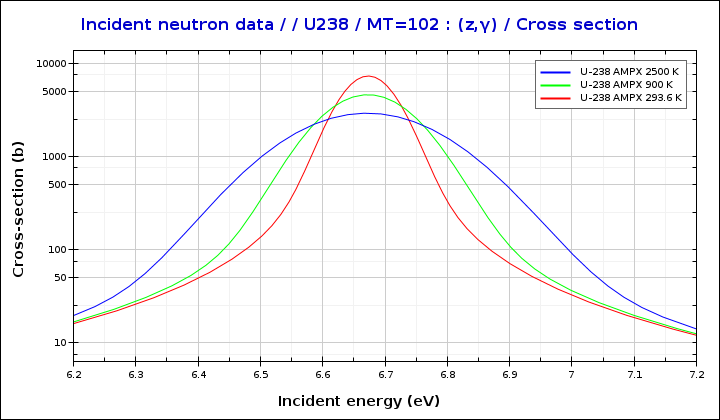
Abstract
The 557 neutron evaluations of ENDF/B-VIII.1 were processed into SCALE's continuous-energy (CE) library format (HDF5, in the layout of the current AMPX; SCALE 6.3.3 reads it after a small conversion) with AMPX built from SCALE's public source code, on one laptop. Every nuclide has 15 temperatures from 293.6 to 2500 K, 350 have unresolved-resonance probability tables, U-238 and Pu-239 carry data for the Doppler broadening rejection correction, and the thermal-scattering kernels of D and O in D₂O, H in H₂O and U and O in UO₂ give bound forms at their own temperatures. Every finished file loads with SCALE's CE data loader. Compared nuclide by nuclide with the NJOY-processed ENDF/B-VIII.1 library of OpenMC at 293.6 K, the median difference over the energy grid is typically 0.03 % for the total, elastic, fission and capture cross sections (499 nuclides), the thermal values agree within 1 % for all of them, and the resonance and fast integrals within 0.1 % for most; the thermal-scattering kernels agree within 0.1–1 % (median over the energy grid), except U in UO₂, for which OpenMC's data differ from the evaluation file used here. 31 of the 32 larger differences (above 1 % in an integral) lie in the unresolved resonance range, and 27 come from how the two codes fill the gaps between the energies at which an evaluation tabulates its unresolved parameters: AMPX interpolates the cross sections linearly, NJOY computes intermediate energies. Where the gaps exceed a factor 3 (up to 51 for Tb-160), the ENDF-6 manual asks for intermediate energies, so there AMPX's values are the questionable ones. One processing artefact was found: a zero inserted at the 20 MeV end point of the temperature-dependent reactions of 110 nuclides by the final assembly step, over the last 0.002 eV. Transport tests found what that comparison cannot see. KENO-VI of SCALE 6.3.3, which reads the library after a small change of layout, showed the same differences from OpenMC with NJOY-processed data as KENO-VI of SCALE 6.0 had shown after conversion to its legacy format, so they came from the library and not from the old code. Four defects were corrected in the library: fission spectra with their tails cut off by the tolerance on secondary distributions; elastic outgoing energies too high for the same reason (H-1, mean E′/E at 1 eV: 0.5036, exact value 0.5000); thermal-scattering kinematics on too coarse a grid; and the lowest row of the probability tables. The bound-kernel tables were then rebuilt with 32 equiprobable cosine bins, with 8 to 21 times fewer outgoing points and k unchanged within statistics. For eight problems (HEU-MET-FAST-001, PU-MET-FAST-001, two water-moderated test spheres, and a CANDU-6 cell cold and hot, with and without kernels or DBRC), k minus OpenMC went from −117 to +259 pcm before the corrections to −39 to +70 pcm after them (1σ about 25 pcm; χ² for the eight problems 225.7 before, 17.4 after). The largest difference left, +70 ± 23 pcm for the hot CANDU cell, is not explained. A converter to ENDF-6 tapes makes the library readable by JANIS, and the paper's cross-section plots were made with it. The library, in both formats, and all code are released. Records of version 1.1 (16 November 2026, which adds H in H₂O): the HDF5 library doi:10.5281/zenodo.24289081 (Z = 1–52, with the master file) and doi:10.5281/zenodo.24289085 (Z = 53–100), the SCALE 6.0 version doi:10.5281/zenodo.24289076; downloads by element on the library page. Version 1.0 (13 November 2026, without H in H₂O): doi:10.5281/zenodo.24200837, doi:10.5281/zenodo.24200839, doi:10.5281/zenodo.24200835.
Keywords: ENDF/B-VIII.1; AMPX; SCALE; continuous-energy cross sections; NJOY; OpenMC; KENO-VI; JANIS; Doppler broadening; unresolved resonances; probability tables; thermal scattering; CANDU
Cite this paper
Claude and Ian Hill (2026). An ENDF/B-VIII.1 continuous-energy neutron library for SCALE, processed with AMPX: comparison with NJOY for every nuclide and transport tests with SCALE 6.0 and 6.3.3 (preliminary version). Preprint, not peer reviewed; version 5, 16 November 2026. Modern Nuclear Data Processing. https://hardtohit10.gitlab.io/ampx-ce-paper.html
PDFBibTeXRIS (EndNote, Zotero, Mendeley)Click the citation to select it.
This article is available under the Creative Commons Attribution 4.0 International licence (CC BY 4.0): it may be shared and adapted, with credit to the authors. Claude is an AI model developed by Anthropic.
1. Introduction
SCALE's Monte Carlo codes read continuous-energy nuclear data from libraries that ORNL processes with AMPX [6]; the libraries distributed with SCALE are based on earlier ENDF/B releases (ENDF/B-VII.0, VII.1 and VIII.0 in SCALE's file-name aliases) [8]. ENDF/B-VIII.1 [2] is the current release of the US library. The application behind this work is CANDU lattice physics, hence the heavy-water and UO₂ kernels. AMPX is part of SCALE's public source code [9], so a SCALE CE library can be built from new evaluations by anyone; the transport codes that read it are not public.
This paper describes such a library: the processing chain and its settings (Section 2), the run (Section 3), a comparison of every nuclide with the NJOY-processed [4] ENDF/B-VIII.1 library distributed for OpenMC [19] (Section 4), the library seen in JANIS (Section 5), a check with SCALE's own data loader (Section 6), a first transport test through SCALE 6.0 after conversion to its legacy file format (Section 7), and the tests with SCALE 6.3.3 that led to corrections of the library, with k before and after them (Section 8). Section 9 describes the release. The project's work log, which records every decision and test, is public [20].
2. Processing chain and settings
AMPX was built from the public SCALE source (SCALE 7.0 beta 3) and run module by module through its driver. For each evaluation the chain is:
| step | AMPX module | what it does here |
|---|---|---|
| 1 | POLIDENT | pointwise cross sections at 0 K from the resonance parameters, reconstruction tolerance 10−3 |
| 2 | BROADEN | Doppler broadening, each temperature directly from 0 K (tolerance 10−3) |
| 3 | PURM, PURM_UP | unresolved-resonance probability tables (300 batches of 600 ladders, 20 bands), at every temperature |
| 4 | Y12 | tabulated secondary distributions, the free-gas thermal kernel, and S(α,β) kernels for bound nuclides; a 10−3 pass gives the thermal cross sections. Tolerance on the distributions: 10−2 in general, 10−3 for elastic scattering and S(α,β) kernels, 10−4 for fission spectra (the last two values since the corrections of Section 8) |
| 5 | ZEST, TOMATO | merging the temperature-dependent data |
| 6 | JAMAICAN | sampling tables (PDF/CDF) in HDF5, thinning tolerance 10−3; bound kernels with 32 equiprobable cosine bins (Section 8) |
| 7 | PLATINUM | assembly of the nuclide file with all temperatures, probability tables and DBRC data |
Table 1. The chain for one evaluation. The tolerances were first chosen in a precision study on O-16, H-2 and U-238 (Section 3), and three of them tightened after the transport tests (Section 8).
Temperatures. 293.6, 350–600 K in steps of 50 K, 700–1000 K in steps of 100 K, 1200, 1500, 1800 and 2500 K. Bound nuclides use the temperatures of their kernels: 17 from 283.6 to 650 K for D and O in D₂O, 94 from 273.15 to 1000 K for H in H₂O and 8 from 296 to 1200 K for U and O in UO₂.
Broadening from 0 K. Given a list of temperatures, BROADEN broadens each one from the previous result, and the error accumulates: the O-16 1/v capture at 0.0253 eV drifted by +0.25 % at 600 K and +0.50 % at 2500 K over the 15 steps. Each temperature is therefore broadened directly from the 0 K data and the results merged; the drift falls to 0.002 % and 0.012 %.
DBRC. The 0 K elastic cross section is kept for U-238 and Pu-239, for the Doppler broadening rejection correction of resonance scattering.
Changes to the evaluations. Y12 cannot read the neutron-multiplicity subsections of MF6 MT18 in the U-235, U-238 and Pu-239 evaluations; it is given a copy without MF6 MT18, so that the fission spectrum comes from MF5 (recorded in the repository's modifications.csv). Na-22 has a negative smooth background at 15 keV in its unresolved range, which PURM cannot sample: it is processed without probability tables. No evaluated value is changed.
SCALE IDs and potential scattering. Nuclides carry SCALE's IDs (free-gas H and D 8001001 and 8001002, since 1001 and 1002 are H in H₂O and D in D₂O; metastable states 1ZZZAAA) and the potential-scattering cross section of SCALE's standard composition library.
3. The run
Precision against cost. At tolerance 10−4 the secondary distributions of O-16 were still being written after 45 minutes; the D-in-D₂O distributions at 10−3 reached 4.2 GB. Cross sections at 10−3 agree with 10−4 to about 0.01 % in integrals (U-238); distributions at 10−2 agree with 10−3 within 0.003 in average cosine and 0.28 % in average outgoing energy (H-2). Memory, not CPU, limits a laptop: JAMAICAN needed more than 2.25 GB for the O-16 kinematics, and the D-in-D₂O kernel at 10−4 more than 6.2 GB for one temperature. That study compared the distributions but not their effect on k, and 10−2 proved too coarse for fission spectra, elastic scattering and thermal kernels (Section 8).
The run. The whole library ran from 7 October 2026 with up to 10 jobs at a time on a laptop with 12 GB of memory for the Linux environment. The finished evaluations took 3,456 job-hours; the longest, Zr-91, 61 h, almost all of it in PURM. Two interruptions (the laptop asleep, then shut down) cost the runs in progress; a restart service now relaunches the driver. Each nuclide file is compressed losslessly (about 40 % of its size); the 557 finished nuclides take 61 GB.
The thermal kernel of D in D₂O at 600–650 K. These three tables have a very narrow quasi-elastic peak, and Y12's integration converges slowly on it: at tolerance 10−3 the thermal cross section was up to 3.9 % above NJOY's at 1 eV. An independent integration reproduces NJOY within 0.03 %, so the excess is the tolerance, not the evaluation. The library uses 5×10⁻⁴ at these three temperatures (the tightest that fits in memory): +0.43, +1.07 and +1.90 % at 1 eV.
Bound nuclides. Two problems stopped the bound runs. The UO₂ kernels of ENDF/B-VIII.1 carry an MF7/MT451 section, the newer information record of thermal-scattering files, which Y12 does not read ("Invalid mt value for file 7"); it is left out of the single-temperature files made for Y12, which are otherwise unchanged (recorded in modifications.csv). The H-in-H₂O kernel starts at 273.15 K, but the single-temperature file names have one decimal and the driver took the temperatures from them, so the broadened cross sections were made at 273.1 K and the final assembly found none at 273.15 K; the driver now reads each temperature from the file. With that corrected, the final assembly of H in H₂O still stopped, with a segmentation fault in PLATINUM, also with twice the memory. The cause was the numbering of the per-temperature thermal cross-section files: the chain gave the i-th temperature unit 50 + i, and with 94 temperatures that reaches unit 77, one of the units (77–80, 88 and 89) that AMPX's driver opens as big-endian. The merge (ZEST) silently left out unit 77 and every later unit, so the merged file held 27 of the 94 tables, and PLATINUM read past its end. The chain now numbers the files from 100 after the 20th temperature, which leaves the inputs of every other entry, all with at most 17 temperatures, unchanged. The file then assembled still had hydrogen's elastic table at the coarse tolerance of Section 8, because the corrections of Section 8 were applied to the files that existed on 4 November and H in H₂O was processed afterwards; Section 9 gives the effect and the test of the corrected file.
4. Comparison with NJOY
Method. For every nuclide that also has a file in the OpenMC library, the cross sections of MT 1, 2, 18 and 102 were compared at each temperature both libraries have (293.6, 600, 900, 1200, 2500 K): the relative difference r = AMPX/NJOY − 1 on the union of both energy grids (both interpolated linearly), its median and maximum, the value at 0.0253 eV, and the integrals ∫σ dE/E over 0.5 eV–10 keV (resonance integral) and 10 keV–20 MeV (fast). The NJOY total is the sum of the reactions OpenMC does not flag as redundant.
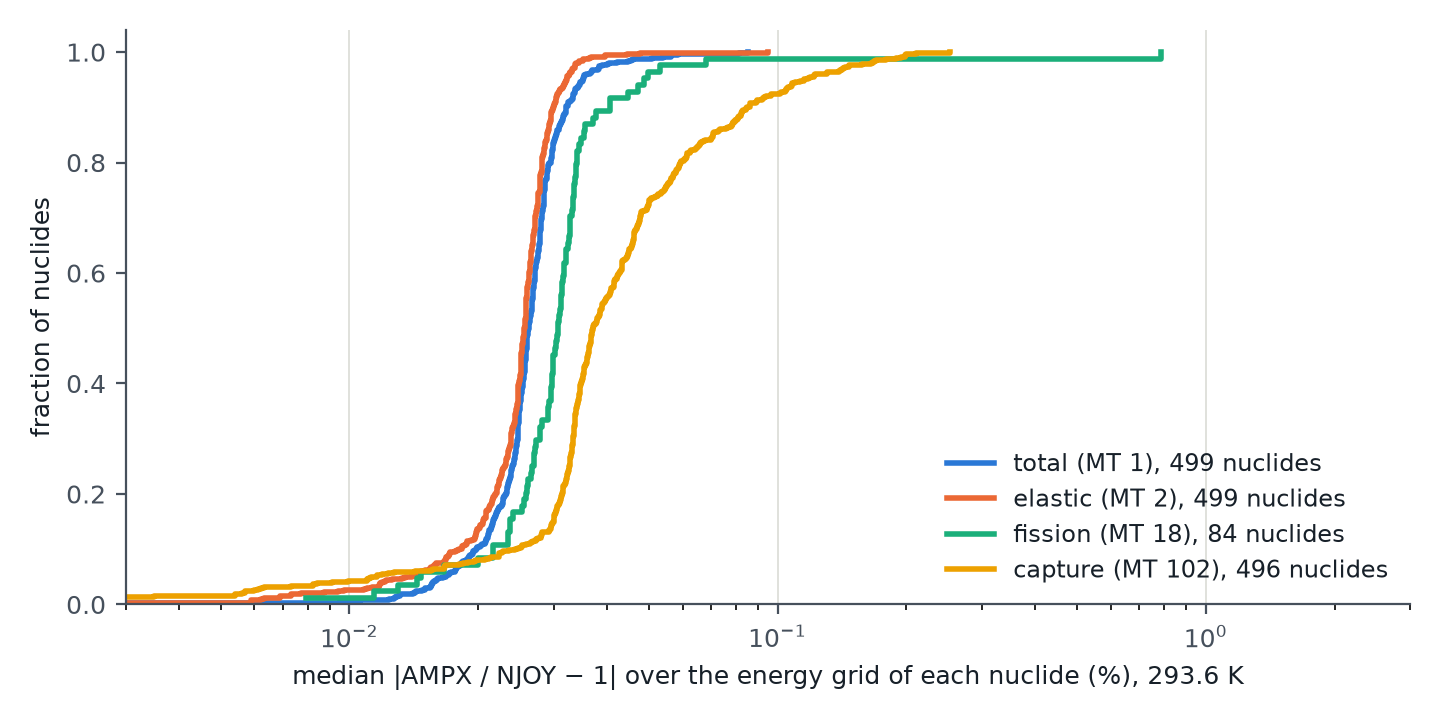
| reaction | nuclides | median of the medians | 90th percentile | largest (nuclide) | 0.0253 eV > 1 % | resonance integral > 1 % | fast integral > 1 % |
|---|---|---|---|---|---|---|---|
| MT 1 | 499 | 0.026 % | 0.032 % | 0.09 % (V-51) | 0 | 8 | 4 |
| MT 2 | 499 | 0.026 % | 0.030 % | 0.09 % (V-51) | 0 | 5 | 0 |
| MT 18 | 84 | 0.031 % | 0.040 % | 0.78 % (Ra-226) | 0 | 1 | 0 |
| MT 102 | 496 | 0.037 % | 0.085 % | 0.25 % (Sr-88) | 0 | 9 | 17 |
Table 2. AMPX against NJOY at 293.6 K, 499 nuclides.
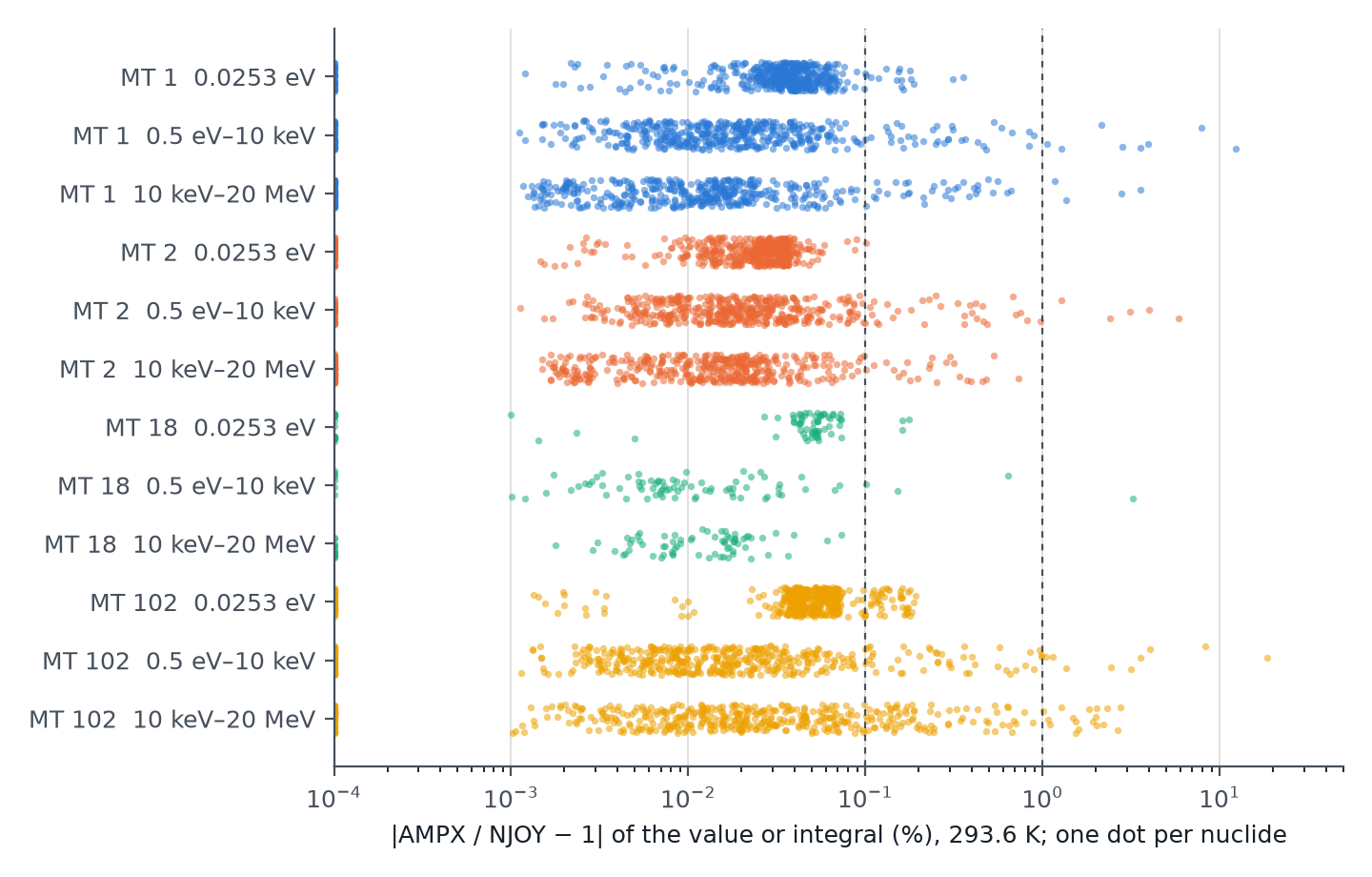
The pointwise data agree to a few hundredths of a percent for almost every nuclide. In the four nuclides examined point by point (O-16, U-235, U-238, Am-242m) the largest single-point differences sit at sharp structure where the two codes place their grid points differently (narrow resonances, thresholds, the resolved–unresolved boundary), with the integrals unchanged. The differences above 1 % in a value or integral are:
| nuclide | MT | quantity | AMPX/NJOY − 1 (%) |
|---|---|---|---|
| Dy-158 | 102 | resonance integral | +18.6 |
| Dy-158 | 1 | resonance integral | +12.4 |
| Tb-160 | 102 | resonance integral | +8.3 |
| Tb-160 | 1 | resonance integral | +7.9 |
| Dy-158 | 2 | resonance integral | +5.8 |
| Dy-156 | 102 | resonance integral | +4.1 |
| Nd-147 | 2 | resonance integral | +4.0 |
| Dy-156 | 1 | resonance integral | +3.9 |
| Ru-103 | 1 | fast integral | +3.6 |
| Kr-82 | 102 | resonance integral | +3.6 |
| Nd-147 | 1 | resonance integral | +3.6 |
| Am-243 | 18 | resonance integral | +3.2 |
| Nd-147 | 102 | resonance integral | +3.2 |
| Dy-156 | 2 | resonance integral | +3.1 |
| Kr-82 | 1 | resonance integral | +2.8 |
| Eu-156 | 1 | fast integral | +2.8 |
Table 3. Values and integrals that differ from NJOY by more than 1 % at 293.6 K (the largest 16 of 44, the total included). Most are explained below.
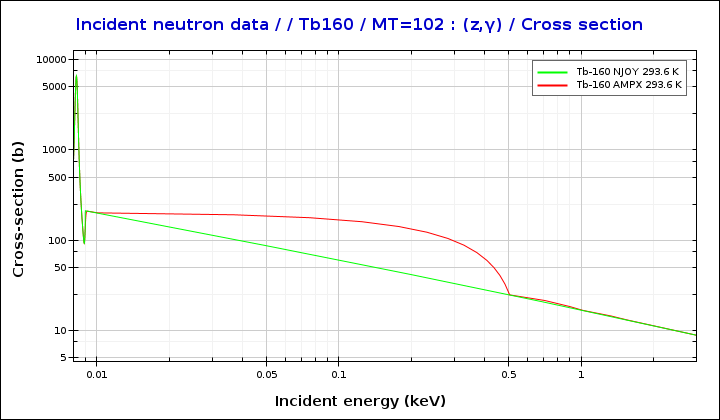
Where the larger differences come from. Take first the 32 values and integrals of MT 2, 18 and 102 that differ by more than 1 %. Integrated band by band, 31 of them collect their difference inside the unresolved resonance range of the evaluation, and 27 have one cause: the energies at which the evaluation tabulates its energy-dependent unresolved parameters. At those energies AMPX and NJOY agree. Between them AMPX interpolates the cross sections linearly: at the geometric midpoint of every gap its value lies within 0.24 % of the straight line between its values at the two ends. NJOY's RECONR keeps the given energies only where neighbours are within a factor 1.26; across a wider gap it adds energies from a standard grid of 13 per decade and computes the cross sections there from interpolated parameters (its source calls such a mesh a carry-over that violates the current rules) [4]. The ENDF-6 formats manual recommends interpolating the cross sections, but where two adjacent energies differ by more than a factor of three it asks the processing code to add intermediate energies, about ten per decade, computed by parameter interpolation [21]. In 17 of the cases (10 nuclides: Dy-158, Tb-160, Dy-156, Nd-147, Am-243, Ho-166m, Gd-154, Pm-151, Eu-153 and Ce-139) the evaluation has such gaps, up to a factor 51 (Tb-160), and AMPX does not add the energies. In the other 10 (fast integrals 1.0–2.7 % higher, gaps of a factor 2–3) AMPX follows the manual and NJOY's extra energies are its own, stricter choice. Tb-160 shows the size of the effect (Figure 3): its capture cross section is 198.0 and 24.38 b at 10 and 510 eV in AMPX and 197.8 and 24.33 b in NJOY, but at 71 eV, in between, 176.5 b against 71.2 b. The remaining 5 (Ge-74, Kr-82, Na-22, Pm-149) were not explained; for Kr-82 and Pm-149 both codes compute intermediate energies and still differ. Of the 12 values and integrals of the total that differ by more than 1 %, 8 follow the cases above. The other 4 (fast integrals of Kr-83, Ru-103, Eu-151, Eu-156) come from the first inelastic level, MT 51, whose fast integral is 29–72 % higher in AMPX.
The first inelastic level in the unresolved range. In 109 of the 349 nuclides with MT 51 and unresolved parameters the MT 51 threshold lies inside the unresolved range. Between the threshold and the upper end of that range AMPX's MT 51 integral differs from NJOY's by more than 1 % for 20 of them, higher in AMPX for 18 of them; above the range the two agree (more than 1 % apart for 2 nuclides). In the unresolved range NJOY's MT 51 equals the evaluation's File 3 values (91 of 109 nuclides). All 20 have competitive widths in their unresolved parameters (80 of the 109 nuclides have); the ENDF-6 manual's convention for a competitive width is that the competitive reaction is given entirely in File 3 and no File 2 contribution is added to it [21]. Whether AMPX adds such a contribution was not traced in its source.
Unresolved range. For U-238, U-235 and Am-242m the probability tables were compared with NJOY's band by band: U-238 elastic and capture band averages agree within 0.01 % (median), U-235 within 0.32 % (median 0.03 %). The self-shielded cross sections at a 1 b background differ by up to 9 % for U-238, the size of the sampling noise of two independent ladder samplings. AMPX's table "total" holds elastic, fission and capture only; NJOY's also includes the smooth inelastic. These comparisons left out the lowest row of each table, which turned out to be wrong (Section 8).
The 20 MeV end point. In 110 nuclides the temperature-dependent reactions (elastic, capture, sometimes fission) end with two points, 19 999 999.998 eV with the correct value and one floating-point step below 20 MeV with zero, so that the total drops to the sum of the other reactions over the last 0.002 eV. In a single-temperature rerun of B-11 the data are correct up to and including the merged file that enters the final assembly (PLATINUM); the zero appears in its output. The pattern, the real end point moved down by a relative 10−10 and a zero added, is consistent with the discontinuity handling of the union-grid code, which was not traced line by line. It is left as it is: no neutron in a fission system reaches it. (A further 39 nuclides list a zero at 20.00001 MeV, just above the evaluated range, which is harmless.)
A pitfall in our own comparison. The first library-wide comparison built the NJOY total from a fixed list of reactions including MT 4. OpenMC's files often leave out MT 4 when the inelastic levels MT 51–91 are given, so that total lacked the inelastic cross section, and the fast integral of MT 1 appeared 10 % higher in AMPX for most nuclides. Building the NJOY total from OpenMC's non-redundant reactions removed the difference (Fe-57: 46.031 against 46.029 b).
Thermal scattering. The bound kernels were compared with NJOY's processing of the same kernels in the OpenMC library, reaction by reaction (AMPX's thermal inelastic cross section, its MT 1007, against the inelastic one; its thermal elastic, MT 1008, against the coherent elastic), at the midpoints of AMPX's energy grid below 5 eV, at every kernel temperature. The median differences over the grid are 0.04–0.27 % for D in D₂O and 0.08–0.19 % for O in D₂O up to 573.6 K, and 0.3–1.0 % at 600–650 K, the tolerance effect of Section 3; for O in UO₂ 0.17–0.26 % (inelastic) and 0.07–0.08 % (coherent elastic, whose largest differences sit at the first Bragg edge, 0.0055 eV, where the two grids step at different energies). U in UO₂ differs by 3.1–3.2 % (inelastic) and 1.35–1.37 % (coherent elastic), AMPX lower, at every temperature. Here the reference itself departs from the evaluation file that was processed, while for O in UO₂ it does not: the coherent elastic cross section computed directly from the file (S/E from the Bragg edges) is 0.7408 b at 1 eV for U in UO₂, against 0.7414 b from AMPX and 0.7519 b in OpenMC (O in UO₂: 0.7408, 0.7414 and 0.7408 b), and an independent integration of the file's S(α,β) with NJOY's lookup rules gives 7.753 b at 1 eV, against 7.739 b from AMPX and 7.927 b in OpenMC (O in UO₂: 3.422, 3.417 and 3.421 b). OpenMC's U-in-UO₂ data thus appear to have been made from a different version of that file, and that comparison does not test AMPX; against the file, AMPX agrees.
5. The library in JANIS
JANIS [22], the NEA's program for looking at nuclear data, reads ENDF-6 and several processed formats but not SCALE's HDF5. A small converter, written for this work and released with the code [20], writes an AMPX nuclide file as an ENDF-6 tape in the style of an NJOY PENDF: one material per temperature with the cross sections as MF3 sections on their own energy grids (or the union grid), the ν̄ tables as MF1, AMPX's thermal-scattering cross section (its MT 1007) as MT 221 for free-gas nuclides and MT 237 for bound ones (numbers from NJOY's range for thermal data), and the 0 K elastic cross section kept for DBRC as MT 2 of a material at 0 K. Probability tables and secondary distributions are not converted. Grids that are not in increasing order (Section 7) are sorted, since ENDF-6 requires it, and values keep 8 to 10 significant digits in the 11-column fields. For U-235, U-238 (with its 0 K data), Am-242m and O-16 in D₂O, all temperatures, every converted value was compared with the HDF5 file: the largest relative differences are 4×10⁻⁸ in energy and 4×10⁻⁷ in the values. The converter is written in Java with the HDF5 reader jhdf [23]. The figures of this paper were made with the NEA's JANIS 4.1 from such tapes, one temperature per tape, because JANIS names each data set after its file; the NJOY curve of Figure 3 is an NJOY2016 PENDF (RECONR and BROADR, tolerances 10−3), identical to OpenMC's Tb-160 data.
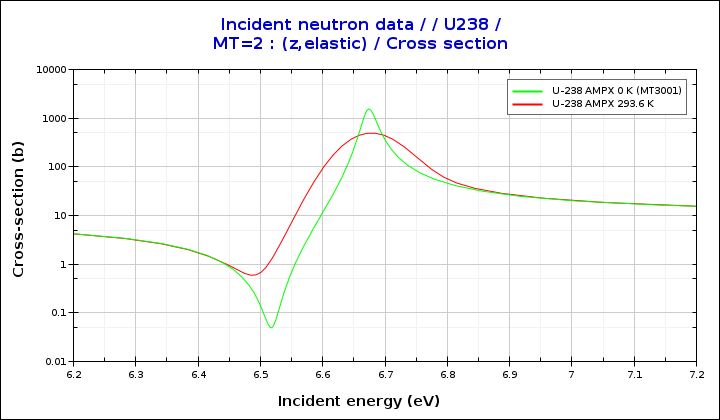
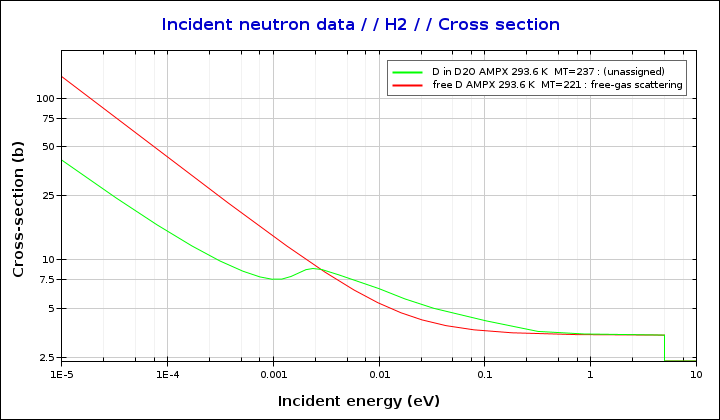
In all 561 files AMPX's thermal data stop at 5.05 eV, Y12's default upper energy, while the file header gives a thermal cutoff of 10 eV, PLATINUM's default and the value of ORNL's sample input. KENO-VI of SCALE 6.3.3 uses one thermal cutoff for all nuclides, its input parameter thc (default 10 eV), and does not use the value in the file; running with thc=5.05 changed k by +12, −23 and −24 ± 30 pcm in three CANDU cases, so the difference does not matter in these problems.
6. SCALE's data loader
Every finished file was loaded with CELibraryReader, built with AMPX: it uses CEResource, the loader of KENO and XSProc, reads every temperature with all data switched on (kinematics, collision data and distributions, probability tables, DBRC, photon production) and runs SCALE's library corrector (redundant sums, nubar ratios, distribution bounds, probability tables). All 561 files loaded at every temperature without a corrector warning before the corrections of Section 8. After them, 561 of 561 have loaded again; the largest peak memory among them was 5.7 GB. The corrector now reports changes in 561 files: the reprocessed tables' first and last energies differ from the cross-section grid by rounding, and it moves them. Of 3,222 such changes in each file's latest check, 3,194 are below one part in a million; 26, in the bound kernels, move a first energy printed as 10−5 eV to the start of the grid, and the corrector does not print the new value; the other two stretch the last row of Pu-240's delayed spectrum from 20 to 30 MeV, the end of its grid. This shows that the files are readable and self-consistent for SCALE's loader; it is not a transport calculation.
7. A transport test through SCALE 6.0
The CE transport codes of SCALE 6.2/6.3 are not in the public source, and at first SCALE 6.3 was not available to us. SCALE 6.0 (2009) was: its CE KENO-VI reads an older, binary "legacy" library format. AMPX's loader can still write that format, in the version the files label 2.0; SCALE 6.0 reads version 1.3. The two are related but differ, and a converter was written from SCALE 6.0's reading routines and AMPX's writer. It makes seven changes; the first two were needed for KENO-VI 6.0 to run at all:
- Collision probabilities. KENO-VI 6.0 takes the survival weight, the absorption probability and the fission neutron production of each collision from tabulated ratios to the total cross section (non-absorption, absorption, ν·σf, (n,2n), (n,3n)) on a collision grid. Version 2.0 leaves them out (the newer code computes them at load time); without them no fission occurred. They are computed on the union grid as the old Fortran PLATINUM did; computing them on a grid refined by the midpoints changed k by +11 ± 30 pcm (Jezebel) and −24 ± 39 pcm (LEU sphere).
- Grid order. The union grids of version 2.0 start with the lowest discontinuity nudged out of order (1.0000000000000001×10⁻⁵, 9.999999999×10⁻⁶, 1.0000000000000003×10⁻⁵ eV). KENO-VI 6.0 builds the mixture grids by stepping through increasing energies, and the material then had almost no total cross section: k = 0.005 for Godiva before sorting the grid, 0.999 after.
- Kinematics. Photon-production sections are removed (SCALE 6.0 reads one neutron section per reaction).
- Probability tables. Padded to the four reactions SCALE 6.0 reads (U-238 has no unresolved fission in ENDF/B-VIII.1); band probabilities set from the cumulative values.
- Thermal flag. Version 2.0's flag, set whenever MT 1007 is present, is kept, so KENO-VI 6.0 samples the tabulated free-gas kernels of free-gas nuclides and not its analytic model. Earlier versions of this paper said that free-gas nuclides were marked as such and that k did not change. That was wrong: a coding error discarded the setting, so nothing had been tested, and every SCALE 6.0 result here is with the tabulated kernels.
- Elastic cross section of bound nuclides. KENO-VI 6.0 takes the scattering cross section from MT 2 and MT 1, and only the kinematics from MT 1007 and 1008. Version 2.0 keeps the free-atom elastic in MT 2 below the thermal cutoff, so there MT 2 is replaced by MT 1007 + MT 1008, and MT 1 follows. This was added on 6 November 2026, after a test with bound deuterium was about 1000 pcm low (Section 8, Table 7).
- Temperatures. Only the temperatures shipped are listed, since KENO takes the nearest listed temperature and opens its file. Byte order is kept; SCALE 6.0 is told to read the files little-endian.
Every converted file is walked exactly as SCALE 6.0's reader walks it (record sizes, grids, probabilities on the collision grid, energies of the temperature-independent reactions on the union grid, table sizes within the declared maxima) before it is packed.
Results. Two fast critical assemblies of the ICSBEP Handbook [13], HEU-MET-FAST-001 and PU-MET-FAST-001 (bare spheres, the simplified models), and two water-moderated test spheres (uranium in water, free-gas hydrogen in both codes, not benchmarks) were run in KENO-VI 6.0 with this library and in OpenMC 0.16.0 with the NJOY-processed ENDF/B-VIII.1 library, with the same models:
| case | KENO-VI 6.0, first version of the library | OpenMC, NJOY | difference (pcm) | KENO-VI 6.0, corrected library | difference (pcm) |
|---|---|---|---|---|---|
| Godiva | 0.99904 ± 0.00016 | 1.00015 ± 0.00010 | −111 ± 19 | 1.00006 ± 0.00015 | −9 ± 18 |
| Jezebel | 0.99827 ± 0.00024 | 0.99943 ± 0.00009 | −116 ± 26 | 0.99928 ± 0.00019 | −15 ± 21 |
| HEU in water | 1.05784 ± 0.00027 | 1.05702 ± 0.00018 | +82 ± 32 | 1.05687 ± 0.00026 | −15 ± 32 |
| LEU in water | 1.16477 ± 0.00027 | 1.16167 ± 0.00021 | +310 ± 34 | 1.16197 ± 0.00030 | +30 ± 37 |
Table 4. k from the two codes (1σ), before and after the corrections of Section 8. Godiva = HEU-MET-FAST-001, Jezebel = PU-MET-FAST-001.
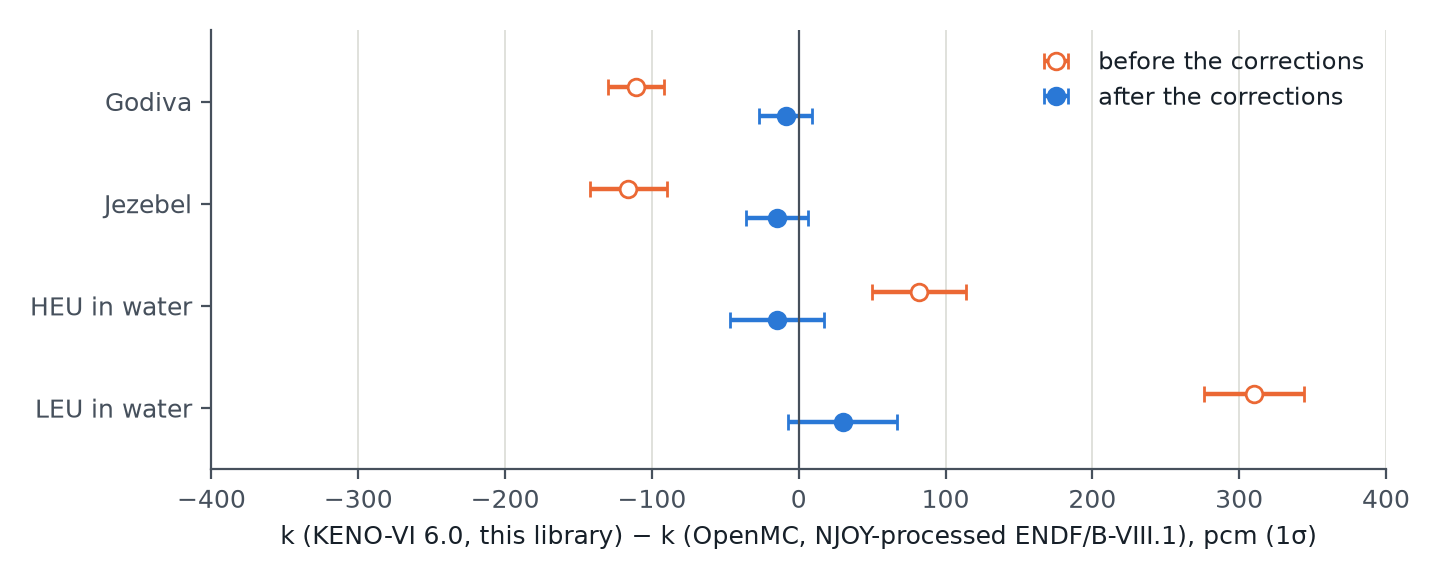
Before the corrections the fast systems were about 110 pcm low and the water spheres high, by 82 pcm (HEU, thermal) and 310 pcm (LEU, more resonance absorption in U-238). With SCALE 6.0's own ENDF/B-VII.0 library, Godiva gives 0.99967 ± 0.00017 in the same model. That comparison mixed three things: the transport physics of a 2009 code against a current one, the AMPX processing against NJOY's, and the conversion. The checks above rule out the conversion's approximations we could test (the collision grid and the probability-table totals, which KENO-VI 6.0 recomputes); multiplicities, nubar data and delayed spectra are as in SCALE 6.0's own files, and every angular and energy table is consistent. Section 8 separates the other two: KENO-VI of SCALE 6.3.3 gave the same pattern, so it was the library. With the corrected library KENO-VI 6.0 gives −9 ± 18 pcm (Godiva), −15 ± 21 pcm (Jezebel), −15 ± 32 pcm (HEU in water), +30 ± 37 pcm (LEU in water): most of what looked like the limits of a 2009 code was the library. These four problems have no bound nuclides; those were tested in KENO-VI 6.0 later (Table 7).
8. SCALE 6.3.3 and the corrections to the library
Reading the library. SCALE 6.3.3 reads its CE data as HDF5, but the AMPX build used here (from SCALE 7.0 beta 3) writes a newer layout, in which the loader derives several quantities itself. With the library as it is, the 6.3.3 input processor crashes on the nuclide index; with its index type, Godiva gives k = 1.87, because KENO reads the absorption sum from the file. A short converter, to_scale63.py, writes selected nuclides in the layout of SCALE 6.3.3: neutron multiplicities, the redundant sums (MT 3, 27, 101, 103–107), collision probabilities, the kernel's cross section as MT 1 and MT 2 of bound nuclides below the end of the kernel data, and no tabulated MT 1007 for free-gas nuclides, so that KENO uses its analytic free-gas model. Everything else is copied unchanged. Of these, MT 27 is what matters for k: without it Godiva is again 1.875, while MT 3, the 103–107 sums, the multiplicities and the collision probabilities leave k identical.
Test problems. The four spheres of Section 7 and a 37-element CANDU-6 lattice cell with simplified materials, each defined once for both codes: cold (293.6 K) with the D₂O kernels, cold with free-gas D₂O, hot (fuel, sheath, coolant and pressure tube at 600 K, with the O in UO₂ kernel; moderator at 293.6 K), and hot with DBRC for U-238 from 0.4 to 210 eV. H-1 is free gas throughout, in both codes. The reference is OpenMC 0.16.0 with the NJOY-processed library. On 2 November KENO ran 500 active generations of 50 000 for the spheres and 250 of 40 000 for the cell. After the corrections each case ran four times, 125 generations of 50 000 and 100 of 25 000, combined by inverse variance.
What the first results said. The “before” column of Table 6 has the pattern of Table 4: Godiva and Jezebel about 100 pcm low, LEU water about 260 pcm high. Since a current KENO shows it too, the cause was the library, not KENO-VI 6.0 or the conversion. In the CANDU cell the D₂O kernels had half the effect they have in OpenMC (cold, kernels minus free gas: −133 ± 28 pcm against −253 ± 23).
How the defects were found. Section 4 compares cross sections, so it could not see them. Three further checks could: the mean outgoing energy and cosine of each table against NJOY's or against an exact value; a comparison with the ENDF/B-VIII.0 library distributed with SCALE 6.3.3, for the 227 evaluations unchanged between VIII.0 and VIII.1; and KENO runs of test copies of the library with single tables or nuclides replaced. SCALE's data served only to find the problems. No value in this library comes from them, and the fixes below use AMPX and the evaluations alone.
| what was wrong | what was changed | effect measured |
|---|---|---|
| Fission spectra. Y12's tolerance cuts the tails, and the rest is renormalized: at 10−2 the U-235 thermal spectrum ran from 13.75 keV to 10.5 MeV, and its mean outgoing energy was 0.3–0.45 % below NJOY's. | MT 18–21, 38 and 455 reprocessed with Y12 at 10−4, 89 nuclides. | Mean outgoing energy against NJOY, median over nuclides: 0.387 % → 0.006 %. In a test copy: Godiva −117 → −21 ± 19 pcm, Jezebel −88 → −48 ± 24 pcm. |
| Thermal kernels. Y12 thins the incident energies of an S(α,β) kernel by its cross section alone, so at 10−2 D in D₂O had 36 incident energies, too few for its outgoing distributions. | MT 1007 kinematics reprocessed with Y12 at 10−3, D and O in D₂O, O and U in UO₂, 50 kernel temperatures (99 incident energies for D in D₂O at 293.6 K). | CANDU cold in a test copy: +98 ± 26 → −14 ± 27 pcm. D in D₂O, mean E′/E at 1 eV, NJOY and this library: 0.6101 and 0.6104 at 293.6 K, 0.6196 and 0.6198 at 573.6 K; a residual remains at 600–650 K (0.6229 and 0.6370 at 650 K). |
| Lowest row of the probability tables. AMPX scales each row so that its band average equals the pointwise cross section at that energy. At the lowest table energy that value is still in the transition from the resolved range: U-238 capture 0.28 b at 20 keV where the unresolved average is 0.53 b, and transport codes interpolate from there to the next row, at 23 keV. | The rows concerned rescaled to the unresolved value, found from the pointwise data alone (ptable_edge.py). Band shapes unchanged. The upper end is left as it was. | Capture integral over the table range changes by more than 1 % in 245 of 351 nuclides and more than 10 % in 79 (Am-243 +37 %, Pu-242 −19 %, U-238 +3 %). LEU water +6 ± 12 pcm. The LEU sphere with 10−4 atoms/b·cm of Am-243 added: −279 ± 25 pcm. |
| Elastic tables. At 10−2 few cosines are kept per incident energy, so the outgoing energy is a chord over a curve. For H-1, E′ = E μ² in the laboratory system, so mean E′/E at 1 eV was 0.50357 (exact 0.50000) and the mean cosine 0.66580 (exact 0.66722). | MT 2 reprocessed with Y12 at 10−3, all 561 nuclides (1.6 → 4.9 million outgoing points). | H-1: E′/E 0.50089, mean cosine 0.66760. LEU water −244 ± 20 pcm, HEU water +55 ± 24 pcm in test copies. |
The 6.3.3 converter (not the library). to_scale63.py left the thermal elastic MT 1008 out of MT 1 and MT 2 of O and U in UO₂: O in UO₂ at 600 K, 0.0253 eV, 0.82 b instead of 5.36 b. | Fixed in the converter. | Affects only the hot CANDU cases, among these problems. |
Table 5. The defects and what was done. Only secondary distributions and probability-table rows of the library changed, and each reprocessing run checked that every other dataset stayed identical, so the cross sections and Sections 4 and 5 are unaffected.
Before and after. Table 6 and Figure 8 give every problem with the library as first built and as corrected.
| case | before: KENO-VI 6.3.3 | after: KENO-VI 6.3.3 | OpenMC, NJOY | before − OpenMC (pcm) | after − OpenMC (pcm) |
|---|---|---|---|---|---|
| Godiva | 0.99898 ± 18 | 1.00024 ± 18 | 1.00015 ± 10 | −117 ± 21 | +9 ± 21 |
| Jezebel | 0.99855 ± 18 | 0.99952 ± 18 | 0.99943 ± 9 | −88 ± 20 | +9 ± 20 |
| HEU in water | 1.05681 ± 15 | 1.05702 ± 17 | 1.05702 ± 18 | −21 ± 23 | 0 ± 25 |
| LEU in water | 1.16435 ± 17 | 1.16208 ± 20 | 1.16176 ± 14 | +259 ± 22 | +32 ± 24 |
| CANDU cold, D₂O kernels | 1.14935 ± 20 | 1.14830 ± 15 | 1.14837 ± 16 | +98 ± 26 | −7 ± 22 |
| CANDU cold, free-gas D₂O | 1.15068 ± 20 | 1.15051 ± 22 | 1.15090 ± 16 | −22 ± 26 | −39 ± 27 |
| CANDU hot | 1.13652 ± 18 | 1.13617 ± 15 | 1.13547 ± 17 | +105 ± 25 | +70 ± 23 |
| CANDU hot, DBRC | 1.13592 ± 25 | 1.13593 ± 15 | 1.13552 ± 16 | +40 ± 30 | +41 ± 22 |
Table 6. k with this library before (2 November 2026) and after the corrections, against OpenMC with NJOY-processed ENDF/B-VIII.1. After: the three CANDU cases with kernels have eight runs each with the final 32-cosine tables (5 November); the other five do not read those tables and have four runs each (4 November). Uncertainties of k in units of 10−5, 1σ. χ² against OpenMC for the eight problems: 225.7 before, 17.4 after.
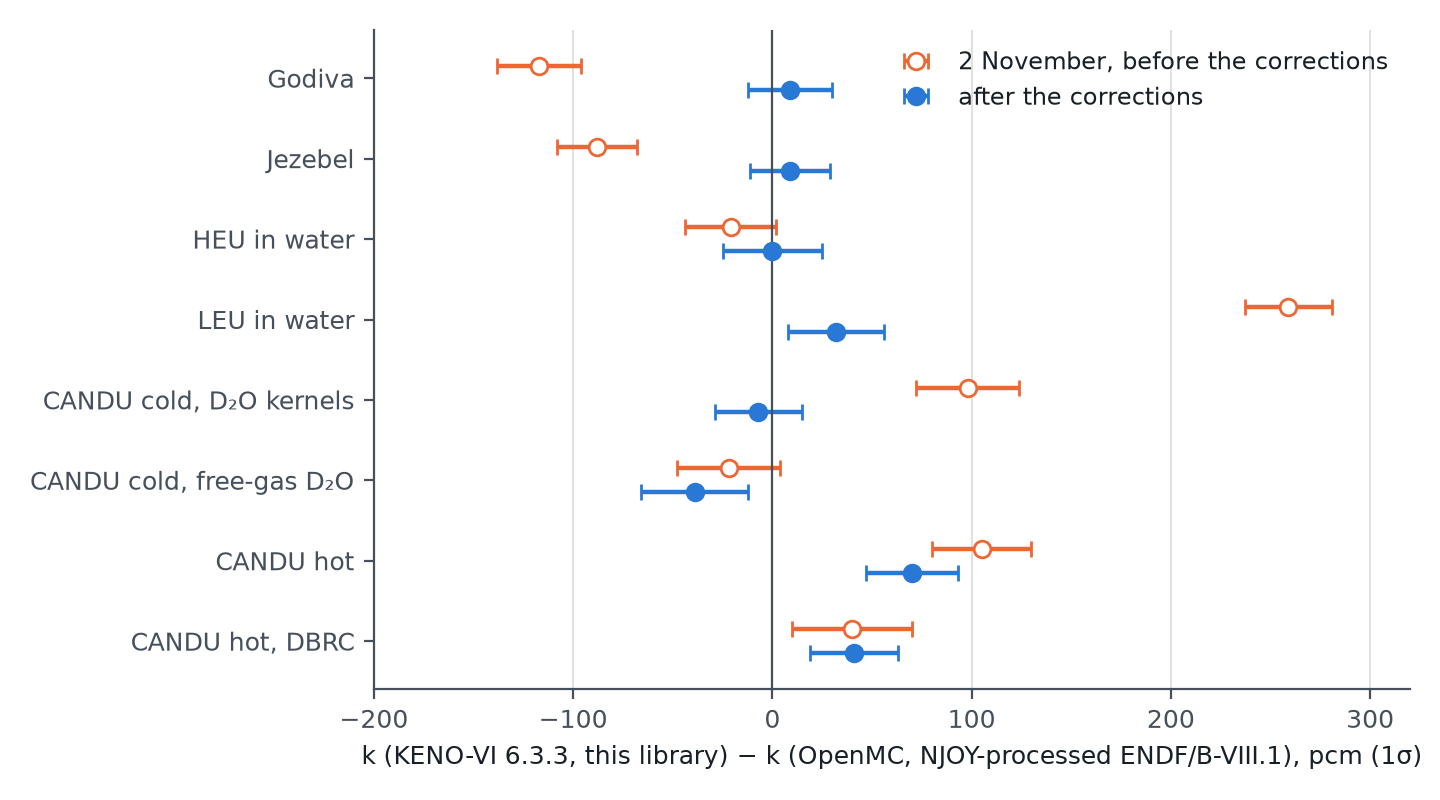
What is left. The largest remaining difference is the hot CANDU case, +70 ± 23 pcm (3.1σ), from eight runs that scatter as expected (χ² 6.5 for 7). By chance alone, a difference this large among eight comparisons would occur about 1.5 % of the time, so we do not put it down to statistics. The hot case with DBRC is also high, +41 ± 22 pcm (1.9σ), while the cold case agrees, so k falls by 1212 ± 21 pcm from cold to hot in KENO and by 1290 ± 23 pcm in OpenMC, a difference of 78 ± 31 pcm. The smaller kernel tables did not cause this: with the large tables and four runs the hot case was already +63 ± 26 pcm. The hot cases are also the only ones with the O in UO₂ kernel, in the fuel, but that kernel does not explain it: at 600 K its cross sections agree with OpenMC's within about 0.1 % from 0.01 to 5 eV, and in a test sphere its effect on k is +857 ± 47 pcm in OpenMC and +909 ± 60 pcm in KENO-VI 6.3.3 (Table 7). The cause has not been found, and this was not followed up. χ² against OpenMC was 10.4 with the large tables and four runs per case; nearly all of the rise to 17.4 comes from the two hot cases. The scatter of the runs over all cases gives χ² 36.9 for 36 degrees of freedom. The effect of DBRC in the hot cell is −24 ± 21 pcm in KENO and +5 ± 23 pcm in OpenMC (OpenMC's rvs method, U-238, the same energy range), a difference within statistics. The kernels' effect in the cold cell is −221 ± 26 pcm, against −253 ± 23 pcm in OpenMC. Other fast reactions, such as inelastic scattering and (n,2n), stay at Y12 10−2.
Size of the kernel tables. JAMAICAN was first run with equiprobable cosine bins switched off (equi=false), which keeps every cosine of the thinned grid: 138–2432 per incident energy, 11–23 million outgoing points per temperature, and about 3.4 GB of memory for a CANDU run. The library now uses AMPX's default for the bound kernels, 32 equiprobable bins (equi=true nang=32). That gives 0.95 million points against 16.6 million for D in D₂O at 293.6 K, 1.07 million against 22.7 million for O in D₂O at 293.6 K, and 1.57 million against 17.1 million for O in UO₂ at 600 K. A CANDU run now needs about 1.3 GB, and the kernels of the four bound nuclides went from about 5.2 GB to about 0.9 GB on disk. Before the test we set the criterion: both CANDU cases within 2σ of the large tables. Four runs per case gave −27 ± 29 pcm (cold) and +29 ± 29 pcm (hot). All 50 kernel temperatures were then rebuilt; the rebuilt tables are identical, dataset by dataset, to the tested ones, so four more seeds were added to give eight runs per case: +9 ± 25 pcm (cold), +8 ± 25 pcm (hot), and +44 ± 28 pcm (hot with DBRC, 1.6σ, not part of the first test). The two sets of four runs of the same tables differ by +73 ± 29 pcm (cold) and −48 ± 31 pcm (hot), which shows how far such a comparison can move.
Bound kernels in SCALE 6.0. The tests of Section 7 have no bound nuclides, so before releasing the smaller tables in the SCALE 6.0 format we ran a heavy-water test sphere (not a benchmark; radius 100 cm, U-235 3.0×10⁻⁵, U-238 3.0×10⁻⁶, D 6.6×10⁻², O-16 3.3×10⁻² atoms/b·cm) in all three codes. KENO-VI 6.0 ran without errors but was 1013 ± 54 pcm below OpenMC, while KENO-VI 6.3.3 agreed with it. The smaller tables were not the cause: the large table gives the same k in KENO-VI 6.0 (1.72468 ± 35 against 1.72463 ± 44). Nor was the thermal cutoff: KENO-VI 6.3.3 at 3, 5.05 and 10 eV gives 1.73532 ± 34, 1.73551 ± 38 and 1.73492 ± 34. And free-gas deuterium agrees in all three codes. The cause was our converter, which left the free-atom elastic in the cross sections that KENO-VI 6.0 reads (D at 0.0253 eV: 4.24 b instead of 5.26 b; Section 7, change 6). With that corrected, KENO-VI 6.0 is within 1.3σ of OpenMC in every case of Table 7, and the SCALE 6.0 files of the bound nuclides were rebuilt. U in UO₂ reads and runs in KENO-VI 6.0, but this sphere holds too little U-238 to test it, so it is untested in that code. Table 7 also shows one difference for KENO-VI 6.3.3 that was not followed up: with both D₂O kernels at 293.6 K it is +83 ± 31 pcm (2.7σ, three runs per code), although the CANDU cold case, with the same kernels, agrees.
| test sphere | OpenMC, NJOY | KENO-VI 6.3.3 − OpenMC (pcm) | KENO-VI 6.0 − OpenMC (pcm) |
|---|---|---|---|
| 293.6 K, D free, O free | 1.72705 ± 34 | +19 ± 48 | +5 ± 49 |
| 293.6 K, D bound, O free | 1.73476 ± 32 | +16 ± 47 | +59 ± 47 (−1013 ± 54 before the correction) |
| 293.6 K, D and O in D₂O bound | 1.73405 ± 19 | +83 ± 31 | +55 ± 43 |
| 600 K, D bound, O free | 1.69431 ± 33 | −33 ± 57 | −21 ± 56 |
| 600 K, D bound, O in UO₂ | 1.70288 ± 33 | +19 ± 50 | +14 ± 54 |
Table 7. Heavy-water test spheres in the three codes. Uncertainties of k in units of 10−5, 1σ. One run per code, except D and O in D₂O: three each in OpenMC and KENO-VI 6.3.3. In the O in UO₂ case all the oxygen has that kernel, as a test of a nuclide with MT 1007 and 1008.
9. The release
Two versions of the library are released under CC BY 4.0: the HDF5 library (one file per nuclide, all temperatures, and a master file that lists them; 61 GB), which SCALE 6.3.3 reads after to_scale63.py (Section 8), and the SCALE 6.0 version at 293.6, 600, 900 and 1200 K (bound nuclides at the nearest kernel temperatures), rebuilt from the corrected library (562 nuclides, 27 GB compressed from 72 GB). SCALE 6.0 reads IDs of at most six digits, so its version uses SCALE 6.0's own IDs where it has the nuclide (free-gas H and D 1801 and 1802, metastable states Z·1000 + 601 + 10k, e.g. Am-242m 95601) and new ones for bound forms SCALE 6.0 did not have (O-16 in UO₂ 8716, U-238 in UO₂ 92938, O-16 in D₂O 8816); every archive comes with a manifest of IDs, temperatures, sizes and checksums. The code (processing driver, comparison scripts, the reprocessing scripts of Section 8, the converters to the layouts of SCALE 6.0 and 6.3.3 and to ENDF-6 for JANIS, the scripts that run SCALE 6.0 without changing its installation, and the models for KENO and OpenMC) is in the public repository [20]. Records of version 1.1 (16 November 2026, which adds H in H₂O): the HDF5 library doi:10.5281/zenodo.24289081 (Z = 1–52, with the master file) and doi:10.5281/zenodo.24289085 (Z = 53–100), the SCALE 6.0 version doi:10.5281/zenodo.24289076; downloads by element on the library page. Version 1.0 (13 November 2026, without H in H₂O): doi:10.5281/zenodo.24200837, doi:10.5281/zenodo.24200839, doi:10.5281/zenodo.24200835.
Version 1.1: H in H₂O
Version 1.1 (16 November 2026) adds H in H₂O (SCALE ID 1001, KENO-VI composition h) at its 94 kernel temperatures, 273.15–1000 K, and in the SCALE 6.0 version at 293.6, 600, 900 and 1000 K; every other file is that of version 1.0. It was accepted on three criteria fixed before its results: all 94 temperatures load in SCALE's data loader; the thermal cross section agrees with NJOY's processing of the same kernel (OpenMC) within 1 % in median at every temperature and at 0.0253 eV (it does within 0.26 % and 0.17 %); and the LEU-in-water sphere of Section 8 with bound hydrogen agrees with OpenMC within 2σ in KENO-VI 6.3.3 and 6.0. The first file failed the third: +287 ± 27 pcm in 6.3.3 and +255 ± 28 pcm in 6.0. The cause was not in the converters, KENO's thermal cutoff or the kernel tables: with every cosine, or 128 equiprobable bins, k was unchanged, and the kernel's mean cosine and mean outgoing energy agree with NJOY's (0.179 and 1.193 times the incident energy at 0.0253 eV). KENO-VI with SCALE's own ENDF/B-VIII.0 library agreed with OpenMC on NJOY-processed ENDF/B-VIII.0 data within statistics, which put the difference in our file rather than in KENO's treatment of bound hydrogen, and tests that replaced parts of the file located it outside the kernel. It was hydrogen's elastic table above the thermal range: at the tolerance of 10−2 its mean E′/E is 0.5036 instead of 0.5000 to 0.5009 (Section 8), because H in H₂O was processed after the corrections of 4 November and the chain's default had stayed 10−2. Rebuilt at 10−3, as for every other nuclide, the sphere gives +36 ± 26 pcm in KENO-VI 6.3.3 and +32 ± 28 pcm in KENO-VI 6.0, the latter with the archive downloaded from the release and unpacked by its installer.
10. Conclusions
A complete ENDF/B-VIII.1 CE library for SCALE can be built with the public AMPX on a laptop in 38 days of running, if the memory limits are respected and each temperature is broadened from 0 K. Against NJOY the pointwise data agree to a few hundredths of a percent for almost every nuclide. The larger differences are almost all in unresolved ranges whose parameters are tabulated on a coarse mesh: AMPX interpolates the cross sections across gaps where the ENDF-6 manual asks for intermediate energies, which AMPX could add, as NJOY does; and where the first inelastic level opens inside the unresolved range, AMPX's cross section for it is often higher than the evaluation's File 3, which NJOY reproduces.
Good agreement in cross sections did not make the library right. A transport test with a current KENO found errors of up to 259 pcm that came from tolerances on secondary distributions and from the lowest row of the probability tables. Anyone building a library this way should use a Y12 tolerance of 10−4 for fission spectra and 10−3 for elastic scattering and S(α,β) kernels, and check the mean outgoing energy against an exact value or another code. With those corrections KENO-VI 6.3.3 agrees with OpenMC and NJOY data within 70 pcm for all eight problems, and within 40 pcm for six; the hot CANDU cell, at +70 ± 23 pcm, is the one difference we cannot put down to statistics, and its cause has not been found. The bound kernels can use AMPX's default of 32 equiprobable cosine bins, at a much lower cost in memory, with k unchanged within statistics. KENO-VI 6.0 with the corrected library agrees with it within statistics for the four spheres and, after a further correction to our converter, for heavy-water test spheres with bound kernels. H in H₂O, added in version 1.1, agrees with OpenMC in a light-water test within statistics in both KENO-VI versions.
About the authors and the status of this work
Claude is an AI model developed by Anthropic. Ian Hill proposed the work, directed it and made the decisions recorded in the work log: the temperatures and tolerances (after the precision study), the DBRC nuclides, the bound nuclides and their kernels, the acceptance of the D-in-D₂O 600–650 K tables, leaving the 20 MeV end point as it is, the converter, the plots with JANIS, the SCALE 6.3.3 tests, each correction to the library and the release. Claude wrote the code, ran the processing and the tests, analysed the results and wrote this article. The results have not been independently reviewed; check them before relying on them. This is a preprint and has not been peer reviewed.
Data and code availability
Code, work log, comparison outputs (results/verify_all/, one file per nuclide) and the KENO-VI results (results/scale60_benchmarks*.txt, results/scale633_before_after.txt, results/campaigns/) are in the public repository [20]. The comparisons with the library distributed with SCALE, which helped to find the defects, stay private, as SCALE is licensed through RSICC; no SCALE data went into this library. The libraries are on Zenodo. Records of version 1.1 (16 November 2026, which adds H in H₂O): the HDF5 library doi:10.5281/zenodo.24289081 (Z = 1–52, with the master file) and doi:10.5281/zenodo.24289085 (Z = 53–100), the SCALE 6.0 version doi:10.5281/zenodo.24289076; downloads by element on the library page. Version 1.0 (13 November 2026, without H in H₂O): doi:10.5281/zenodo.24200837, doi:10.5281/zenodo.24200839, doi:10.5281/zenodo.24200835.
References
- [2]National Nuclear Data Center, ENDF/B-VIII.1 evaluated nuclear data library, Brookhaven National Laboratory, https://www.nndc.bnl.gov/endf-releases/.
- [4]R.E. MacFarlane, D.W. Muir, R.M. Boicourt, A.C. Kahler, J.L. Conlin, The NJOY Nuclear Data Processing System, Version 2016, LA-UR-17-20093, Los Alamos National Laboratory (2016).
- [6]D. Wiarda, M.E. Dunn, N.M. Greene, M.L. Williams, C. Celik, L.M. Petrie, AMPX-6: A Modular Code System for Processing ENDF/B, ORNL/TM-2016/43, Oak Ridge National Laboratory (2016).
- [8]W.A. Wieselquist, R.A. Lefebvre, M.A. Jessee (Eds.), SCALE Code System, ORNL/TM-2005/39, Version 6.2.4, Oak Ridge National Laboratory (2020).
- [9]SCALE-Public source code, Oak Ridge National Laboratory, https://code.ornl.gov/scale/code/scale-public.
- [13]International Handbook of Evaluated Criticality Safety Benchmark Experiments, NEA/NSC/DOC(95)03, OECD Nuclear Energy Agency.
- [19]P.K. Romano, N.E. Horelik, B.R. Herman, A.G. Nelson, B. Forget, K. Smith, “OpenMC: A state-of-the-art Monte Carlo code for research and development”, Annals of Nuclear Energy 82 (2015) 90–97; ENDF/B-VIII.1 HDF5 library, https://openmc.org/official-data-libraries/.
- [20]ENDF/B-VIII.1 continuous-energy library for SCALE with AMPX, code and work log, https://gitlab.com/hardtohit10/endfb81-scale-ce.
- [21]M. Herman (Ed.), ENDF-6 Formats Manual, ENDF-102, BNL-NCS-44945-05-Rev., Brookhaven National Laboratory (revised June 2005), section "Interpolation in the Unresolved Resonance Region".
- [22]N. Soppera, M. Bossant, E. Dupont, “JANIS 4: An Improved Version of the NEA Java-based Nuclear Data Information System”, Nuclear Data Sheets 120 (2014) 294–296, doi:10.1016/j.nds.2014.07.071.
- [23]J. Mudd, jHDF: a pure-Java HDF5 library, version 0.6.10, https://github.com/jamesmudd/jhdf.