Preprint · not peer reviewed
ENDF/B-VIII.1 neutron covariances in the SCALE 56-group structure: two processing routes, NJOY and AMPX, and their effect on criticality uncertainties
An AI model developed by Anthropic. This article was written by Claude; it has not been reviewed or endorsed by Anthropic.
Posted 2 October 2026 · Revised 6 October 2026 (version 2) · Processing performed 24–26 September and 5–6 October 2026
Version 2 (6 October 2026). Section 8 is new: it adds the nuclides of SCALE's own library that have no ENDF/B-VIII.1 covariances, rebuilt from the BLO low-fidelity covariances and older ENDF/B evaluations (releases v1.1 and v1.2), and compares them with SCALE's entries. Sections 1–7, with their numbers, tables and figures, describe release v1.0 and are unchanged.
Abstract
The covariance data of ENDF/B-VIII.1 were processed into relative covariance matrices in the 56-group structure used by SCALE, for every one of the 266 neutron evaluations that carry covariances, by two independent routes: NJOY2016 driven by SANDY, and SCALE's own AMPX code system built from the public source. Both routes used the same thermal-reactor weighting spectrum, temperature and decisions on the evaluated data, and both libraries were written in SCALE's COVERX format. For the reactions that dominate thermal systems the two libraries agree to better than 0.001 percentage points in relative standard deviation, and 90.7 % of all 57 870 significant group values agree to within 1 % of each other. The differences that remain are concentrated in the resolved-resonance range: NJOY's processing of R-matrix resonance-parameter covariances gives correlations far outside ±1 for nine nuclides (up to 1098 for Rh-103), and isolated one-group values in narrow groups, while AMPX has neither; AMPX derives its fission-spectrum weights from a source-averaged spectrum and omits one O-16 cross-reaction block. Processing also exposed problems in the evaluations themselves: three cross-material fission blocks with correlations up to 15.7, which were removed, corrupted elements in the O-16 elastic covariance, and fission-spectrum covariances for Pu-238 and Pu-239 that do not conserve probability. Applied with the sandwich rule to three ICSBEP benchmarks, the two libraries give total nuclear-data uncertainties in keff that agree within 0.003 % Δk/k (0.666–0.758 %), the difference coming almost entirely from the missing O-16 block. These are 26–36 % lower than with an ENDF/B-VII.1 library, mainly because of smaller ν̄, U-238 capture, fission-spectrum and Pu-239 fission uncertainties and a new anticorrelation between H-1 elastic scattering and capture.
Revision (version 2). SCALE's own library has 219 IDs for which ENDF/B-VIII.1, and so release v1.0, has no covariances. Following the sources and treatment that SCALE's manual documents, 196 of them were rebuilt with the same two routes, 192 from the BLO low-fidelity covariances (2008) on ENDF/B-VIII.1 cross sections and 4 from older ENDF/B evaluations, and 2 more carry this work's data as SCALE's duplicate IDs (release v1.2). Compared with SCALE's entries, 95 % of the BLO group values below 6.4 MeV agree within 0.1 percentage points (97–98 % with the ENDF/B-VII.1 cross sections SCALE used), and in the three benchmarks every added nuclide's contribution matches SCALE's library within 0.00004 % Δk/k. Above 6.4 MeV SCALE's weighting is undocumented and is not reproduced. Fifteen IDs could not be rebuilt, because their source data are not published (Section 8).
Keywords: nuclear data covariances; ENDF/B-VIII.1; NJOY; AMPX; PUFF-IV; SCALE; COVERX; sensitivity and uncertainty analysis; sandwich rule; criticality safety; low-fidelity covariances
1. Introduction
Sensitivity and uncertainty methods propagate the uncertainties of evaluated nuclear data to integral responses such as the multiplication factor keff. The first-order "sandwich" estimate, data-adjustment methods based on generalized linear least squares, and similarity assessments between applications and benchmarks all need the same ingredient: a multigroup library of relative covariance matrices, consistent with the group structure of the sensitivity coefficients. In the SCALE code system [8] these libraries are distributed in the COVERX format, in 56 groups.
The evaluations do not give covariances in that form. ENDF-6 files [3] give cross-section covariances on the evaluator's own energy bins (MF33), covariances of resonance parameters that must be propagated to cross sections (MF32), and covariances of ν̄ (MF31) and of the fission-neutron spectrum χ (MF35). Turning them into group covariances needs a weighting spectrum, reconstructed point-wise cross sections, a collapse over the group structure and the propagation of resonance-parameter covariances. Two code systems do this: NJOY [4], [5] with its ERRORR module, and AMPX [6] with PUFF-IV, which produces SCALE's own libraries.
ENDF/B-VIII.1 [2] brings new covariances for many nuclides. This paper describes the processing of all of them into SCALE's 56 groups by both routes, compares the two resulting libraries group by group, documents the problems found on the way in the codes and in the evaluations, and applies both libraries, together with an ENDF/B-VII.1 library, to the keff uncertainty of three criticality benchmarks. The libraries, the scripts and the full results are public [14].
2. Data and common choices
The ENDF/B-VIII.1 neutron sublibrary has 558 evaluations; 266 of them carry covariance data, and all 266 were processed. Table 1 lists the choices that both routes share. The weighting function approximates a thermal reactor,
with kT = 0.0253 eV and θ = 1.4 MeV, the pieces joined continuously. It replaces the default weightings of both codes, one of which has a 14 MeV fusion peak.
Table 1. Choices shared by the two routes.
| Item | Setting |
|---|---|
| Evaluations | ENDF/B-VIII.1 neutron sublibrary; 266 of 558 files with covariance data |
| Group structure | SCALE 56 groups, 10−5 eV – 20 MeV |
| Weighting | Eq. (1): Maxwellian, 1/E, fission spectrum (NJOY iwt=4, AMPX JERGENS IW=2) |
| Point-wise data | resonances reconstructed at 0 K to 0.1 %, Doppler broadened to 293.6 K |
| Covariance files | MF33 with MF32 added, MF31 (ν̄: MT452, 455, 456), MF35 for thermal-induced fission (block containing 0.0253 eV) |
| Output | COVERX libraries with SCALE nuclide IDs (295 IDs, including SCALE's thermal-scattering duplicates; natural carbon carried by C-12); NJOY also as ERRORR tapes |
3. The two processing routes
3.1 The group collapse
Both codes collapse the evaluated covariances on a working grid that contains every group boundary and every evaluator bin boundary (ERRORR's union grid, PUFF-IV's super grid), so that each working interval s lies in one group and one evaluator bin. With reaction rates Rx,s = ∫s σx(E) φ(E) dE as weights, the relative covariance of the group cross sections of reactions x and y is
where Cxy(s, t) is the evaluated relative covariance of the bins containing s and t. Resonance-parameter covariances Vp are propagated as Dx Vp DyT, with Dx,Ik = ∂σx,I/∂pk, and added to any MF33 contribution. The two codes differ in how they obtain the reaction rates on the working grid and the derivatives D.
3.2 NJOY route
NJOY2016.78 [4] was run through SANDY 1.2 [7] (RECONR, BROADR, GROUPR, ERRORR), with SANDY's input writers extended for the weighting, cross-material blocks and MF35 options. ERRORR assumes that cross section and flux are flat inside each group of the GENDF file it receives, so a 56-group GENDF would lose the shape of the reaction rates inside each group. Each nuclide was therefore processed twice. A probe run reads the union grid that ERRORR prints; GROUPR then produces a GENDF on exactly that grid, snapped to the ENDF energies, and the final ERRORR run uses it, with a check that the union grid did not change. For U-235 this reproduces ERRORR working from the point-wise file alone to within 10−3 percentage points. Resonance-parameter covariances were processed with irespr=1: ERRORR reports using its ERRORJ-derived method for the Breit–Wigner and Reich–Moore formats and a SAMMY-based method for the R-matrix-limited format (LRF=7). Cross-material blocks used iread=2. MF35 was processed on a 56-group GENDF, because the union-grid method does not apply to it.
3.3 AMPX route
AMPX was built from the SCALE-Public source [9] and run per nuclide through the chain of Table 2, which follows the methods of the AMPX-6 manual [6]. PUFF-IV integrates the point-wise cross sections and weighting function directly on its super grid and computes analytic resonance-parameter derivatives with routines from SAMMY [10]. Four adjustments to the chain were needed. TGEL had to run twice, because its totals leave out reactions it creates in the same run (for Be-7 a single run gave a total of 43 b instead of 1.4 × 10⁵ b). Its MT3 follows an older sum rule that omits absorption, so MT3 was rebuilt as total minus elastic. Y12 cannot read the new LAW=−5 multiplicity data of ENDF/B-VIII.1 (MF6 MT18), so it received a copy of each evaluation without that section, which affects only the fission-spectrum weights. Finally, X10 reads the group structure from a unit that the SCALE driver forces to big-endian byte order. All 266 nuclides completed, in 4.3 CPU-hours.
Table 2. The two chains, step by step.
| Step | NJOY route | AMPX route |
|---|---|---|
| Resonance reconstruction, 0 K | RECONR | POLIDENT |
| Doppler broadening, 293.6 K | BROADR | BROADEN |
| Redundant reactions (MT1, 3, 4, 18, 27, 101, 103–107) | RECONR | TGEL, twice; FUNCCALC and ZEST for MT3 = MT1 − MT2 |
| Weighting function | GROUPR iwt=4 | JERGENS |
| Group data for the weights | GROUPR on ERRORR's union grid (two-pass) | integrated by PUFF-IV on its super grid |
| χ for the MF35 weights | MF5 group values of the evaluation (56-group GENDF) | Y12 and X10 56-group master library |
| Covariances, MF33 with MF32, MF31, MF35 | ERRORR | PUFF-IV |
| Cross-material blocks | ERRORR iread=2 | second PUFF-IV pass with the partners' files |
| Library assembly | own COVERX writer | own assembly into COVERX with SCALE IDs |
3.4 Changes to the evaluated data
Every change to an evaluation was recorded with its reason. Table 3 summarizes them; the NJOY route made 134 changes in 40 files.
Table 3. Changes to the evaluated data.
| Route | Change | Reason |
|---|---|---|
| both | three cross-material fission blocks removed: U-235 × U-238, U-235 × Pu-239, U-233 × Pu-240 | with the partners' own variances they imply correlations up to 15.7; the remaining cross-material blocks reach |ρ| = 0.56 |
| both | self-referencing MAT1 of H-1 and B-10 set to 0, data kept | keeps the H-1 elastic × capture block |
| both | self-referencing extra blocks of Np-237 left out | decision |
| NJOY | 96 zero MF33 sections added | ERRORR processes MF32 only for reactions that have MF33 |
| NJOY | W-182, 183, 184: values above the resolved range replaced by an MF33-only run | ERRORR wrote NaN there |
| AMPX | Y12 reads a copy without MF6 MT18 | LAW=−5 data not readable; affects only χ weights |
| AMPX | MT3 built as MT1 − MT2 where MF3 has none | TGEL's MT3 omits absorption |
3.5 Checks of the products
- COVERX format. The writer reproduces SCALE's own 56- and 252-group libraries byte for byte. A first version packed the band records by rows instead of columns, transposing every asymmetric block; a self-consistent round trip cannot detect this. It was found through the comparison with AMPX and confirmed on SCALE's library: read by columns, all 1836 of its asymmetric blocks have |ρ| ≤ 1; read by rows, 934 do not.
- Display. Every NJOY output file was loaded with the import and plotting code of JANIS 4.0 [11], 408 cases in all. All matrices display; the cross-material blocks need their partner materials in the same file. JANIS imported nothing from the W tapes that contained NaN, which is how that problem was found.
- Regression tests. A tiered test suite, from format unit tests up to full NJOY, AMPX and JANIS runs of selected nuclides compared with stored reference records, accompanies the code [14].
- Sandwich code. The sandwich results of Section 5 were repeated with the independent reader and sandwich function of SAUNA [12]: 0.6661, 0.7191 and 0.7553 % Δk/k against 0.6661, 0.7191 and 0.7554 % Δk/k.
4. Comparison of the two libraries
4.1 Contents
Table 4. The two COVERX libraries.
| Quantity | NJOY route | AMPX route |
|---|---|---|
| SCALE IDs | 295 | 295 |
| Material–reactions | 1880 | 1941 |
| Matrices (non-zero) | 6396 (3261) | 3625 (3625) |
| Cross-material matrices | 51 | 10 |
| Nuclides with negative variances | 1 (Ca-40) | 0 |
| Nuclides with |ρ| > 1 where both cross sections are significant | 19 | 10 |
NJOY writes a matrix for every pair of reactions it processes, including empty ones; AMPX writes only non-zero matrices. A group is significant when its cross section is at least 0.1 % of the reaction's maximum and at least 10−6 b.
The ten nuclides with significant |ρ| > 1 in the AMPX library are also among the nineteen in the NJOY library. They come from the evaluations: O-16, whose evaluated elastic covariance (1584 bins) contains 18 isolated elements of magnitude 7–112 among neighbours of order 10−8; six platinum isotopes (Pt-191 to 194, 196 and 198) and Ta-181, whose inelastic × capture blocks exceed the two reactions' own variances; Mn-55 (elastic × (n,2n)); and V-51, with blocks that are non-zero where the (n,α) variance is zero. The other nine NJOY cases are discussed in Section 4.3. All of these were left as processed.
4.2 Agreement
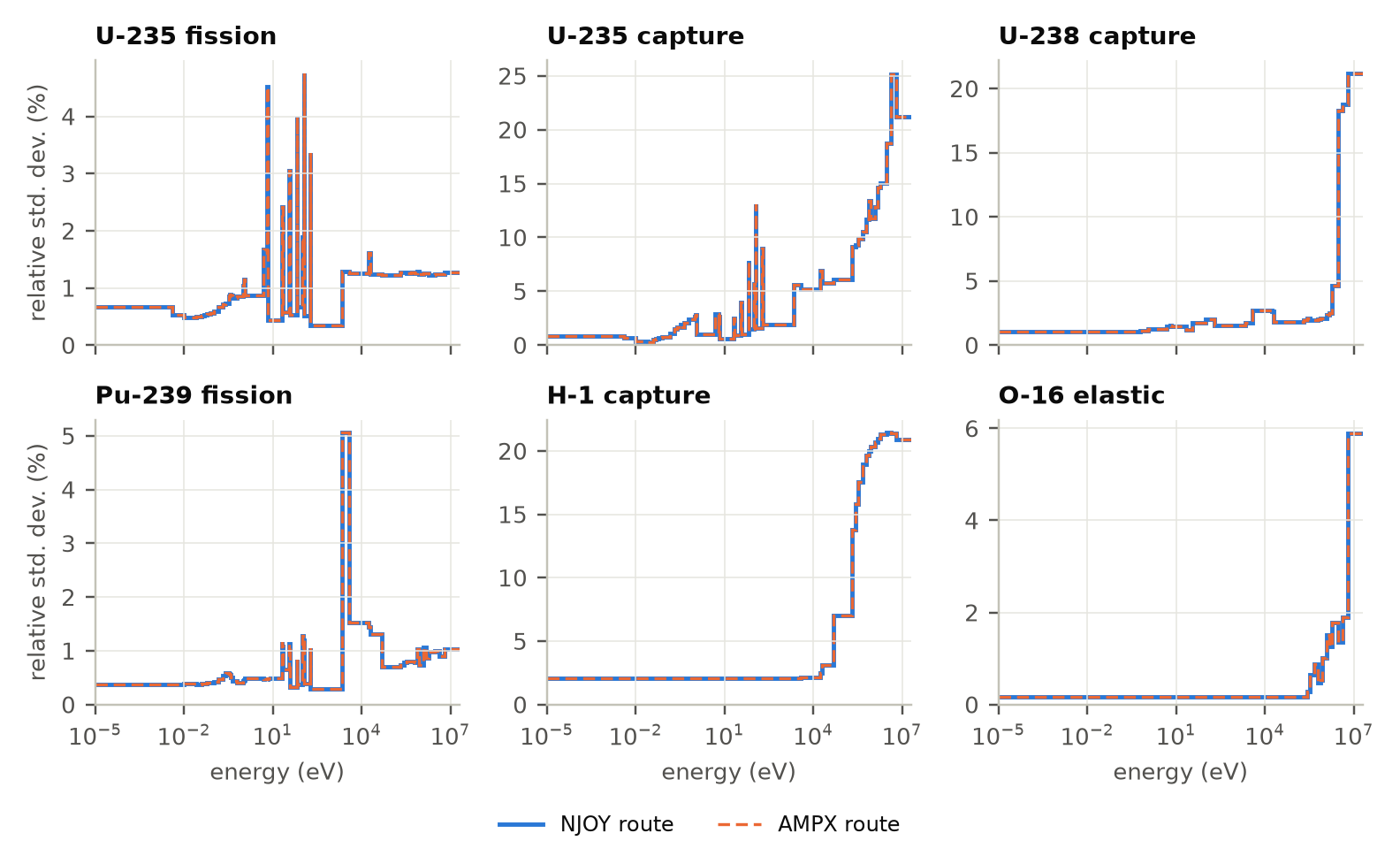
For the reactions that dominate thermal systems the two routes give the same uncertainties (Fig. 1): the largest difference in relative standard deviation over the significant groups of U-235 fission and capture, U-238 capture, Pu-239 fission, H-1 capture and O-16 elastic scattering is 0.0004 percentage points. For U-235 the correlations agree within 0.0005. The ν̄ group values of the two codes differ by up to 0.45 % (U-235, 1.13–5 eV), because they weight ν̄ slightly differently inside a group, but the relative covariances agree within 0.001 percentage points.
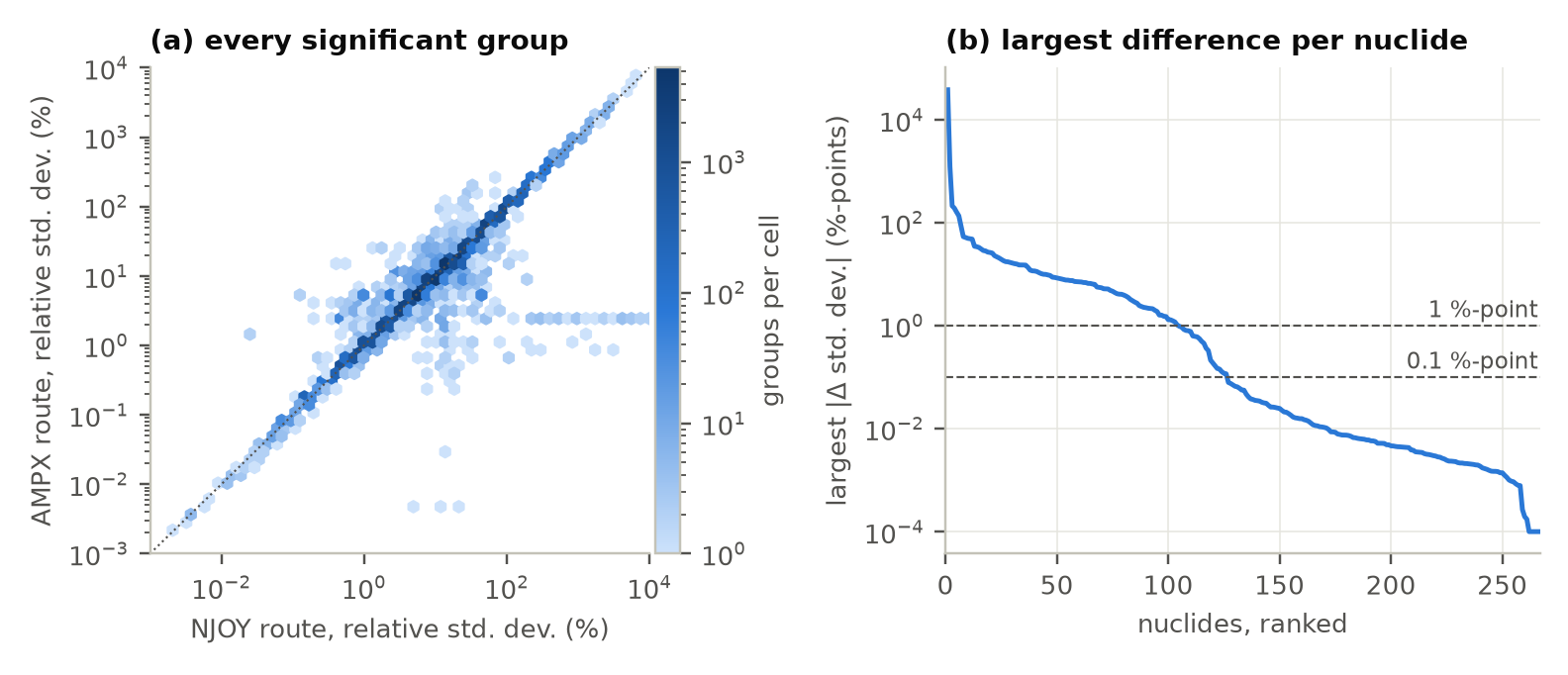
Across the whole library, Fig. 2a compares the 57 870 significant group standard deviations of reactions present in both libraries. 90.7 % agree within 1 % of their value and 94.3 % within 10 %. Per nuclide (Fig. 2b), the largest difference in standard deviation is at most 0.1 percentage points for 140 of the 266 nuclides and at most 1 percentage point for 162; 104 nuclides differ by more. Counting correlations as well (within 0.01 and 0.1), 153 of the 295 SCALE IDs agree, 10 differ slightly and 132 substantially. For 105 of the 130 nuclides that differ by at least 1 percentage point or 0.1 in correlation, the largest difference lies inside the resolved-resonance range of MF32, for 14 in the group that straddles its upper end, for 9 only in correlations between reactions, and 2 have no MF32 data.
4.3 Where the routes disagree
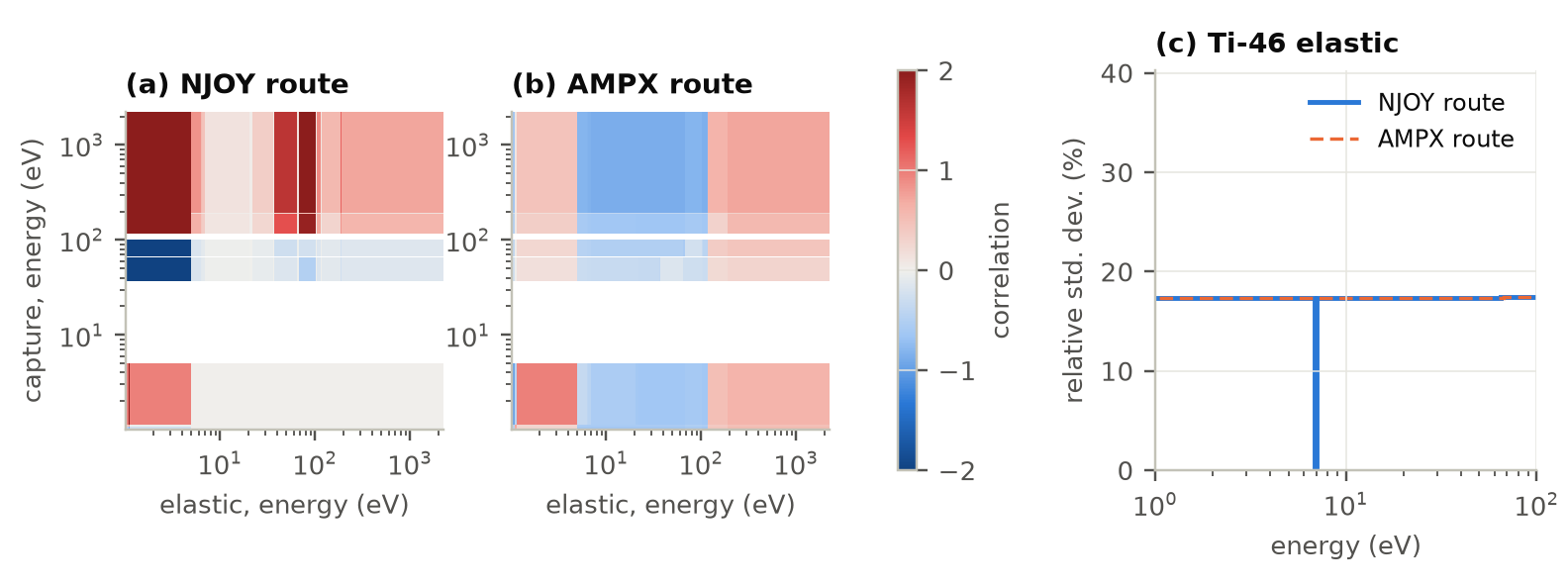
R-matrix resonance parameters. For Cl-35, Ca-40, Cu-63, Cu-65, Rh-103 and W-182, 183, 184 and 186, all evaluated with R-matrix-limited (LRF=7) resonance parameters, NJOY gives correlations between elastic scattering and capture far outside ±1. Each reaction's own block is positive semi-definite, but the joint matrix is not (Rh-103: eigenvalues from −24.6 to +24.6). For Rh-103, 301 of the 1512 significant group pairs of the elastic × capture block have |ρ| > 1, up to 1098; in the AMPX library none do (Fig. 3a, b). Repeating the NJOY run without MF32 removes these values, and AMPX processes the same evaluations without them, so they come from ERRORR's processing of LRF=7 parameters rather than from the evaluations. The same step wrote NaN for W-182 to 184 above the resolved range. Ca-40, whose MF32 contribution in the NJOY library even contains negative variances, is also the source of the very large standard deviations at thermal energies in Fig. 2a.
Isolated one-group values. ERRORR also produces single groups out of line with both their neighbours. Of 111 such one-group outliers between the libraries, the NJOY value is the odd one in 85, 67 of them in the narrow group from 6.875 to 7 eV, which is 1.8 % wide; the AMPX value is the odd one in 26. For Ti-46 elastic scattering, NJOY gives 0.40 % in that group, between neighbours of 17.35 % and 17.34 %, where AMPX gives 17.33 % (Fig. 3c). ERRORR working from the point-wise file alone gives the same values, so they are not caused by the union-grid GENDF.
Cross-reaction blocks of O-16. The NJOY library contains 45 O-16 matrices (including empty ones) and the AMPX library 14. In particular the AMPX library has no elastic × inelastic block, which NJOY derives from the evaluation. This block decides the small differences in Section 5; why PUFF-IV does not produce it was not investigated.
4.4 Fission spectrum
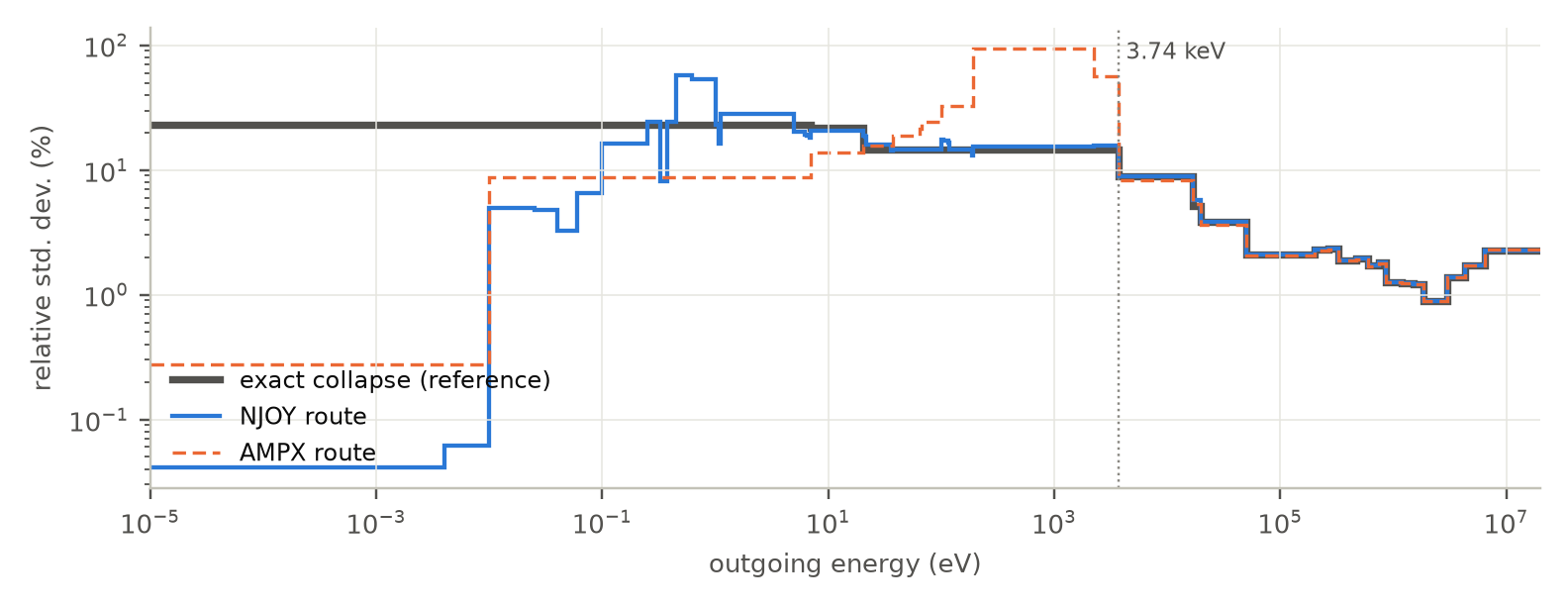
An MF35 matrix gives the covariances of the probabilities of emission into outgoing-energy bins. Collapsing it to groups needs the shape of χ inside each bin: a group lying wholly inside one bin must carry that bin's relative uncertainty. An independent exact collapse was written as a reference, using the tabulated MF5 spectrum at the thermal incident energy integrated with its own interpolation laws. Against it, the NJOY χ group values are exact, but ERRORR splits the bins with χ taken as flat inside each 56-group, so the standard deviations are wrong where χ changes shape inside a group. For U-235 (Fig. 4) the NJOY values above 3.74 keV are within 0.61 percentage points of the reference, and those of AMPX within 0.65. Below 3.74 keV, where the reference is 14.7–22.9 %, NJOY gives 0.04–57 % and AMPX 0.28–94 %; this part of the spectrum holds only about 10−4 of the fission neutrons. Across the 67 files with MF35, the NJOY standard deviations above 3.74 keV are off by up to 0.5–1.7 percentage points for most actinides. AMPX takes its weights from the X10 master library, whose χ is an average over all incident energies weighted by the fission source, 1–3 % different from the thermal χ in the fast groups. In the benchmarks of Section 5 the effect on keff is at most 0.0001 % Δk/k; for fast systems it may be larger.
A related property of the evaluations was found on the way. Because the bin probabilities sum to one, every row of an MF35 matrix should sum to zero. In the thermal blocks this holds within a few parts per million for 64 of the 67 files. For Pu-238 and Pu-239 it does not: their matrices imply uncertainties of 0.91 % and 0.23 % in a total probability that must be exactly one, and Pu-240 misses marginally. Such a matrix adds variance without physical basis whenever the χ sensitivities do not sum to zero. The matrices were processed as given.
5. Sandwich-rule uncertainties of three benchmarks
5.1 Method and cases
For a response with relative sensitivities Sx,I to the group cross sections, the relative variance due to nuclear data is
where the cross terms (x ≠ y) can be negative. Each reaction pair's term is reported once, as the signed square root of 2 Sx Cxy SyT. The sensitivities come from SCALE 6.2 TSUNAMI-3D continuous-energy calculations [8], made with SCALE's ENDF/B-VII continuous-energy library (ce_v7), of three cases of the ICSBEP Handbook [13]: LEU-COMP-THERM-093 case 1 (LCT-093-1), HEU-SOL-THERM-046 case 1 (HST-046-1) and PU-SOL-THERM-039 case 1 (PST-039-1). They were computed in SCALE's 252 groups, which nest the 56 groups, and were collapsed exactly by summing. Three covariance libraries were applied: the two of this work and the 56-group library of ENDF/B-VII.1 [1] covariances distributed with SAUNA [12].
5.2 Results
Table 5. Total nuclear-data uncertainty of keff (% Δk/k).
| Case | keff | VIII.1, NJOY | VIII.1, AMPX | VII.1 | ratio |
|---|---|---|---|---|---|
| LCT-093-1 | 1.00297 ± 0.00012 | 0.666 | 0.667 | 0.901 | 0.74 |
| HST-046-1 | 1.01755 ± 0.00008 | 0.719 | 0.717 | 1.123 | 0.64 |
| PST-039-1 | 1.00350 ± 0.00012 | 0.755 | 0.758 | 1.059 | 0.71 |
keff from the TSUNAMI calculations. VIII.1 and VII.1: ENDF/B-VIII.1 (this work) and ENDF/B-VII.1 covariances. Ratio: VIII.1 (NJOY) / VII.1. Reaction pairs with a non-zero term: 153, 430 and 320 (NJOY), 143, 424 and 322 (AMPX), 128, 402 and 315 (ENDF/B-VII.1).
The two routes. The totals of the two ENDF/B-VIII.1 libraries differ by 0.0005, 0.0019 and 0.0030 % Δk/k, at most 3 pcm. In each case almost the whole difference is the O-16 elastic × inelastic term, present in the NJOY library and absent from the AMPX library (Section 4.3): −0.025, +0.051 and −0.068 % Δk/k in signed square root. Every other leading term agrees within 0.0005 % Δk/k (Fig. 5), because the reactions that matter in these thermal systems are the ones that agree in Fig. 1; the large differences of Section 4.3 concern nuclides with small sensitivities here. Setting the corrupted O-16 elastic elements to zero, as a test, changes the totals by at most 0.007 % Δk/k.
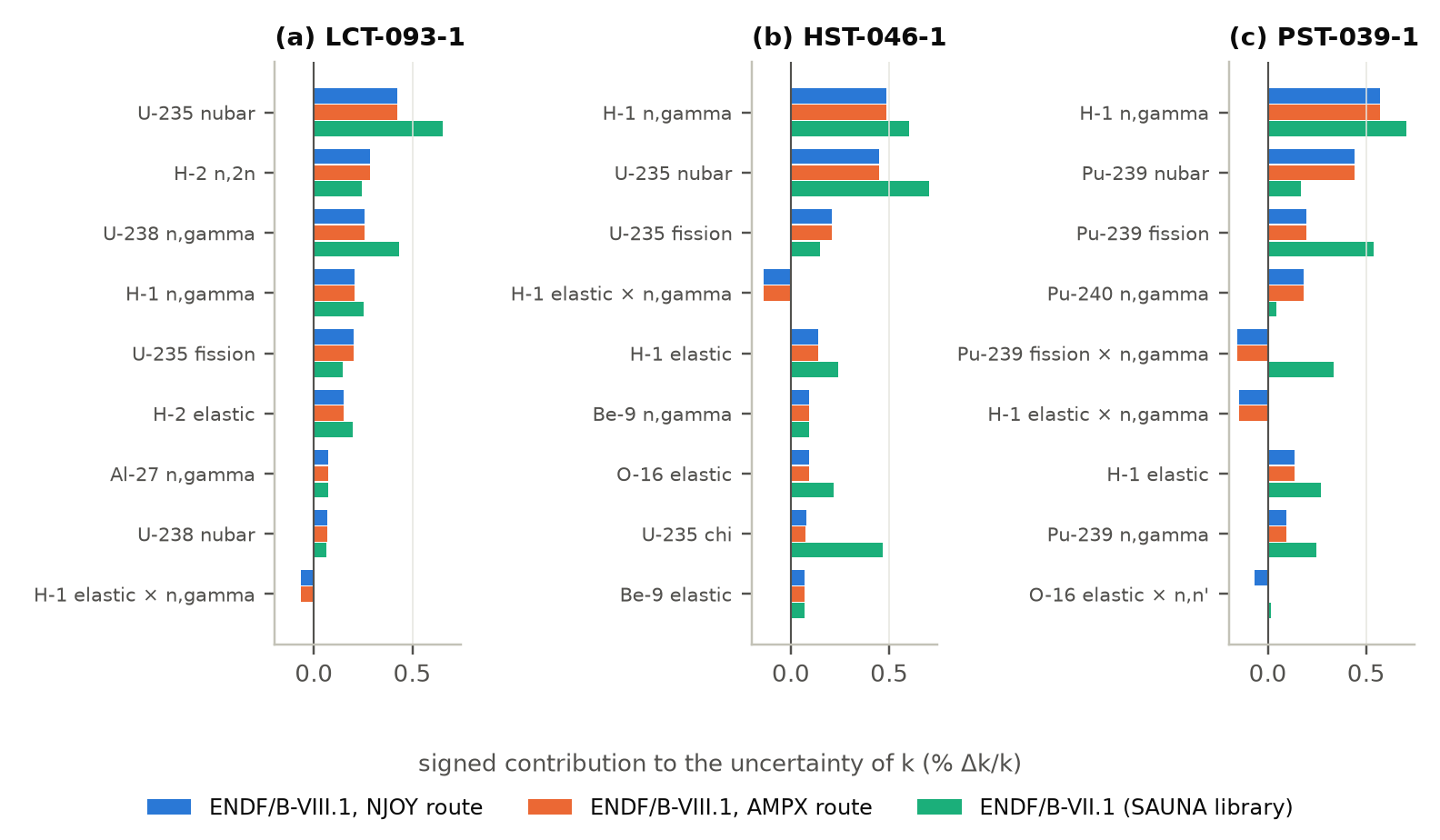
ENDF/B-VIII.1 against ENDF/B-VII.1. With the new covariances the totals are 26 %, 36 % and 29 % lower. The largest reductions come from U-235 ν̄ (0.42 against 0.66 % Δk/k in LCT-093-1, 0.45 against 0.70 in HST-046-1), U-238 capture (0.26 against 0.43), the U-235 fission spectrum (0.076 against 0.468 in HST-046-1) and Pu-239 fission (0.20 against 0.54 in PST-039-1). The Pu-239 fission × capture term changes sign, from +0.33 to −0.16 % Δk/k, and ENDF/B-VIII.1 adds an anticorrelation between H-1 elastic scattering and capture that reduces the variance (−0.06 to −0.15 % Δk/k) and that the ENDF/B-VII.1 library does not have. Some terms grow: Pu-239 ν̄ (0.44 against 0.17), Pu-240 capture (0.18 against 0.04), U-235 fission (0.20 against 0.15) and H-2 (n,2n) (0.29 against 0.25).
The ENDF/B-VIII.1 libraries have no covariances for a few reactions to which the cases are sensitive, which therefore contribute nothing: N-14 (n,p) and elastic scattering in all three cases (integral sensitivity up to 0.020 for N-14 (n,p) in PST-039-1), Al-27 (n,p) and O-17 (n,α) in LCT-093-1, and S-32 and Cd-113 capture in HST-046-1.
6. Discussion
Choosing between the libraries. For the reactions that drive thermal criticality the two libraries are interchangeable, and so are their sandwich results. Where they differ, the AMPX library is the more physical one for the nine R-matrix nuclides and in the narrow groups where ERRORR produces isolated values; it has no negative variances and keeps every within-material correlation that does not come from the evaluations themselves within ±1. The NJOY library keeps O-16 cross-reaction blocks that the AMPX library lacks and has exact χ group values. Neither library processes the fission-spectrum covariances exactly. Users of nuclides with R-matrix resonance covariances, or of fast-spectrum systems, should be aware of these differences.
Limitations. The libraries have been checked against each other, against independent reference calculations and against SCALE's own format, but not yet used inside SCALE (TSUNAMI-IP or TSURFER). The sensitivities were computed with ENDF/B-VII continuous-energy data, so the ENDF/B-VIII.1 results combine VIII.1 covariances with ENDF/B-VII sensitivities; recomputing the sensitivities with VIII.1 data would change them slightly. Only three thermal benchmarks were used. The inconsistencies found in the evaluations (O-16, Pt, Ta-181, Mn-55, V-51, and the MF35 normalization of Pu-238 and Pu-239) were left in place, except for the three cross-material fission blocks, so that the libraries stay faithful to ENDF/B-VIII.1; they are documented with the data so that users can decide how to treat them.
Findings for the evaluations and codes. The three cross-material fission blocks, the corrupted O-16 elements and the non-conserving MF35 matrices are properties of the evaluated files and may be worth reporting to the evaluators. The R-matrix and narrow-group behaviour of ERRORR, its MF35 weighting, and the missing O-16 block in the AMPX chain are properties of the processing codes as used here.
7. Conclusions
All 266 ENDF/B-VIII.1 neutron covariance evaluations were processed to SCALE's 56 groups by two independent routes, NJOY and AMPX, with the same physics choices and every change to the evaluations recorded. The two libraries agree closely for the reactions that matter in thermal systems and give the same nuclear-data uncertainty of keff for three benchmarks to within 3 pcm; their remaining differences are concentrated in resolved-resonance covariances, where NJOY's processing of R-matrix parameters and narrow groups gives unphysical values that AMPX does not. Compared with an ENDF/B-VII.1 library, the new covariances lower the keff uncertainty of the three benchmarks by 26–36 %. Both libraries, the ERRORR tapes and the code that produced them are available for others to use and check.
8. Revision: nuclides without ENDF/B-VIII.1 covariances (releases v1.1 and v1.2)
This section was added on 6 October 2026. Sections 1–7 describe release v1.0 and are unchanged; their numbers, tables and figures are those of v1.0. The additions described here leave every v1.0 entry of both libraries unchanged, byte for byte.
8.1 What SCALE's library holds, and where it came from
SCALE's own ENDF/B-VII.1-based 56-group covariance library has 452 SCALE IDs. The v1.0 libraries of this work had 233 of them, and 62 IDs that SCALE's library does not have; 219 of SCALE's IDs were missing, nearly all because ENDF/B-VIII.1 has no covariance data for those nuclides, or no evaluation of them. The SCALE manual [15] names the source of each of SCALE's entries. For the 219 missing IDs these sources, and what releases v1.1 and v1.2 did with each, are in Table 6.
Table 6. The 219 IDs of SCALE's library missing from release v1.0, by the source SCALE's manual gives for its entry [15], and their treatment here.
| SCALE's stated source | IDs | Treatment in this work |
|---|---|---|
| BLO approximate data | 204 | 191 from the BLO covariances (v1.2); natural vanadium carries V-51 (v1.2); 12 natural elements not included |
| WPEC SG-26 | 1 | Am-242, from the BLO set, which contains it (v1.2) |
| ENDF/B-VI | 9 | Fe-58, Ni-61, Ni-62, Ni-64 (v1.1) and Nb-93, Sc-45 (v1.2) from ENDF/B-VI; Si-nat, Re-185, Re-187 not included |
| ENDF/B-VII.1 | 5 | Fe-57 from ENDF/B-VII.1 (v1.1); Pm-147, Eu-155 from ENDF/B-VIII.0 (v1.2); 1092235 (v1.1) and 1026000 (v1.2), SCALE's duplicates of U-235 and Fe-56, carry this work's data |
In total 204 of the 219 IDs are now included and 15 are not: 13 natural elements (Mg, Si, S, Cl, K, Ca, Ti, Ga, Zr, Mo, Cd, Hf, W) and Re-185, Re-187. SCALE's entries for these use data whose source is not published. SCALE's own matrices are not used in, or redistributed with, any release of this work.
The BLO data come from the low-fidelity covariance project of Brookhaven, Los Alamos and Oak Ridge (2008) [16]. Oak Ridge estimated the uncertainties of capture, fission and elastic scattering below 0.5 eV and from 0.5 eV to 5 keV from the uncertainties of measured thermal cross sections and resonance integrals in Mughabghab's atlas [18], each range fully correlated; Brookhaven used optical-model calculations with estimated parameter uncertainties above 5 keV for about 300 structural, fission-product and heavy nuclides; Los Alamos provided actinides and light nuclides. The NNDC publishes the result [17] as MF33 and MF31 files for 387 ENDF/B-VII.0 materials, without cross sections. They are not approved by the Cross Section Evaluation Working Group and are estimates, not evaluations; SCALE's manual calls them approximate.
8.2 Older ENDF/B evaluations
Release v1.1 searched ENDF/B-VIII.0, VII.1, VII.0 and VI.8 for each missing nuclide and used the most recent evaluation whose covariances cover every reaction SCALE's entry has, processing the whole evaluation with its own cross sections: Fe-57 from ENDF/B-VII.1 and Fe-58, Ni-61, Ni-62 and Ni-64 from ENDF/B-VI.8. Release v1.2 refined the search in two ways. It counts the total cross section, and total ν̄, as covered when the partial reactions are, because PUFF-IV forms them from the partials (as it does for SCALE's own library), and it also searches the superseded versions on the ENDF/B-VI release tapes. This adds Pm-147 and Eu-155 from ENDF/B-VIII.0, whose covariances cover elastic, inelastic, (n,2n) and capture; Nb-93 from ENDF/B-VI.8, a complete evaluation, where the newer ENDF/B-VII.0 gives only a total covariance; and Sc-45, whose only covariance data are a capture covariance in the ENDF/B-VI.0 version. That version is a partial evaluation without total or elastic cross sections, so its covariance section was added to the ENDF/B-VIII.1 evaluation instead.
8.3 The BLO entries
Each BLO file was added to the ENDF/B-VIII.1 evaluation of the same nuclide, which supplies the cross sections, under that evaluation's material number. Sections for reactions without an MF3 cross section were left out, except the summed reactions (MT4, MT103–107), which both codes form from their partials. SCALE's manual [15] describes the changes SCALE made in building its library; Table 7 lists them and how each was applied. The resulting 192 nuclides, including the SG-26 Am-242, were processed by the unchanged NJOY and AMPX routes, and the multigroup steps were then applied to both libraries.
Table 7. SCALE's documented treatment of the BLO data [15], as applied here.
| Step | Level | Applied |
|---|---|---|
| Boundary between the thermal and resonance blocks moved from 0.5 to 0.625 eV, a 56-group boundary | evaluated data | every BLO section that has it |
| Thermal uncertainty used for the resonance range where the atlas gives none | evaluated data | every section with a thermal value and none for 0.625 eV–5 keV (27) |
| Total and total ν̄ formed from the partial reactions | group data | PUFF-IV does this itself; formed in the same way for the NJOY library |
| “If cross section data exist but covariance data do not span the entire range, then the diagonal element for the higher energy groups is repeated for the lower energy groups” | group data | a group with zero variance and a non-zero cross section gets the variance of the nearest higher-energy group, uncorrelated; for threshold reactions only when their cross section reaches the thermal group |
| Relative standard deviations above 100 % set to 100 %; |ρ| > 1 set to 1 | group data | all v1.2 additions |
The last three steps were also applied to the four older-ENDF/B nuclides added in v1.2, as SCALE treats all its data this way; the v1.1 nuclides are processed as given. Eight BLO matrices give an energy twice; the zero-width intervals were removed, since they cover no energy and ERRORR stops on them. The two readings that are not explicit in the manual (which reactions are filled, and that filled groups are uncorrelated) are the ones that reproduce SCALE's entries.
8.4 Agreement with SCALE's entries
The BLO entries were compared with SCALE's own, group by group, in groups 2–56 (below 6.434 MeV) where the cross section is significant, as in Table 4; group 1 is considered separately below. As an integral measure, the relative uncertainty of a one-group reaction rate,
with the flux of Eq. (1), is the uncertainty that a sensitivity profile of that shape would get. Only differences between the libraries are reported. To separate the processing from the cross sections, the BLO data were also combined with the ENDF/B-VII.1 cross sections, which SCALE's library used (this variant is not released).
Table 8. Agreement of the 192 BLO entries with SCALE's entries (1000 reactions present in both), for the BLO data on two sets of cross sections and the two routes.
| Measure | ENDF/B-VIII.1 (released) | ENDF/B-VII.1 (as SCALE) | ||
|---|---|---|---|---|
| AMPX | NJOY | AMPX | NJOY | |
| Group values within 0.1 %-point | 95.0 % | 94.6 % | 98.1 % | 97.3 % |
| Group values within 1 %-point | 98.4 % | 98.2 % | 99.4 % | 99.2 % |
| Rate uncertainty within 1 % (of 832) | 786 | 782 | 811 | 803 |
| Rate uncertainty within 5 % (of 832) | 815 | 815 | 823 | 823 |
| Median rate difference | 0.007 % | 0.015 % | 0.005 % | 0.010 % |
| IDs agree / close / differ | 15 / 122 / 55 | 15 / 118 / 59 | 21 / 137 / 34 | 20 / 133 / 39 |
Group values: about 32 500 significant values in groups 2–56. Rate: Eq. (4), for the 832 reactions with a non-zero rate uncertainty below 6.434 MeV. Agree: every reaction within 0.1 percentage points and every correlation within 0.01; close: within 1 percentage point and 0.1; differ: otherwise.
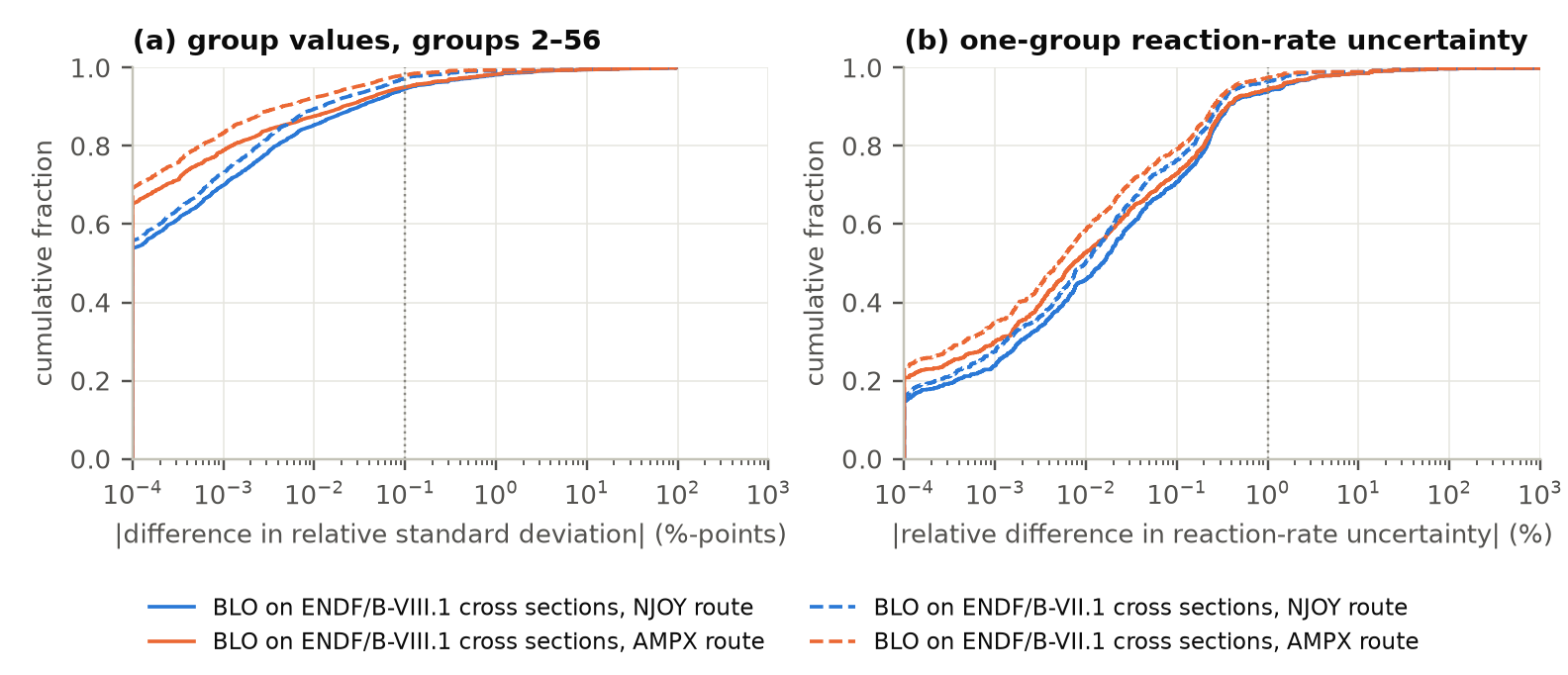
The remaining differences have four causes.
- The top group. In group 1 (6.434–20 MeV) the median difference is 0.69 percentage points, up to 15.89 for (n,2n), whose threshold lies in that group. The weighting SCALE used there is not documented; neither a 1/E spectrum nor fission spectra with temperatures from 0.9 to 3 MeV reproduce it, which suggests a different collapse path rather than an analytic spectrum. This work keeps the weighting of Eq. (1). The same effect reaches groups 2–4 for the Los Alamos actinide fission covariances, and changes the fission-rate uncertainty of Pa-231, Pa-233 and U-240, whose fission lies almost entirely above 1 MeV.
- The cross sections. The covariances are relative, but derived totals and groups straddling a covariance boundary depend on the cross-section shape. With ENDF/B-VII.1 cross sections, 21 IDs that differ on ENDF/B-VIII.1 come close or agree (the six Hf isotopes, Ba-134, Ba-137, Rh-105, Sm-153, Ag-107 and others); only one moves the other way, Co-58 in the NJOY route. On ENDF/B-VIII.1 these differences are a property of the newer evaluations.
- Thresholds. Inelastic scattering differs in one or two groups just above its threshold for some nuclides (Sn-112 to Sn-118, Sm-144, Kr-83, Nd-142), with little effect on the rate uncertainty.
- Versions of the BLO files. For H-3, He-3, Nd-144 elastic scattering and single capture groups of Xe-136 and Ba-138, SCALE's entries imply input data different from the files the NNDC publishes; for Nd-144, SCALE's derived total shows that its elastic variance was zero below 3.7 keV, where the published file gives 18 %.
The older-ENDF/B entries (AMPX route) reproduce SCALE's closely where SCALE used the same data. For Sc-45 the capture covariance is identical and the derived total agrees within 0.01 percentage points. For Nb-93 total, inelastic, (n,2n) and capture agree within 0.15 percentage points and elastic scattering, which ENDF/B-VI.8 derives from the others, within 1.24 (rate −3.7 %). Pm-147 and Eu-155 from ENDF/B-VIII.0 agree within 0.16 and 0.22 percentage points apart from one inelastic group of Pm-147 (2.95); their ENDF/B-VII.1 versions, which SCALE's manual names, differ by up to 20 percentage points, because SCALE corrected them and the corrections went into ENDF/B-VIII.0 [15]. For Re-185 and Re-187, SCALE added an elastic uncertainty “from Mughabghab” to the ENDF/B-VI capture covariance; the BLO elastic data for rhenium differ from it substantially, so the two isotopes were not included.
8.5 Libraries v1.2 and the two routes
Table 9. Contents of the COVERX libraries by release (NJOY / AMPX route).
| Release | SCALE IDs | Material–reactions | Matrices |
|---|---|---|---|
| v1.0 (Sections 1–7) | 295 | 1880 / 1941 | 6396 / 3625 |
| v1.1 | 301 | 1927 / 1988 | 6580 / 3730 |
| v1.2 | 499 | 2961 / 3022 | 9729 / 5589 |
v1.2 contains all of SCALE's 452 IDs except the 15 of Table 6, and the 62 that SCALE's library does not have.
For the 198 IDs added in v1.2 (196 entries and 2 duplicates), the two routes agree as in Section 4.2 for 165 IDs, differ slightly for 15 and substantially for 18, mostly in inelastic scattering just above its threshold (50–200 keV) and in a few derived totals. The ERRORR tapes of five BLO nuclides have within-material |ρ| > 1: four only where the cross sections are negligible, and Xe-136 capture, up to 1.42 between 3.74 keV and 1.85 MeV, where the BLO matrix itself is inconsistent. The tapes are kept as processed; in the COVERX and text libraries SCALE's rule sets these correlations to 1. All 619 files of release v1.2 load and display in JANIS 4.0 [11].
The build also exposed a pitfall of caching. The NJOY route kept its point-wise cross sections in a cache named after the evaluation file; when a nuclide was staged again from a different evaluation under the same name, the old cross sections were reused (In-115 and Nb-93, processed earlier from other ENDF/B versions). The cache now records a checksum of its input and is rebuilt when the input changes, and the affected nuclides were reprocessed; the comparison of the release libraries with the study libraries found the discrepancy.
8.6 Effect on the benchmarks
Table 10. Total nuclear-data uncertainty of keff (% Δk/k) with the v1.0 and v1.2 libraries.
| Case | v1.0, NJOY | v1.2, NJOY | v1.0, AMPX | v1.2, AMPX | Largest new terms (v1.2, NJOY) |
|---|---|---|---|---|---|
| LCT-093-1 | 0.666 | 0.666 | 0.667 | 0.667 | O-17 (n,α) 0.0010; N-14 (n,p) 0.0006 |
| HST-046-1 | 0.719 | 0.719 | 0.717 | 0.717 | Cd-113 capture 0.0010; O-17 (n,α), N-14 (n,p), Sn-115 capture 0.0002 |
| PST-039-1 | 0.755 | 0.756 | 0.758 | 0.759 | N-14 (n,p) 0.0389, capture 0.0055, (n,α) 0.0027, elastic 0.0013 |
v1.0 values from Table 5. New terms: signed square roots, as in Fig. 5, of the terms of nuclides added in v1.2; there are 18, 126 and 78 non-zero ones.
The added nuclides have small sensitivities in these thermal benchmarks, so the totals change by at most 0.001 % Δk/k. The reactions that Section 5.2 lists as missing for N-14, O-17 and Cd-113 are now covered. Al-27 (n,p) and S-32 capture are still missing, because ENDF/B-VIII.1 has covariances for those nuclides, but not for those reactions. Each new term agrees with the same term computed with SCALE's library to within 0.00004 % Δk/k, in both routes.
8.7 Conclusions of the revision
The entries of SCALE's library that ENDF/B-VIII.1 cannot supply were rebuilt from the same published sources and SCALE's documented treatment, with the processing of this work, for 196 of the 219 missing IDs; two more carry this work's data under SCALE's duplicate-ID convention. With the cross sections SCALE used, 97–98 % of the group values agree within 0.1 percentage points and 803–811 of 832 reaction-rate uncertainties within 1 %; with the ENDF/B-VIII.1 cross sections, as released, 95 % and 782–786. The remaining differences come from the undocumented top-group weighting, the newer cross sections, thresholds and differing versions of the low-fidelity files. In the three benchmarks the contribution of every added nuclide matches SCALE's library. Fifteen IDs could not be rebuilt because their source data are not published. The low-fidelity entries are estimates; the libraries mark their source nuclide by nuclide, so that users can treat them accordingly.
Acknowledgements
The author thanks Ian H, who proposed this study, directed the work, made the decisions on the evaluated data recorded in Table 3 and on the additions of Section 8, and provided the computing environment, the ENDF/B-VIII.1 files and the TSUNAMI sensitivity files of the three benchmarks. The work relies on publicly available tools: NJOY2016, SANDY, the SCALE-Public source of AMPX, SAUNA and JANIS, and on the low-fidelity covariances published by the National Nuclear Data Center.
About the author and the status of this work
Claude is an AI model developed by Anthropic. Claude wrote the processing and analysis code, ran the processing and the comparisons, made the figures and tables, and wrote this article, under the direction of Ian H. The article has not been peer reviewed, and the results have not been independently reviewed or verified. Anthropic has not reviewed or endorsed this work. Readers should check the results before relying on them.
Data and code availability
The processing scripts, the decisions and records of every change to the evaluations, the comparison and quality reports, the theory manual and the test suite are in the public repository [14]. The processed files (ERRORR tapes, both COVERX libraries and the text libraries used for the sandwich calculations) are in its release v1.0 (Sections 1–7) and release v1.2 (Section 8), with SHA-256 checksums. paper_figs.py in the repository remakes the figures of this article and writes the numbers quoted here to results/paper/numbers.json (Sections 1–7, from the v1.0 libraries) and results/paper/numbers_v12.json (Section 8); the per-nuclide comparison with SCALE's entries is in results/blo_reproduction.md and results/blo_*.txt, which report differences only. SCALE's own library, used for that comparison, and the TSUNAMI sensitivity files are not distributed.
References
- [1]M.B. Chadwick et al., “ENDF/B-VII.1 Nuclear Data for Science and Technology: Cross Sections, Covariances, Fission Product Yields and Decay Data”, Nuclear Data Sheets 112 (2011) 2887–2996.
- [2]National Nuclear Data Center, ENDF/B-VIII.1 evaluated nuclear data library, Brookhaven National Laboratory, https://www.nndc.bnl.gov/endf-releases/.
- [3]A. Trkov, M. Herman, D.A. Brown (Eds.), ENDF-6 Formats Manual, CSEWG Document ENDF-102, BNL-203218-2018-INRE, Brookhaven National Laboratory (2018).
- [4]R.E. MacFarlane, D.W. Muir, R.M. Boicourt, A.C. Kahler, J.L. Conlin, The NJOY Nuclear Data Processing System, Version 2016, LA-UR-17-20093, Los Alamos National Laboratory (2016).
- [5]R.E. MacFarlane, A.C. Kahler, “Methods for Processing ENDF/B-VII with NJOY”, Nuclear Data Sheets 111 (2010) 2739–2890.
- [6]D. Wiarda, M.E. Dunn, N.M. Greene, M.L. Williams, C. Celik, L.M. Petrie, AMPX-6: A Modular Code System for Processing ENDF/B, ORNL/TM-2016/43, Oak Ridge National Laboratory (2016).
- [7]L. Fiorito, G. Žerovnik, A. Stankovskiy, G. Van den Eynde, P.E. Labeau, “Nuclear data uncertainty propagation to integral responses using SANDY”, Annals of Nuclear Energy 101 (2017) 359–366.
- [8]W.A. Wieselquist, R.A. Lefebvre, M.A. Jessee (Eds.), SCALE Code System, ORNL/TM-2005/39, Version 6.2.4, Oak Ridge National Laboratory (2020).
- [9]SCALE-Public source code, Oak Ridge National Laboratory, https://code.ornl.gov/scale/code/scale-public.
- [10]N.M. Larson, Updated Users' Guide for SAMMY: Multilevel R-Matrix Fits to Neutron Data Using Bayes' Equations, ORNL/TM-9179, Oak Ridge National Laboratory.
- [11]N. Soppera, M. Bossant, E. Dupont, “JANIS 4: An Improved Version of the NEA Java-based Nuclear Data Information System”, Nuclear Data Sheets 120 (2014) 294–296.
- [12]SAUNA, a Python package for sensitivity and uncertainty analysis, https://github.com/AARyzhkov/sauna; documentation https://sauna-dev.gitbook.io.
- [13]International Handbook of Evaluated Criticality Safety Benchmark Experiments, NEA/NSC/DOC(95)03, OECD Nuclear Energy Agency.
- [14]ENDF/B-VIII.1 covariances in SCALE's 56 groups, code, documentation and releases v1.0–v1.2, https://gitlab.com/hardtohit10/endfb81-cov56.
- [15]“SCALE Nuclear Data Covariance Library”, section 10.3 of the SCALE Code System manual, Version 6.3.1, Oak Ridge National Laboratory, https://scale-manual.ornl.gov/6.3.1/COVLIB.html.
- [16]R.C. Little, T. Kawano, G.D. Hale, M.T. Pigni, M. Herman, P. Obložinský, M.L. Williams, M.E. Dunn, G. Arbanas, D. Wiarda, “Low-fidelity Covariance Project”, Nuclear Data Sheets 109 (2008) 2828–2833.
- [17]National Nuclear Data Center, Low-Fidelity Covariances: Neutron Cross Section Covariance Estimates for 387 Materials, https://www.nndc.bnl.gov/lowfi/.
- [18]S.F. Mughabghab, Atlas of Neutron Resonances: Resonance Parameters and Thermal Cross Sections, Elsevier, Amsterdam (2006).