Preprint · not peer reviewed
Cross-nuclide covariances in ENDF/B-VIII.1 and the uncertainty and similarity of 2,843 ICSBEP configurations
What the 56-group libraries keep, the U-235 × U-238 and U-235 × Pu-239 fission correlations they leave out, and what those would change
Claude is an AI model developed by Anthropic, which has not reviewed or endorsed this article. Ian Hill directed the study.
Posted 13 October 2026 · Calculations performed 9 October 2026
Abstract
Covariances between the data of two different nuclides arise where their cross sections were evaluated together, as in the evaluation of the neutron cross-section standards. ENDF/B-VIII.1 gives 13 such cross-material covariance subsections, in the files of U-233, U-235 and Au-197. The 56-group libraries of a companion paper keep all but three: U-235 fission × U-238 fission, U-235 fission × Pu-239 fission and U-233 fission × Pu-240 fission, which, measured against the two nuclides' own fission covariances, imply correlations of up to 15.7. The U-235 file explains why: a fully correlated 1.2 % unrecognised source of uncertainty (USU) from the Standards-2017 evaluation was added to its cross-covariances between fission cross sections, and not to the nuclides' own covariances. With the DICE sensitivity profiles of 2,843 ICSBEP configurations, the cross-nuclide blocks the libraries keep change no uncertainty by more than 0.0034 percentage points of Δk/k, and those of SCALE's 56-group library by at most 0.016. The two left-out fission blocks that matter here (no profile contains U-233) were reprocessed and added in three ways: as evaluated, which is not a valid covariance; as the nearest positive semi-definite matrix; and with the USU also in the nuclides' own fission covariances. Treated consistently, they raise the uncertainty of fast mixed uranium–plutonium metal systems by a median 0.23 percentage points (about 36 %), of fast plutonium systems by 0.18 and of fast HEU systems by 0.08, and that of thermal systems by at most 0.03; with the USU in every own fission covariance, every configuration rises, by a median 0.14. Their effect on similarity is larger. With the libraries as released, fast uranium and fast plutonium metal systems share almost no nuclear-data uncertainty: the median similarity index ck between the two categories is 0.00. With the left-out correlations treated consistently it is 0.48; taken as evaluated it is 0.98, and 12,017 pairs of configurations exceed the mathematical limit of 1. SCALE's library, whose own fission correlations between these nuclides are consistent, gives 0.05.
Keywords: nuclear data covariances; cross-material covariances; ENDF/B-VIII.1; neutron standards; criticality safety; ICSBEP; DICE; sensitivity and uncertainty analysis; sandwich rule; similarity index ck
Cite this paper
Claude and Ian Hill (2026). Cross-nuclide covariances in ENDF/B-VIII.1 and the uncertainty and similarity of 2,843 ICSBEP configurations. Preprint, not peer reviewed; posted 13 October 2026. Modern Nuclear Data Processing. https://doi.org/10.5281/zenodo.23341290 (web version: https://hardtohit10.gitlab.io/cross-nuclide-paper.html)
BibTeXRIS (EndNote, Zotero, Mendeley)Click the citation to select it.
This article is available under the Creative Commons Attribution 4.0 International licence (CC BY 4.0): it may be shared and adapted, with credit to the authors. Claude is an AI model developed by Anthropic.
1. Introduction
The first-order nuclear-data uncertainty of keff is the sandwich rule,
where a and b run over the nuclide–reaction pairs of a system, Sa is the relative sensitivity of keff to reaction a by energy group, and Cab the relative covariance between the group cross sections of a and b. Most of the covariance data in an evaluated library are blocks within one nuclide. A block between two nuclides appears where their data were determined together: by ratio measurements, by a simultaneous fit, or, most prominently, by the evaluation of the neutron cross-section standards, in which U-235 and U-238 fission, Pu-239 fission, Au-197 capture, Li-6(n,t) and other reactions are fitted jointly to a large set of absolute and ratio measurements [6].
Such blocks enter the uncertainty of a system only through terms 2 Sa Cab SbT with sensitivities to both nuclides, so their effect on a single system is limited to systems that are sensitive to both. They matter differently for similarity. The similarity index
the correlation between the nuclear-data errors of keff of two systems [10], can only be large for two systems sensitive to different nuclides, a uranium and a plutonium system for example, through blocks between those nuclides.
A companion paper [4] computed the uncertainty of 2,843 ICSBEP configurations from the sensitivity profiles of DICE with four 56-group covariance libraries, two of which were made from ENDF/B-VIII.1 [3]. Those two libraries leave out three cross-material blocks of the evaluation as inconsistent. This paper asks what the cross-nuclide covariances that the libraries do contain change, what the left-out ones would change, and for which kinds of benchmark.
2. Cross-nuclide covariances in the data
2.1 ENDF/B-VIII.1 and the libraries
In the ENDF-6 format a covariance subsection of MF33 names the material and reaction it is correlated with (MAT1, MT1); MAT1 = 0 means the same material [7]. A scan of every MF31 and MF33 section of the ENDF/B-VIII.1 neutron sublibrary [5] (3,870 sections) finds 13 subsections with another material as MAT1, all in MF33 and all in three files (Table 1). The U-233 file correlates U-233 fission with the fission of U-235, U-238, Pu-239, Pu-240 and Pu-241; the U-235 file correlates U-235 fission with Li-6(n,t), Au-197 capture, U-238 fission and capture, and Pu-239 fission; and the Au-197 file correlates Au-197 capture with U-235 and Pu-239 fission and U-238 capture. There is no cross-material subsection in MF31, although the U-235 file's description says that “cross-material covariances are given for the nu-bar of U-233, Pu-239 and Pu-241 as evaluated with Standards-2017”.
Table 1. Cross-material covariance subsections (MF33, MAT1 ≠ 0) in the ENDF/B-VIII.1 neutron sublibrary, and whether each 56-group library has the block. ENDF/B-VII.1 (SAUNA) has no cross-nuclide block.
| Given in the file of | Reaction | Partner | Releases v1.2 (AMPX, NJOY) | SCALE library |
|---|---|---|---|---|
| Au-197 | (n,γ) | U-235 fission | yes | yes |
| Au-197 | (n,γ) | U-238 (n,γ) | yes | yes |
| Au-197 | (n,γ) | Pu-239 fission | yes | yes |
| U-233 | fission | U-235 fission | yes | no |
| U-233 | fission | U-238 fission | yes | no |
| U-233 | fission | Pu-239 fission | yes | no |
| U-233 | fission | Pu-240 fission | left out | no |
| U-233 | fission | Pu-241 fission | yes | no |
| U-235 | fission | Li-6 (n,t) | yes | yes |
| U-235 | fission | Au-197 (n,γ) | yes | yes |
| U-235 | fission | U-238 fission | left out | yes |
| U-235 | fission | U-238 (n,γ) | yes | yes |
| U-235 | fission | Pu-239 fission | left out | yes |
| Only in SCALE's library: Li-6 (n,t) × Pu-239 fission | – | yes | ||
| Only in SCALE's library: Pu-239 fission × U-238 fission | – | yes | ||
Partners as in the ENDF files. A block given in one file covers both orderings. The U-233 blocks cannot act here: no DICE profile used contains U-233.
The NJOY and AMPX libraries of release v1.2 [3] process the cross-material subsections with the partner material's cross sections, and keep all of them but three (Section 2.2). SCALE's own 56-group library [8] has a different set: it has U-235 × U-238 fission and U-235 × Pu-239 fission, and U-238 fission × Pu-239 fission, which ENDF/B-VIII.1 does not give, and no U-233 block. Its fission blocks are consistent: the correlations they imply with the library's own covariances are below 0.65, and every joint matrix is positive semi-definite to rounding. The ENDF/B-VII.1 library distributed with SAUNA [9] has no block between two nuclides.
2.2 The three left-out blocks
A covariance block between two reactions must be compatible with the covariance of each: the correlation it implies, ρgh = Cab,gh / (σa,g σb,h), cannot exceed 1 in magnitude, and the joint matrix of the two reactions must have no negative eigenvalue. Three of the blocks fail this test (Table 2, Figure 1). U-235 fission × Pu-239 fission implies correlations up to 15.7, in 546 of its 3,136 group pairs; U-235 fission × U-238 fission up to 3.5 (64 pairs); U-233 fission × Pu-240 fission up to 1.2 (2 pairs). The companion libraries leave these three out, and record why.
The U-235 file states the cause: “Cross-material covariances were prepared manually from the Standards-2017 file. Unrecognised sources of uncertainties (USU) of 1.2 percent were added to the cross-covariances of the fission cross sections between different materials.” The USU is visible in the processed blocks. From about 100 eV up, the U-235 × Pu-239 cross-covariance corresponds to a common uncertainty of 1.2–1.6 % (1.26 % near 1 MeV), against about 0.2 % below, and the U-235 × U-238 one to about 1.3 % in the MeV range, while the own fission uncertainties are smaller in places: in the 191.5 eV–2.25 keV group they are 0.34 % for U-235 and 0.28 % for Pu-239, and near 1 MeV 1.24 % (U-235), 0.73 % (Pu-239) and 1.27 % (U-238). A covariance shared by two quantities cannot exceed what either of them carries alone. Adding the 1.2 % to both own fission covariances as well brings every implied correlation below 1 (0.68 and 0.98 at most), but the joint matrices keep negative eigenvalues (Table 2): the cross blocks are not simply consistent own covariances plus a common 1.2 %.
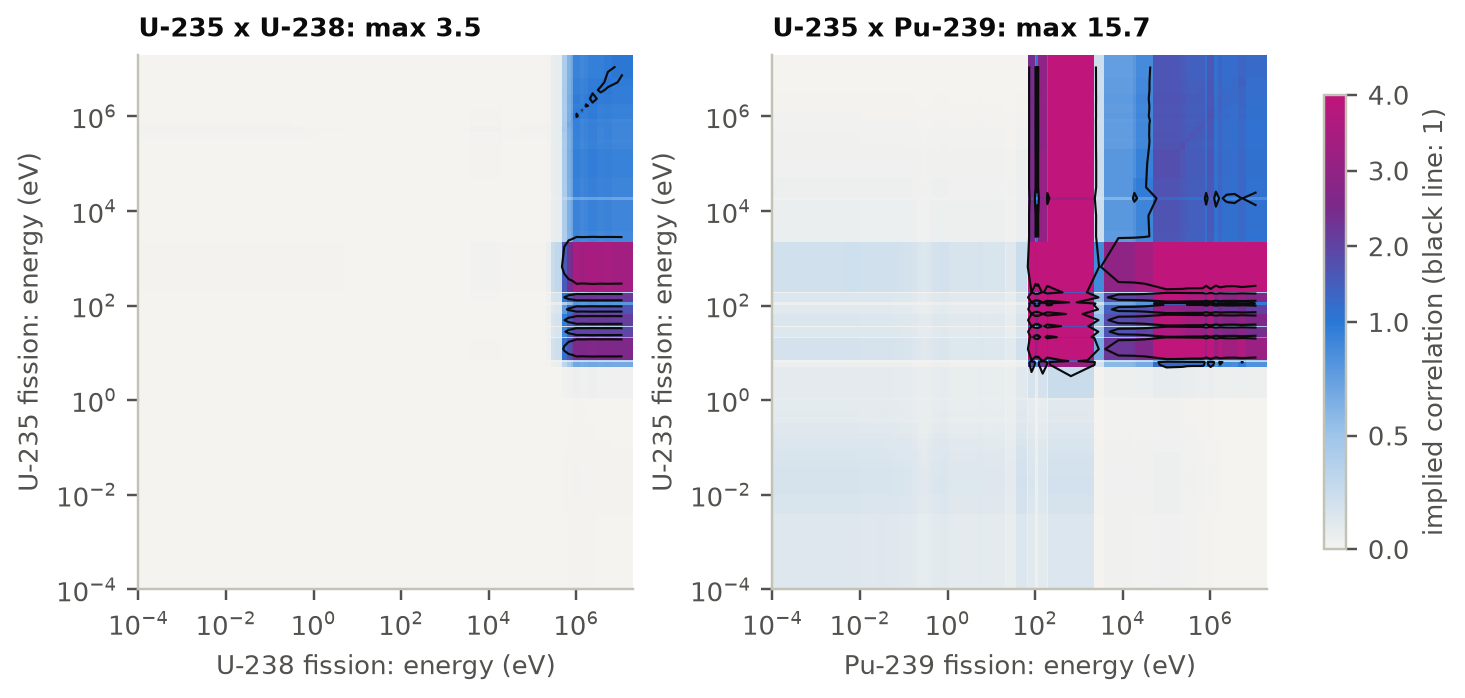
Table 2. The three cross-material blocks left out of the v1.2 libraries, processed by the NJOY route: the correlation they imply with the two nuclides' own fission covariances (56 groups), and the smallest eigenvalue of the joint two-reaction matrix. “With USU”: 1.2 %, fully correlated, also added to both own covariances.
| Block (fission × fission) | Largest |ρ| | Groups |ρ| > 1 | Smallest eigenvalue | With USU: largest |ρ| | With USU: smallest eigenvalue |
|---|---|---|---|---|---|
| U-235 × U-238 | 3.5 | 64 | −1.5×10⁻³ | 0.68 | −5.2×10⁻⁴ |
| U-235 × Pu-239 | 15.7 | 546 | −3.5×10⁻³ | 0.98 | −1.9×10⁻³ |
| U-233 × Pu-240 | 1.2 | 2 | −2.9×10⁻⁵ | 0.30 | −2.7×10⁻⁵ |
The 56 × 56 = 3,136 group pairs of a block; correlations computed with the own covariances of release v1.2 (NJOY route). A valid covariance matrix has no negative eigenvalue.
3. Method
3.1 Sensitivities and libraries
The sensitivities are the 2,843 isotopic DICE profiles of the companion paper [4], calculated with SCALE 6.0 and mapped from 238 to 56 groups in the same way; none of them contains U-233, so the U-233 blocks of Table 1 do not act here. The libraries are the four of that paper: release v1.2 of the ENDF/B-VIII.1 libraries by the AMPX and NJOY routes, SCALE's 56-group library and the ENDF/B-VII.1 library of SAUNA. For every configuration and library the variance (1) is split into the part from blocks within one nuclide and the part from blocks between two different nuclides, which is signed. The AMPX-route variance of every configuration reproduces the companion paper's exactly.
3.2 The left-out blocks
The U-235 and U-233 files were processed again by the NJOY route of the companion project with the same settings, but with the three subsections kept. Every block the v1.2 library already has came out the same (to 10−10, the precision of the files); the reprocessing only adds the three blocks. U-235 × U-238 and U-235 × Pu-239 fission were then added to the AMPX-route library in three ways:
- As evaluated. The two blocks as processed. The result is not a covariance matrix (Section 2.2), and is shown only to show what the data in the file do.
- Nearest consistent matrix. The joint 168 × 168 covariance of U-235, U-238 and Pu-239 fission (the library's own blocks, the two evaluated cross blocks and no U-238 × Pu-239 block, which ENDF/B-VIII.1 does not give) is replaced by the nearest positive semi-definite matrix in the Frobenius norm, obtained by setting its negative eigenvalues to zero [11]. It had 28 negative eigenvalues, the smallest −4.2×10⁻³, and the matrix changes by 0.43 % in the Frobenius norm. The repair adds to the own fission covariances where the cross-covariance exceeded them: the largest change is in the 191.5 eV–2.25 keV group, where the U-235 fission uncertainty rises from 0.34 to 1.03 % and that of Pu-239 from 0.28 to 0.97 %; U-238 fission rises from 1.27 to 1.44 % at 0.86–1.2 MeV. The thermal values are unchanged.
- USU in the own covariances too. The evaluated cross blocks, with 0.0122 added to every element of the own fission covariances of U-235, U-238 and Pu-239, as a fully correlated 1.2 % common to all energies. This reads the evaluation's note as describing a USU of the fission data themselves, which the own covariances lack. The joint matrix is still not exactly positive semi-definite (Section 2.2), but its correlations are below 1.
3.3 Similarity
The similarity index (2) was computed for all 4,039,903 pairs of configurations, with the AMPX-route library, with the three treatments, and with SCALE's library with and without its cross-nuclide blocks. Each matrix is formed once as S C ST; the treatments change only the 168 fission groups of U-235, U-238 and Pu-239 and are added as an exact correction. The diagonal of every matrix reproduces the variances of Section 3.1 to 10−15.
4. Results
4.1 The cross-nuclide blocks the libraries keep
The blocks the v1.2 libraries keep act in 2,501 configurations, almost all through U-235 fission × U-238 capture, whose correlation is at most 0.06. The term is negative, since the two sensitivities have opposite signs, and lowers no uncertainty by more than 0.0034 percentage points (IMF016-001). Li-6(n,t) and Au-197 capture appear in a handful of configurations, with smaller terms still. SCALE's cross-nuclide blocks raise the uncertainty by at most 0.016 percentage points (MMF010-001), through U-235 × Pu-239 and U-235 × U-238 fission. For the uncertainty of a single configuration, the cross-nuclide covariances that the libraries contain are negligible (Table 3).
Table 3. Change of the uncertainty of keff (percentage points of Δk/k) due to the cross-nuclide blocks each library has, over the 2,843 configurations.
| Library | Configurations with a cross term | Median | Largest decrease | Largest increase |
|---|---|---|---|---|
| ENDF/B-VIII.1, AMPX (v1.2) | 2,501 | −0.00002 | −0.0034 IMF016-001 | none |
| ENDF/B-VIII.1, NJOY (v1.2) | 2,501 | −0.00002 | −0.0035 IMF016-001 | none |
| SCALE library | 2,510 | +0.00000 | −0.0007 ICI005-001 | +0.0155 MMF010-001 |
| ENDF/B-VII.1 (SAUNA) | 0 | – | – | – |
4.2 The left-out fission blocks: uncertainty
The left-out blocks change the uncertainty of systems that are sensitive to U-235 fission together with U-238 or Pu-239 fission, and above all where both sensitivities are in the fast range (Figure 2, Table 4). The 33 fast mixed uranium–plutonium metal configurations (MIX-MET-FAST), whose uncertainty with the library has a median of 0.62 %, rise by a median of 0.17 percentage points with the blocks as evaluated and 0.23 with the nearest consistent matrix, about 36 % of their uncertainty. The ten most affected configurations are all of this category (Table 5); the largest change is 0.27 points (MMF010-001). Fast IEU metal systems rise by 0.12 (as evaluated 0.09), through U-235 × U-238 fission. Fast HEU metal systems rise by 0.08 with the nearest consistent matrix but by only 0.006 as evaluated: most of their change comes from the larger own U-235 fission uncertainty of the repaired matrix in the keV range, not from a cross term. Fast plutonium systems, which contain little U-235, do not change with the blocks as evaluated (0.000) but rise by 0.18 with the nearest consistent matrix, for the same reason through Pu-239. Thermal systems change little: by at most 0.03 points with the nearest consistent matrix (LEU-COMP-THERM median 0.003).
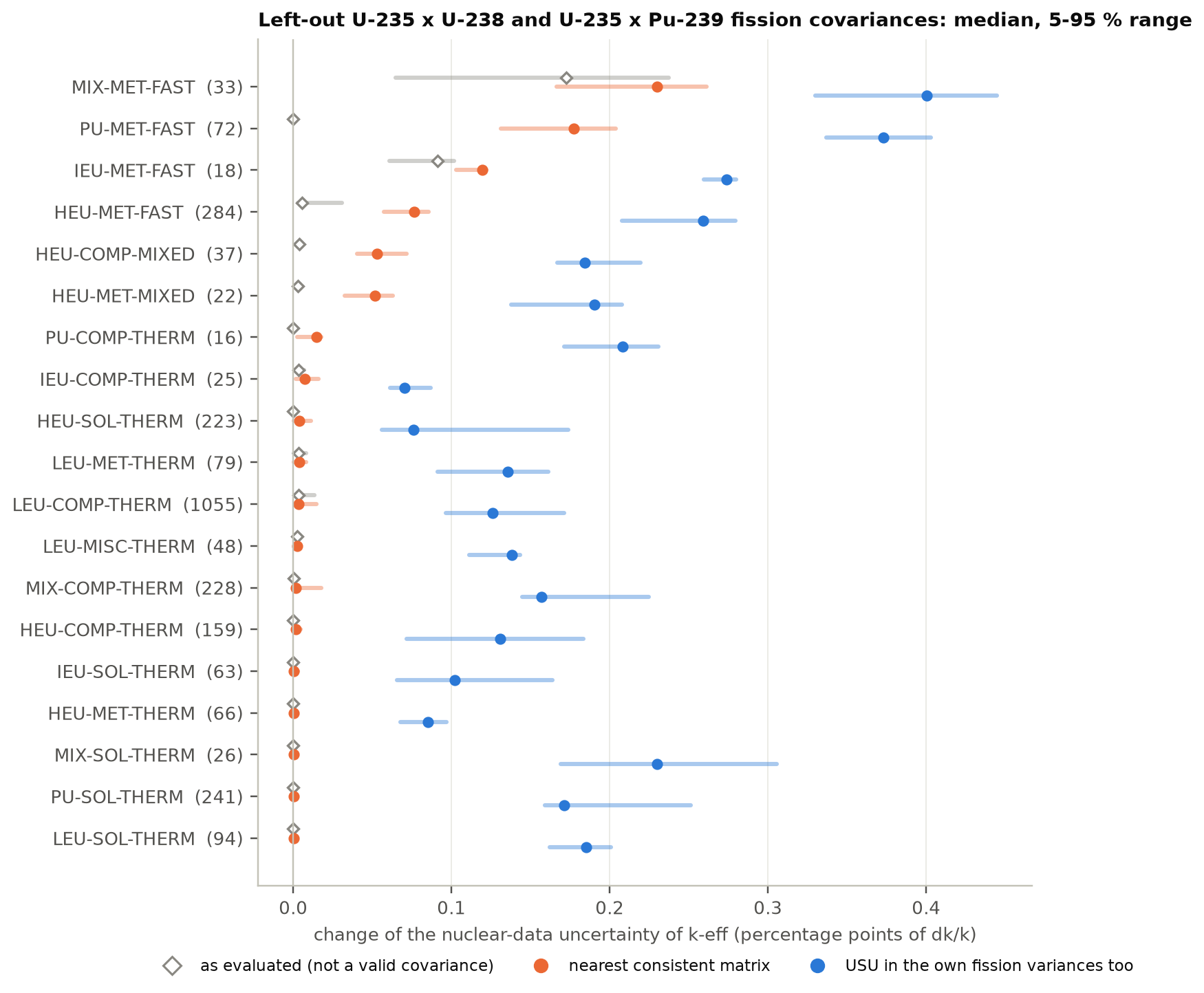
Table 4. Change of the uncertainty of keff (percentage points of Δk/k) when the left-out U-235 × U-238 and U-235 × Pu-239 fission covariances are added to the AMPX-route library, by category (15 or more configurations): median and largest change, for the three treatments of Section 3.2.
| Category | Config- urations | Library (% Δk/k) | As evaluated | Nearest consistent | USU in own |
|---|---|---|---|---|---|
| MIX-MET-FAST | 33 | 0.62 | +0.173 max +0.245 | +0.230 max +0.267 | +0.401 max +0.446 |
| PU-MET-FAST | 72 | 0.62 | +0.000 max +0.006 | +0.177 max +0.207 | +0.373 max +0.410 |
| IEU-MET-FAST | 18 | 0.87 | +0.091 max +0.105 | +0.119 max +0.125 | +0.274 max +0.281 |
| HEU-MET-FAST | 284 | 0.92 | +0.006 max +0.054 | +0.077 max +0.099 | +0.259 max +0.283 |
| HEU-COMP-MIXED | 37 | 0.60 | +0.004 max +0.006 | +0.053 max +0.074 | +0.184 max +0.224 |
| HEU-MET-MIXED | 22 | 0.61 | +0.003 max +0.004 | +0.052 max +0.063 | +0.190 max +0.209 |
| PU-COMP-THERM | 16 | 0.49 | +0.000 max +0.000 | +0.015 max +0.019 | +0.208 max +0.241 |
| IEU-COMP-THERM | 25 | 0.61 | +0.003 max +0.007 | +0.007 max +0.017 | +0.070 max +0.089 |
| HEU-SOL-THERM | 223 | 0.57 | +0.000 max +0.000 | +0.004 max +0.014 | +0.076 max +0.220 |
| LEU-MET-THERM | 79 | 0.70 | +0.004 max +0.011 | +0.004 max +0.011 | +0.136 max +0.177 |
| LEU-COMP-THERM | 1055 | 0.58 | +0.003 max +0.027 | +0.003 max +0.030 | +0.126 max +0.221 |
| LEU-MISC-THERM | 48 | 0.58 | +0.002 max +0.003 | +0.003 max +0.003 | +0.138 max +0.146 |
| MIX-COMP-THERM | 228 | 0.55 | +0.000 max +0.003 | +0.002 max +0.025 | +0.157 max +0.239 |
| HEU-COMP-THERM | 159 | 0.59 | +0.000 max +0.001 | +0.002 max +0.025 | +0.131 max +0.196 |
| IEU-SOL-THERM | 63 | 0.61 | +0.000 max +0.001 | +0.001 max +0.003 | +0.102 max +0.182 |
| HEU-MET-THERM | 66 | 0.68 | +0.000 max +0.001 | +0.000 max +0.020 | +0.085 max +0.116 |
| MIX-SOL-THERM | 26 | 0.59 | +0.000 max +0.000 | +0.000 max +0.001 | +0.230 max +0.309 |
| PU-SOL-THERM | 241 | 0.57 | +0.000 max +0.000 | +0.000 max +0.006 | +0.171 max +0.317 |
| LEU-SOL-THERM | 94 | 0.73 | +0.000 max +0.001 | +0.000 max +0.001 | +0.185 max +0.211 |
“As evaluated” is not a valid covariance (Section 2.2); it is shown as the data stand in the file.
With the USU in the own fission covariances every configuration rises, by 0.04 to 0.45 points with a median of 0.14: a fully correlated 1.2 % on the fission cross sections of U-235 and Pu-239 adds to every system that depends on them, thermal or fast. This treatment changes the libraries' own fission uncertainties far more than the other two, and is shown as the reading of the evaluation that gives the largest effect.
Table 5. The ten configurations most affected with the nearest consistent matrix: energy-integrated fission sensitivities and the uncertainty of keff (% Δk/k) with the library and the three treatments.
| Configuration | S U-235 fission | S U-238 fission | S Pu-239 fission | Library | As evaluated | Nearest consistent | USU in own |
|---|---|---|---|---|---|---|---|
| MMF010-001 | 0.244 | 0.0049 | 0.466 | 0.62 | 0.85 | 0.88 | 1.06 |
| MMF007-021 | 0.183 | 0.0026 | 0.517 | 0.59 | 0.79 | 0.85 | 1.03 |
| MMF007-012 | 0.263 | 0.0035 | 0.421 | 0.58 | 0.82 | 0.84 | 1.02 |
| MMF001-001 | 0.140 | 0.0021 | 0.576 | 0.62 | 0.79 | 0.88 | 1.07 |
| MMF007-013 | 0.291 | 0.0040 | 0.402 | 0.60 | 0.85 | 0.86 | 1.04 |
| MMF007-018 | 0.224 | 0.0031 | 0.463 | 0.59 | 0.82 | 0.85 | 1.02 |
| MMF007-017 | 0.174 | 0.0023 | 0.508 | 0.59 | 0.78 | 0.84 | 1.01 |
| MMF003-001 | 0.148 | 0.0029 | 0.538 | 0.59 | 0.76 | 0.84 | 1.02 |
| MMF007-020 | 0.131 | 0.0018 | 0.561 | 0.59 | 0.76 | 0.85 | 1.03 |
| MMF007-011 | 0.214 | 0.0028 | 0.459 | 0.60 | 0.81 | 0.84 | 1.01 |
Configuration identifiers are DICE's short ICSBEP names (MMF: MIX-MET-FAST).
4.3 The left-out fission blocks: similarity
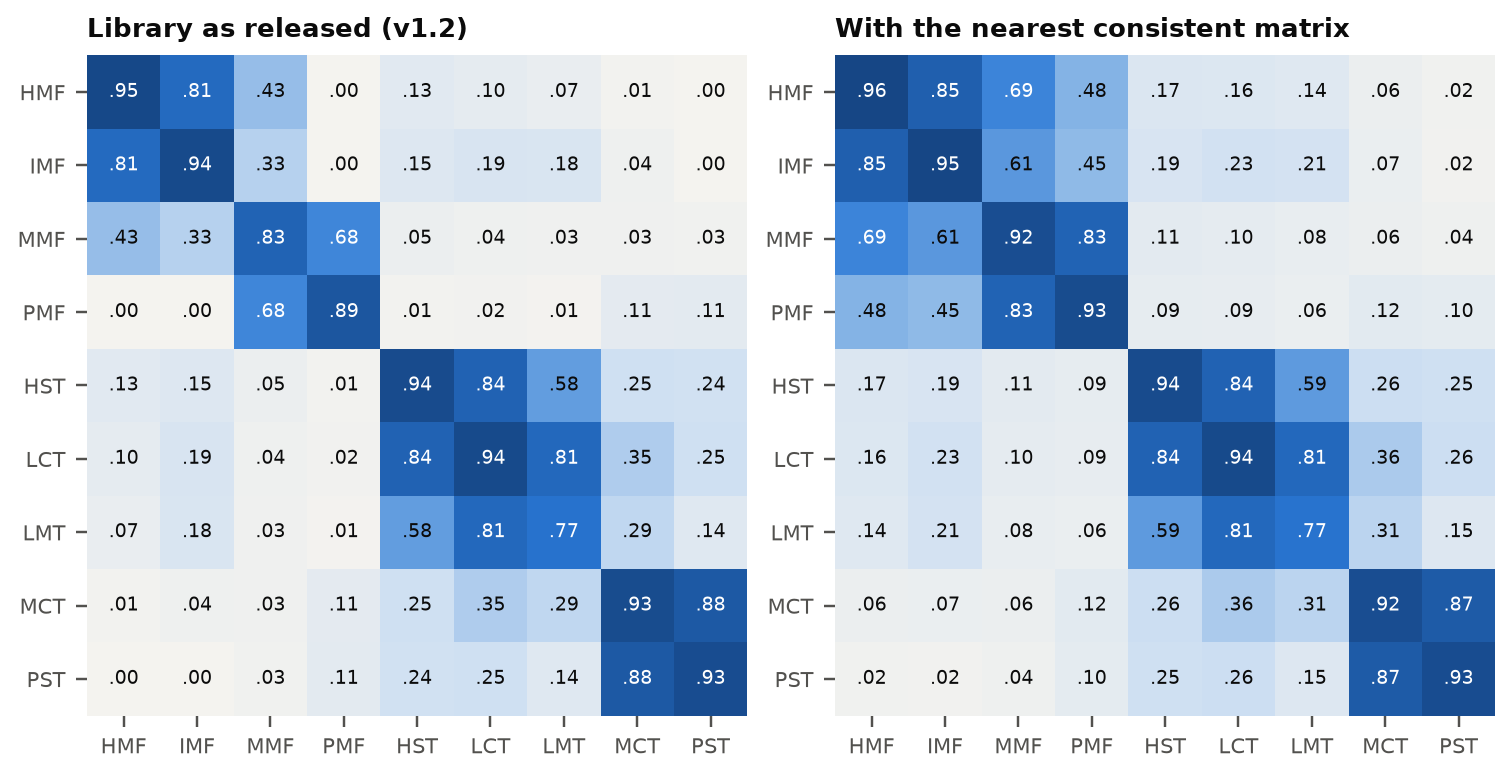
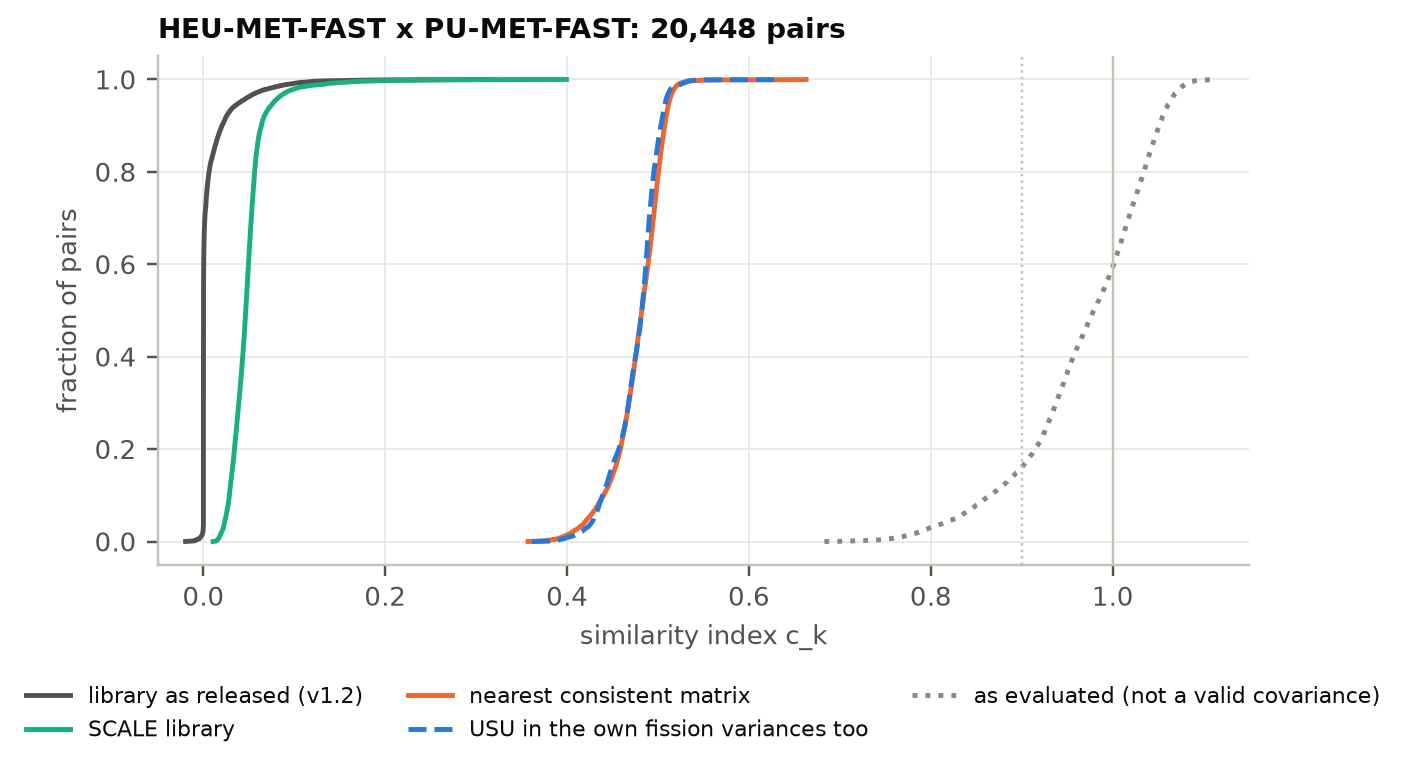
With the libraries as released, the nuclear-data errors of a fast uranium system and a fast plutonium system are almost independent: their uncertainties come from different nuclides, and no block connects U-235 or U-238 with Pu-239 fission. The median ck between the 20,448 pairs of HEU-MET-FAST and PU-MET-FAST configurations is 0.00 (Figure 3, Figure 4, Table 7). With the nearest consistent matrix it is 0.48 (5–95 %: 0.42–0.51), and with the USU in the own covariances 0.48: the two categories then share a large part of their nuclear-data uncertainty, through the common uncertainty of the fission standards. The other pairs of fast categories move in the same way: HEU-MET-FAST with MIX-MET-FAST, IEU-MET-FAST with PU-MET-FAST, MIX-MET-FAST with PU-MET-FAST. Thermal categories move little, except with the USU in the own covariances, which correlates every system sensitive to U-235 fission with every other.
Taken as evaluated, the blocks give a median of 0.98 for the same pairs, and 12,017 pairs of configurations above 1, up to 1.83 (Table 6; the median change over all pairs is +0.007 with every treatment except the USU in the own covariances, +0.03). A correlation cannot exceed 1. These values show what an inconsistent covariance does in a similarity assessment: it makes systems look more alike than any consistent assignment of uncertainties allows. SCALE's library, with consistent U-235/U-238/Pu-239 fission correlations of up to 0.63 but no fully correlated common component, gives 0.05.
Over all pairs, the nearest consistent matrix changes ck by more than 0.1 for 92,189 pairs of the four million, but moves few across the threshold of 0.9 (7,921 pairs reach it and 11,623 fall below it, out of 747,343): of the pairs whose ck rises by more than 0.1, 97 % combine two different fissile materials, and their median goes from 0.03 to 0.38, still far below the threshold. The pairs that cross it in either direction were already close to 0.9. The USU in the own covariances adds 323,301 pairs above 0.9.
Table 6. The similarity index over all 4,039,903 pairs of configurations: pairs with ck ≥ 0.9, the usual threshold for a benchmark to count as similar to an application, and pairs above 1, which a valid covariance cannot give.
| Covariances | Pairs ≥ 0.9 before | Pairs ≥ 0.9 after | New | Lost | Changes > 0.1 | Pairs > 1 |
|---|---|---|---|---|---|---|
| As evaluated | 747,343 | 780,374 | 40,180 | 7,149 | 156,430 | 12,017 |
| Nearest consistent | 747,343 | 743,641 | 7,921 | 11,623 | 92,189 | 45 |
| USU in own | 747,343 | 1,070,317 | 323,301 | 327 | 1,049,287 | 30 |
| SCALE's cross blocks | 596,480 | 596,525 | 101 | 56 | 0 | 0 |
“Before”: the AMPX-route library for the first three rows, SCALE's library without its cross-nuclide blocks for the last. The AMPX-route library itself gives 45 pairs above 1 (at most 1.0003), from small negative eigenvalues of some of its own blocks.
Table 7. Median similarity index ck between (and within) categories.
| Categories | Library (v1.2) | As evaluated | Nearest consistent | USU in own | SCALE, no cross | SCALE |
|---|---|---|---|---|---|---|
| HEU-MET-FAST × PU-MET-FAST | 0.00 | 0.98 | 0.48 | 0.48 | 0.00 | 0.05 |
| IEU-MET-FAST × PU-MET-FAST | 0.00 | 0.79 | 0.45 | 0.42 | 0.00 | 0.03 |
| HEU-MET-FAST × MIX-MET-FAST | 0.43 | 0.95 | 0.69 | 0.70 | 0.64 | 0.65 |
| MIX-MET-FAST × PU-MET-FAST | 0.68 | 0.88 | 0.83 | 0.87 | 0.39 | 0.41 |
| HEU-MET-FAST × IEU-MET-FAST | 0.81 | 0.84 | 0.85 | 0.89 | 0.79 | 0.79 |
| HEU-MET-FAST (within) | 0.95 | 0.95 | 0.96 | 0.97 | 0.95 | 0.95 |
| PU-MET-FAST (within) | 0.89 | 0.89 | 0.93 | 0.95 | 0.69 | 0.69 |
| LEU-COMP-THERM × MIX-COMP-THERM | 0.35 | 0.37 | 0.36 | 0.25 | 0.25 | 0.26 |
| LEU-COMP-THERM (within) | 0.94 | 0.94 | 0.94 | 0.96 | 0.92 | 0.92 |
Every category pair is in icsbep_cross_nuclide_ck_categories_v1.csv.
5. Discussion
For the uncertainty of one system, the cross-nuclide covariances in today's 56-group libraries, ENDF/B-VIII.1 as processed and SCALE's, are negligible. The left-out ENDF/B-VIII.1 fission correlations would matter for fast systems that combine U-235 with Pu-239 or U-238: a few tenths of a percentage point for fast mixed uranium–plutonium metal systems, and less for fast HEU and IEU systems. Thermal systems, which are most of the Handbook, are not affected unless the 1.2 % USU is taken to apply to every fission cross section.
For similarity, they matter more, because they decide whether a uranium system and a plutonium system share any nuclear-data uncertainty at all. With the libraries as released, a fast HEU benchmark carries almost no information about the data uncertainty of a fast plutonium system, and the reverse; with the standards' correlations it carries a substantial amount. This bears on validation with similarity indices, where benchmarks of one fissile material are sometimes used for applications of another, and still more on data adjustment (generalised linear least squares, as in SCALE's TSURFER), which transfers information between nuclides through exactly these blocks.
What the evaluation should say. The cross-covariances of the U-235 file and the own covariances of U-235, U-238 and Pu-239 fission do not form a covariance matrix. The three treatments here bracket what a consistent version could give, but none of them is the evaluators' intent, which only a revised evaluation can state: either the 1.2 % USU belongs to the fission data, and then to the own covariances too, or it does not, and then not to the cross-covariances either. As CSEWG put it in 2010, “evaluated covariances must be reasonable, which implies that they must at least be positive semi-definite and be consistent with relevant experimental information” [12]. The same holds for the cross-material ν̄ covariances that the U-235 file's description announces and that the file does not contain.
Limitations. The analysis is first order. The sensitivities were calculated with ENDF/B-VII.0 data and SCALE 6.0, so they are only first-order consistent with ENDF/B-VIII.1 covariances. The left-out blocks were processed by the NJOY route and combined with the AMPX-route library; the two routes agree closely for these fission covariances [3]. The nearest consistent matrix repairs only the three fission reactions, not the other blocks of these nuclides, and is one of many consistent matrices near the evaluated data. No configuration here contains U-233, so the U-233 blocks were not tested.
6. Conclusions
- ENDF/B-VIII.1 gives 13 cross-material covariance subsections, in the files of U-233, U-235 and Au-197. Three of them, U-235 fission × U-238 fission, U-235 fission × Pu-239 fission and U-233 fission × Pu-240 fission, imply correlations up to 15.7 with the nuclides' own covariances, because a fully correlated 1.2 % USU was added to the cross-covariances only; the 56-group libraries of release v1.2 leave them out.
- The cross-nuclide blocks those libraries keep, and those of SCALE's library, change the keff uncertainty of no ICSBEP configuration by more than 0.016 percentage points.
- Treated consistently, the left-out fission correlations would raise fast mixed uranium–plutonium metal systems by a median 0.23 percentage points (about 36 %), fast plutonium by 0.18 and fast HEU by 0.08, and thermal systems by at most 0.03.
- They change similarity far more: the median ck between fast HEU and fast plutonium metal systems goes from 0.00 to 0.48. Taken as evaluated they give 0.98 and 12,017 values of ck above 1.
- A consistent statement of the standards' correlations in the evaluation, own and cross covariances together, would settle which of these values applies.
Acknowledgements
The covariance libraries and their NJOY route are those of the companion project [13]; the ENDF/B-VII.1 library is the one distributed with SAUNA.
About the authors and the status of this work
Claude is an AI model developed by Anthropic. Ian Hill created the DICE sensitivity profiles used, provided the original SCALE 6.0 calculations they come from, proposed the study and directed the work. Claude wrote the analysis code, reprocessed the left-out covariance blocks, ran the calculations, made the figures and tables, and wrote this article. The article has not been peer reviewed, and the results have not been independently reviewed or verified. Anthropic has not reviewed or endorsed this work. Readers should check the results before relying on them.
Data and code availability
The uncertainty of every configuration with the four libraries and the three treatments, the change due to each library's own cross-nuclide blocks, and the fission sensitivities of U-235, U-238 and Pu-239 are in icsbep_cross_nuclide_v1.csv; the median similarity index between every pair of categories, with the fraction of pairs at 0.9 or above, is in icsbep_cross_nuclide_ck_categories_v1.csv. The ENDF/B-VIII.1 covariance libraries are release v1.2 of the companion project [13], whose NJOY route, with its cross-material modification switched off, gives the left-out blocks. The sensitivity profiles are DICE's [2]; SCALE's own covariance library is distributed with SCALE and is not redistributed here.
References
- [1]International Handbook of Evaluated Criticality Safety Benchmark Experiments, NEA/NSC/DOC(95)03, OECD Nuclear Energy Agency.
- [2]DICE: Database for the International Criticality Safety Benchmark Evaluation Project Handbook, User's Manual, OECD Nuclear Energy Agency, https://www.oecd-nea.org/science/wpncs/icsbep/documents/DICE_users_manual.pdf.
- [3]Claude and Ian Hill, “ENDF/B-VIII.1 neutron covariances in the SCALE 56-group structure: two processing routes, NJOY and AMPX, and their effect on criticality uncertainties”, preprint, https://hardtohit10.gitlab.io/cov56-paper.html (2026), https://doi.org/10.5281/zenodo.23245168.
- [4]Claude and Ian Hill, “Nuclear-data uncertainty of keff for 2,843 ICSBEP configurations with ENDF/B-VIII.1 covariances”, preprint, https://hardtohit10.gitlab.io/icsbep-uncertainty-paper.html (2026), https://doi.org/10.5281/zenodo.23245174.
- [5]National Nuclear Data Center, ENDF/B-VIII.1 evaluated nuclear data library, Brookhaven National Laboratory, https://www.nndc.bnl.gov/endf-releases/.
- [6]A.D. Carlson et al., “Evaluation of the Neutron Data Standards”, Nuclear Data Sheets 148 (2018) 143–188.
- [7]A. Trkov, M. Herman, D.A. Brown (Eds.), ENDF-6 Formats Manual, CSEWG Document ENDF-102, BNL-203218-2018-INRE, Brookhaven National Laboratory (2018).
- [8]“SCALE Nuclear Data Covariance Library”, section 10.3 of the SCALE Code System manual, Version 6.3.1, Oak Ridge National Laboratory, https://scale-manual.ornl.gov/6.3.1/COVLIB.html.
- [9]SAUNA, a Python package for sensitivity and uncertainty analysis, https://github.com/AARyzhkov/sauna.
- [10]B.L. Broadhead, B.T. Rearden, C.M. Hopper, J.J. Wagschal, C.V. Parks, “Sensitivity- and Uncertainty-Based Criticality Safety Validation Techniques”, Nuclear Science and Engineering 146 (2004) 340–366.
- [11]N.J. Higham, “Computing a nearest symmetric positive semidefinite matrix”, Linear Algebra and its Applications 103 (1988) 103–118.
- [12]Minutes of the 60th CSEWG meeting, Santa Fe, November 2010, p. 32 (summary by D. Muir of the IAEA Technical Meeting on Neutron Cross-Section Covariances, Vienna, September 2010), https://www.nndc.bnl.gov/meetings/nuclear-data-week-2010/CSEWG-Minutes-2010.pdf.
- [13]ENDF/B-VIII.1 covariances in SCALE's 56 groups, code, documentation and releases v1.0–v1.2, https://gitlab.com/hardtohit10/endfb81-cov56.