Preprint · not peer reviewed
Similarity of a CANDU-6 lattice cell to criticality benchmarks for k-infinity and coolant void reactivity
Continuous-energy sensitivities from OpenMC, ENDF/B-VIII.1 covariances, and 2,843 ICSBEP configurations
An AI model developed by Anthropic. This article was written by Claude; it has not been reviewed or endorsed by Anthropic.
Posted 8 October 2026 · Calculations performed 7 October 2026
Abstract
A collision-history estimator of continuous-energy sensitivity coefficients of k, weighted by a fission-matrix estimate of the fission-source importance, was added to OpenMC 0.16.0. On Godiva it agrees with a direct perturbation of the U-235 density (0.8050 against 0.7976 ± 0.0067) and with TSUNAMI-3D's fission, ν̄ and capture sensitivities within 2 %, and the importance weighting proves necessary. Applied to a CANDU-6 37-element natural-uranium lattice cell with ENDF/B-VIII.1 data, it gives the sensitivities of k∞ in the cooled (1.12531) and voided (1.14636) states and of the coolant void reactivity, CVR = 16.32 ± 0.13 mk. With ENDF/B-VIII.1 covariances processed by AMPX, the nuclear-data uncertainty is 0.81 % Δk/k for k∞ and 2.5 % of the CVR (0.40 mk), against 1.09 % and 3.2 % with ENDF/B-VII.1. The largest single contributor to the CVR, and the second largest to k∞, is H-2 (n,2n), whose evaluated relative uncertainty exceeds 100 % just above its threshold. None of 2,843 ICSBEP configurations reaches ck = 0.9 with the k∞ of the lattice. The most similar is a heavy-water-moderated low-enriched uranium metal lattice (LMT001-001, 0.853), and 35 configurations exceed 0.7. Of four IRPhE heavy-water lattices, a ZED-2 configuration is the most similar, at 0.89–0.93 depending on the covariance library. No benchmark's k is strongly correlated with the CVR. The correlations lie between −0.33 and +0.05 for the ICSBEP configurations and reach −0.41 for ZED-2, so a single benchmark of k can reduce the nuclear-data uncertainty of the CVR by at most 9 %.
Keywords: CANDU; coolant void reactivity; sensitivity and uncertainty analysis; similarity index ck; OpenMC; continuous-energy Monte Carlo; ICSBEP; IRPhE; ENDF/B-VIII.1; nuclear data covariances
1. Introduction
Calculations of a power reactor are validated against experiments that resemble it, and for criticality and reactor-physics codes "resemble" has a quantitative form: two systems are alike, for the purpose of nuclear-data validation, when their calculated responses depend on the same nuclear data in the same way. The similarity index ck [1] measures this as the correlation between the nuclear-data errors of two responses, computed from their sensitivity profiles and a covariance library. It is used to choose the benchmarks that validate an application and, through data assimilation, to estimate the application's bias.
For a CANDU reactor two responses matter most: the multiplication of the natural-uranium, heavy-water-moderated lattice, and the coolant void reactivity (CVR), the change of reactivity when the heavy-water coolant of the fuel channels is lost, which is positive in CANDU and is a central quantity of its safety analysis. The ICSBEP Handbook [2] contains few heavy-water systems and none like a power-reactor lattice; the IRPhE Handbook [3] contains heavy-water lattice experiments. A companion paper [4] computed the nuclear-data uncertainty of keff for 2,843 ICSBEP configurations from the sensitivity profiles of DICE, the Handbook's database, with ENDF/B-VIII.1 covariances processed in SCALE's 56 groups [5]. This paper uses the same profiles and covariances to ask how similar each of those configurations, and four IRPhE heavy-water lattices, is to a CANDU-6 lattice cell, for k∞ in the cooled and voided states and for the CVR.
The CANDU sensitivities are computed here with continuous-energy (CE) Monte Carlo. The released OpenMC 0.16.0 [6] has differential tallies for density and temperature but no sensitivities of k to nuclear data, so a collision-history estimator weighted by the fission-source importance, of the kind used in SCALE's CE TSUNAMI [7], was added to it (392 lines; the patch is published with this paper). Section 2 describes the method and Section 3 its verification; Sections 4 and 5 give the CANDU model and the results.
2. Method
2.1 Sensitivity of k in continuous energy
The relative sensitivity of k to a nuclear-data parameter x (the cross section of one reaction of one nuclide in one energy group, ν̄, or the fission spectrum χ in one group) is
Let F*(r) be the importance of a fission neutron born at r: the expected number of its descendants in a late generation, relative to the average over the fission source (the iterated fission probability). Because F* is the adjoint of the fission source, first-order perturbation theory gives the relative change of k as the relative change of the F*-weighted production of fission neutrons per source neutron, with the source held fixed. The change of that expectation is estimated from the histories themselves (a differential-operator, or likelihood-ratio, estimator): along each history a derivative Rx accumulates
- −Nj σx,j(E) ℓ for every flight of length ℓ through a material containing the nuclide j of x at density Nj, with the neutron's energy E in the group of x;
- +1 at every collision at which reaction x of nuclide j is sampled (scattering, inelastic scattering, (n,2n)), counted after the neutrons of that collision are produced;
- +1 at the start of the history for χ of the nuclide whose fission produced the neutron, in its birth group.
OpenMC creates fission sites at every collision with a fissionable nuclide, their number Pc at collision c sampled with mean w ν̄σf/(σt k) for that nuclide and the neutron's weight w. The sensitivity is then
summed over the collisions of all active histories, where Rx,c is the derivative accumulated up to collision c and δx,c = 1 when x is the fission cross section or ν̄ of the producing nuclide in the group of the collision energy (production is proportional to both). The χ sensitivity is constrained to keep χ normalised, S′χ,g = Sχ,g − χg Σh Sχ,h, with χg the nuclide's share of births in group g.
F* is taken constant in each fuel cell and obtained beforehand from a fission matrix [8]: a run with an OpenMC tally of ν-fission by birth cell and by cell gives Aj′j, the fission neutrons produced in cell j′ per neutron born in cell j, whose dominant left eigenvector is F*. The reactions are elastic scattering, inelastic scattering (all scattering except elastic and (n,2n)), (n,2n), fission, capture (all absorption except fission, (n,p) and (n,α)), (n,p), (n,α), total ν̄ and χ. For a nuclide with thermal-scattering data, scattering below the S(α,β) cut-off is counted as elastic, as in multigroup sensitivity codes. Each batch gives one estimate of Eq. (2); the quoted statistical uncertainties are the standard deviations of the batch means. The implementation is one new source file, with calls from a few places in OpenMC's transport and batch loops. It is switched on by an environment variable that names a configuration file (group structure, nuclides, cell importances) and writes the sensitivities in SCALE's 238 groups.
2.2 Coolant void reactivity
With kc and kv the multiplication of the cooled and voided lattice,
The relative sensitivity of a reactivity difference can be large, since the difference is small; it is the change in CVR, as a fraction of CVR, per fractional change of x. A uniform change of all ν̄ by a factor changes both k by that factor and the CVR by its inverse, so the ν̄ sensitivities of the CVR sum to about −1.
2.3 Uncertainty and similarity
The first-order relative uncertainty of a response, and the similarity of two responses a and b, are
with C a relative covariance library in SCALE's 56 groups and S the sensitivities by nuclide, reaction and group, collapsed from 238 to 56 groups as in the companion paper (the ten 238-group bins that straddle a 56-group boundary are split in proportion to lethargy) [4]. Applied to the CVR and a benchmark's k, ck is the correlation between the nuclear-data error of the CVR and that of the benchmark's k. This is what a benchmark can contribute to the CVR in a data assimilation. The four libraries are those of the companion paper: ENDF/B-VIII.1 processed by AMPX and by NJOY (release v1.2 [5]), SCALE's 56-group library and an ENDF/B-VII.1 library. ENDF/B-VIII.1 processed by AMPX is the reference. The NJOY library mis-processes the R-matrix covariances of nine nuclides [4], none of which is in the CANDU cell, but which inflate the NJOY uncertainty of 147 ICSBEP configurations and so lower their ck.
In a few groups that straddle a reaction threshold, the libraries give relative standard deviations of 102 to 108: O-16 (n,n′) at 4.3–6.43 MeV, B-10 (n,n′) at 0.75–1.2 MeV, Ni-62 (n,α) and, in the ENDF/B-VII.1 library, Si-29 (n,p). These are relative to a group cross section that is nearly zero. They multiply whatever sensitivity a profile has in those groups. DICE's profiles have none there, and removing these groups changes no ICSBEP uncertainty by even 0.001 percentage points. The IRPhE profiles converted from MCNP6 do carry numerical noise there, though: −3×10⁻¹⁰ for O-16 (n,n′) in ZED-2 gives that benchmark 8.6 % Δk/k with the NJOY library. The rows and columns of every group with a relative standard deviation above 100 (10,000 %) are therefore set to zero. SCALE's library has no such groups.
2.4 Statistical uncertainty
Statistical noise in S adds on average Σ Cgg ug2 to Eq. (4)'s variance, summed over reactions and groups, with ug the standard deviation of Sg. This noise floor is reported with each uncertainty. The statistical uncertainty of the uncertainties and of the ck values is estimated by repeating them 30 times with each group sensitivity of the CANDU responses perturbed by a normal deviate of its standard deviation. For the CVR the cooled and voided runs are independent and uCVR,g = [(uv,g/kv)2 + (uc,g/kc)2]1/2/|CVR|. The statistical uncertainties of the DICE profiles are not propagated.
3. Verification on Godiva
The estimator was first applied to Godiva (HEU-MET-FAST-001), a bare sphere of highly enriched uranium. Godiva is a severe test of the importance weighting, since the importance of a fission neutron falls by a factor of four from the centre to the surface. The sphere (radius 8.7407 cm, ENDF/B-VIII.1 at 293.6 K) was divided into ten shells of equal volume for F*. The sensitivity run used 20,000 neutrons per batch and 120 batches, of which 20 were inactive. The reference is a TSUNAMI-3D-K5 calculation (SCALE 6.0 [9], 238-group ENDF/B-VII.0 data, 1,000 active generations of 20,000 neutrons), so the comparison includes differences of code, data and group treatment.
Table 1. Godiva (HEU-MET-FAST-001): integrated k sensitivities of U-235 from the patched OpenMC (ENDF/B-VIII.1) with the fission-matrix importance F* and with F* = 1, from TSUNAMI-3D (SCALE 6.0, ENDF/B-VII.0, 238 groups), and the cosine between the OpenMC and TSUNAMI-3D group profiles. OpenMC values ± one batch standard deviation.
| Reaction | OpenMC, F* | OpenMC, F* = 1 | TSUNAMI-3D | Profile cosine |
|---|---|---|---|---|
| elastic | +0.1089 ± 0.0015 | +0.0971 | +0.1046 | 0.9957 |
| (n,n′) | +0.0802 ± 0.0008 | +0.0694 | +0.0869 | 0.9855 |
| (n,2n) | +0.0022 ± 0.0001 | +0.0020 | +0.0020 | 0.9949 |
| fission | +0.6531 ± 0.0007 | +0.6483 | +0.6523 | 0.9996 |
| capture | −0.0394 ± 0.0001 | −0.0395 | −0.0401 | 0.9975 |
| ν̄ | +0.9824 ± 0.0009 | +0.9824 | +0.9824 | 0.9998 |
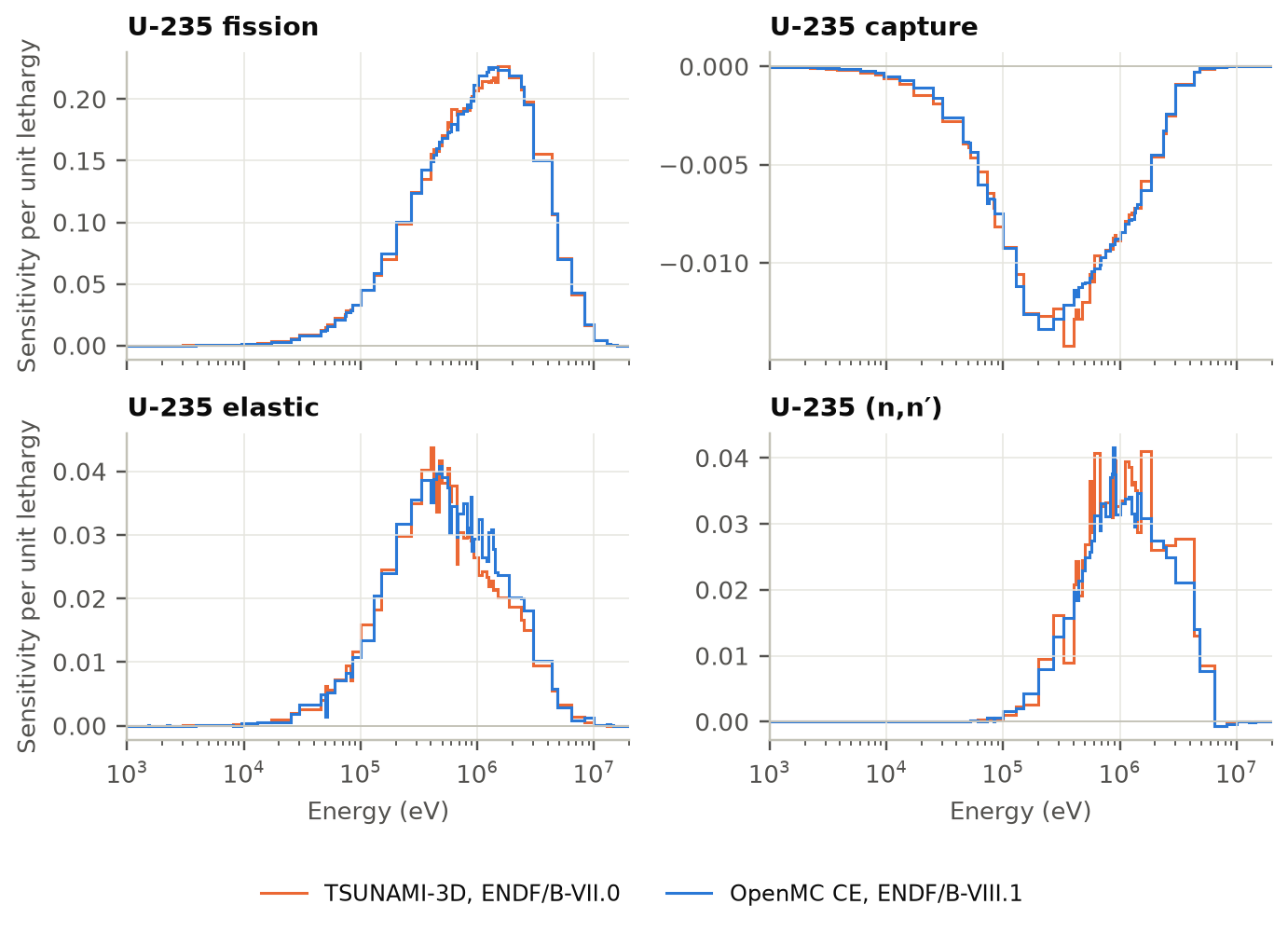
Fission, ν̄ and capture agree with TSUNAMI-3D to within 2 %, with profile cosines of 0.997 and more (Table 1, Figure 1). Elastic and inelastic scattering differ by +4 % and −8 % and (n,2n) by +10 % of a small value, while elastic plus inelastic differs by only 1 % and the profile cosines are still 0.996 and 0.986. The two calculations use different evaluations of U-235 (ENDF/B-VII.0 and ENDF/B-VIII.1), and differences in how the scattering is split between reactions are the likely cause. The direct perturbation (Table 2) is the sharper test, since it uses the same code and data. Scaling the U-235 density by ±5 % gives 0.7976 ± 0.0067, against 0.8050 for the sum of the U-235 reaction sensitivities. Without the importance (F* = 1) the sum is 0.7773, three standard deviations too low, because scattering then loses much of its effect, which comes from moving neutrons between regions of different importance: elastic scattering falls from 0.109 to 0.097 and inelastic from 0.080 to 0.069. The importance weighting is therefore needed, and the fission-matrix F* is accurate enough for it.
4. The CANDU-6 lattice cell
The model is the standard CANDU-6 cell of 37-element natural UO2 fuel, with the dimensions, compositions, densities and temperatures of test case TCWU05 distributed with the lattice code DRAGON 5.1 [10]. The pellets (radius 0.6122 cm) sit in Zircaloy sheaths in rings of 1, 6, 12 and 18 elements, and the coolant is 99.22 at.% heavy water at 560.7 K and 0.812 g/cm3. Around it are the Zr–2.5Nb pressure tube, a helium gas annulus, the Zircaloy calandria tube, and 99.91 at.% heavy-water moderator at 345.7 K in a square cell of 28.575 cm pitch. The fuel is at 941.3 K. The cell is two-dimensional with reflective boundaries, so its multiplication is k∞. In the voided state the coolant density is 0.001 g/cm3 and nothing else changes. The nuclear data are ENDF/B-VIII.1 in OpenMC's format, with thermal scattering for D and O in D2O and H in H2O in the coolant and the moderator.
Each state was run with 100,000 neutrons per batch and 600 batches, 100 of them inactive. The importance F* was obtained per fuel element from a fission matrix (50,000 neutrons, 150 batches) and averaged over the elements of each ring, which are equivalent by symmetry. It is nearly flat: the ring means are 1.003, 1.004, 1.000 and 0.999 from the centre outwards when cooled, and 1.007, 1.005, 1.002 and 0.998 when voided. That is expected in an infinite lattice in which every fission neutron's chain spreads over the whole bundle. The sensitivities were checked by direct perturbation of four nuclides with 50,000 neutrons per batch and 350 batches (Table 2).
Table 2. Direct perturbation: the sensitivity of k to a nuclide's atom density (central difference, ±h) against the sum of the nuclide's reaction sensitivities (all cross sections, not ν̄ or χ), for Godiva and for the CANDU-6 cell (cooled).
| System | Nuclide | h | Direct | Sum of reaction sensitivities | With F* = 1 |
|---|---|---|---|---|---|
| Godiva | U-234 | 5 % | +0.0029 ± 0.0065 | +0.0073 | +0.0069 |
| U-235 | 5 % | +0.7976 ± 0.0067 | +0.8050 | +0.7773 | |
| U-238 | 5 % | +0.0209 ± 0.0072 | +0.0177 | +0.0160 | |
| CANDU-6 | U-235 | 5 % | +0.3711 ± 0.0027 | +0.3666 ± 0.0002 | — |
| U-238 | 5 % | −0.3792 ± 0.0026 | −0.3758 ± 0.0004 | — | |
| H-2 | 10 % | +0.0543 ± 0.0013 | +0.0541 ± 0.0019 | — | |
| O-16 | 10 % | −0.0219 ± 0.0013 | −0.0206 ± 0.0013 | — |
For all four nuclides the direct sensitivity agrees with the sum of the reaction sensitivities within 1.7 combined standard deviations (the largest difference, for U-235). This includes the small sensitivities of H-2 (+0.054, mostly elastic scattering) and O-16 (−0.021, elastic scattering and (n,α)).
5. Results
5.1 k∞, void reactivity and their sensitivities
The cell has k∞ = 1.12531 ± 0.00012 cooled and 1.14636 ± 0.00012 voided, a coolant void reactivity of 16.32 ± 0.13 mk. Table 3 lists the integrated sensitivities of the leading reactions, and Figure 2 and Figure 3 show profiles.
Table 3. Integrated sensitivities of the CANDU-6 cell: k∞ cooled and voided, and the coolant void reactivity (CVR), for the reactions with the largest values (± one standard deviation, from the batch statistics).
| Nuclide | Reaction | k∞, cooled | k∞, voided | CVR |
|---|---|---|---|---|
| U-235 | ν̄ | +0.9495 ± 0.0002 | +0.9452 ± 0.0002 | −1.180 ± 0.014 |
| U-235 | fission | +0.4549 ± 0.0002 | +0.4503 ± 0.0002 | −0.701 ± 0.013 |
| U-238 | capture | −0.4002 ± 0.0001 | −0.3937 ± 0.0001 | +0.751 ± 0.004 |
| U-235 | capture | −0.0882 ± 0.0000 | −0.0881 ± 0.0000 | +0.095 ± 0.001 |
| H-2 | elastic | +0.0576 ± 0.0019 | +0.0741 ± 0.0018 | +0.826 ± 0.140 |
| U-238 | ν̄ | +0.0505 ± 0.0000 | +0.0548 ± 0.0000 | +0.180 ± 0.003 |
| U-238 | fission | +0.0295 ± 0.0000 | +0.0316 ± 0.0000 | +0.084 ± 0.002 |
| Zr-91 | capture | −0.0283 ± 0.0000 | −0.0266 ± 0.0000 | +0.118 ± 0.000 |
| O-16 | elastic | −0.0149 ± 0.0013 | −0.0104 ± 0.0013 | +0.259 ± 0.097 |
| Zr-92 | capture | −0.0082 ± 0.0000 | −0.0077 ± 0.0000 | +0.033 ± 0.000 |
| H-2 | capture | −0.0061 ± 0.0000 | −0.0057 ± 0.0000 | +0.028 ± 0.000 |
| U-238 | (n,n′) | −0.0060 ± 0.0001 | −0.0061 ± 0.0001 | +0.003 ± 0.007 |
| O-16 | (n,α) | −0.0043 ± 0.0000 | −0.0042 ± 0.0000 | +0.007 ± 0.000 |
| Nb-93 | capture | −0.0042 ± 0.0000 | −0.0039 ± 0.0000 | +0.018 ± 0.000 |
| H-1 | capture | −0.0041 ± 0.0000 | −0.0033 ± 0.0000 | +0.044 ± 0.000 |
| B-10 | (n,α) | −0.0031 ± 0.0000 | −0.0030 ± 0.0000 | +0.013 ± 0.000 |
| H-2 | (n,2n) | +0.0026 ± 0.0000 | +0.0025 ± 0.0000 | −0.009 ± 0.001 |
| Zr-94 | capture | −0.0021 ± 0.0000 | −0.0020 ± 0.0000 | +0.008 ± 0.000 |
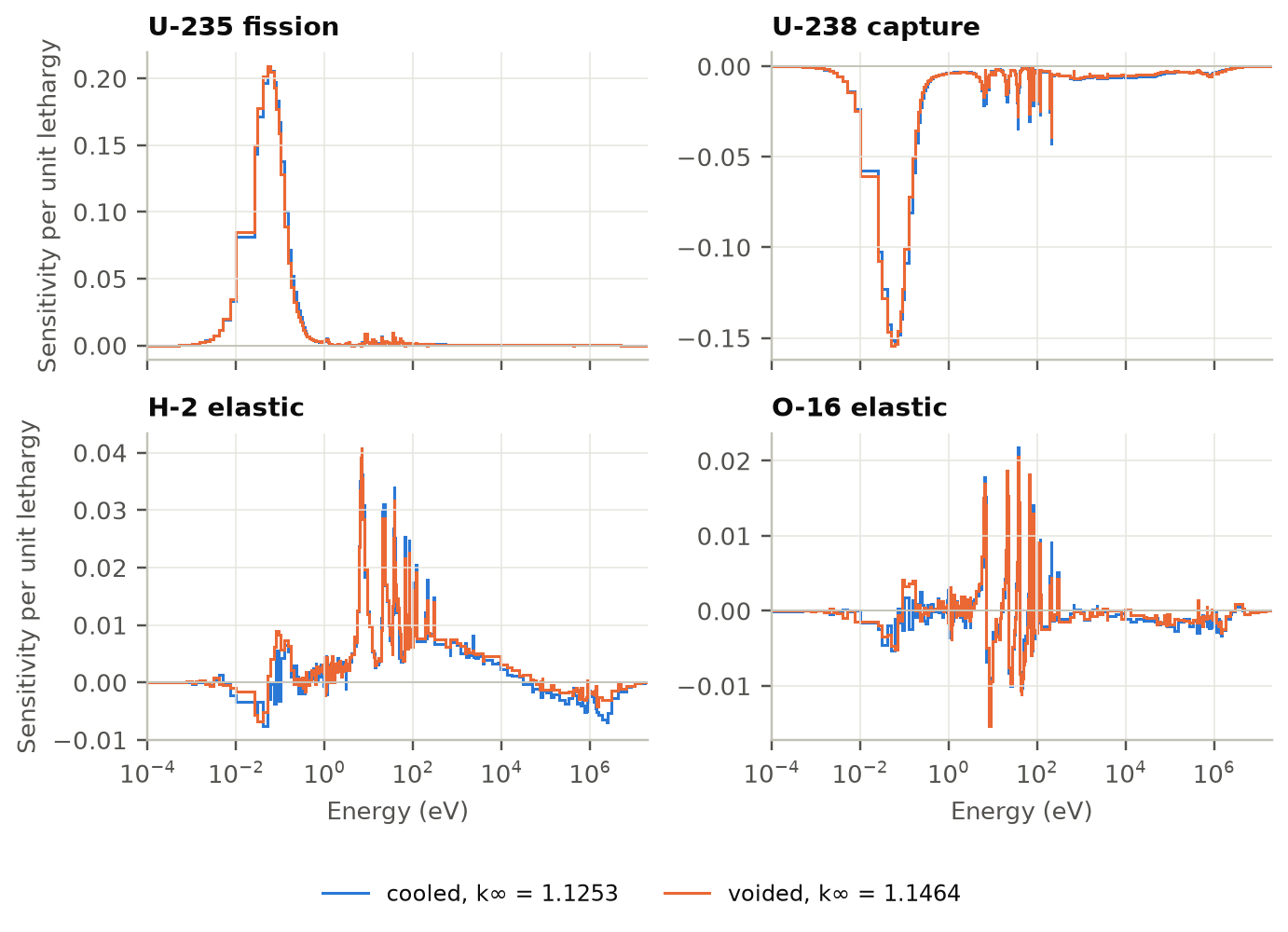
k∞ depends mainly on U-235 ν̄ and fission and on U-238 capture, as in any natural-uranium lattice. Of the moderator, H-2 elastic scattering has a sensitivity of only +0.058, since an infinite lattice loses no neutrons by leakage. Zirconium capture in the pressure and calandria tubes and sheaths adds −0.04. When the coolant is voided, H-2 elastic scattering in the moderator matters more (+0.074), and so does U-238 fission (+0.032 against +0.029), since fast neutrons are no longer moderated in the coolant. The large sensitivities change by 2 % or less.
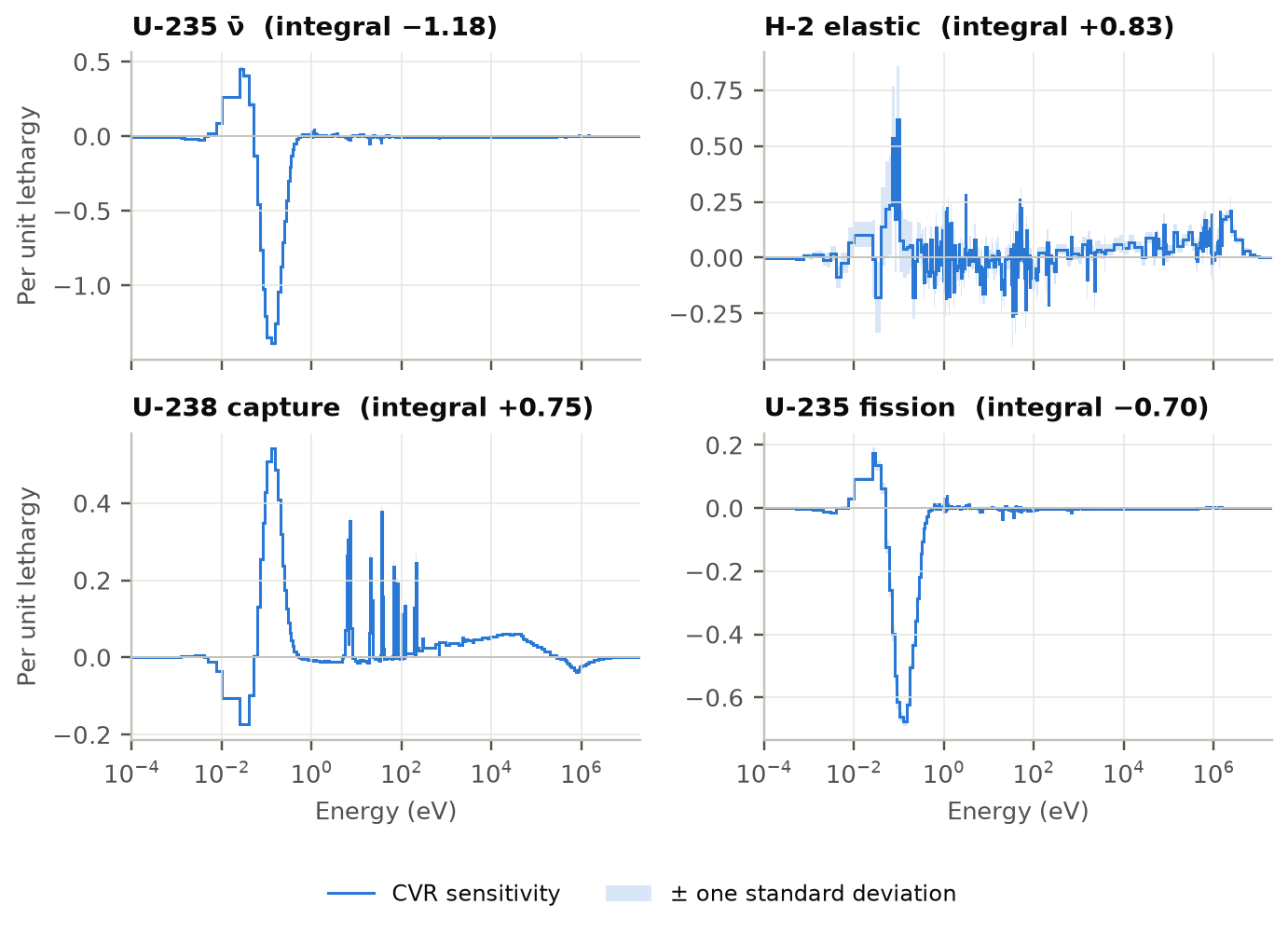
The CVR sensitivities are larger, because the CVR is a small difference. The ν̄ sensitivities of U-235 (−1.18) and U-238 (+0.18) add up to −1, as they must (Section 2.2). U-235 fission gives −0.70 and U-238 capture +0.75, mainly from the thermal range and the resolved resonances: more capture in U-238 means a larger void reactivity. H-2 elastic scattering gives +0.83 and Zr-91 capture +0.12. The H-2 elastic value is the difference of the two states' H-2 elastic sensitivities, each uncertain by ±0.002, divided by the CVR. It is therefore the least precise (±0.14), and much of its structure above 1 eV in Figure 3 lies within the statistical band.
5.2 Nuclear-data uncertainty
Table 4. Nuclear-data uncertainty of the CANDU-6 responses (one standard deviation) with the four covariance libraries of the companion paper [3].
| Covariance library | k∞ cooled (% Δk/k) | k∞ voided (% Δk/k) | CVR (% of CVR) | CVR (mk) |
|---|---|---|---|---|
| ENDF/B-VIII.1, AMPX route | 0.81 | 0.79 | 2.5 | 0.40 |
| ENDF/B-VIII.1, NJOY route | 0.80 | 0.79 | 2.2 | 0.36 |
| SCALE 56-group library | 0.90 | 0.89 | 2.8 | 0.45 |
| ENDF/B-VII.1 | 1.09 | 1.07 | 3.2 | 0.52 |
Groups at reaction thresholds with relative standard deviations above 10,000 % are left out (Section 2.3); they do not affect these values. The CVR is 16.32 mk.
With ENDF/B-VIII.1 the nuclear-data uncertainty of k∞ is 0.81 % Δk/k (AMPX route) and 0.80 % (NJOY route), against 0.90 % with SCALE's library and 1.09 % with ENDF/B-VII.1. The voided values are slightly lower. The CVR is uncertain by 2.5 % of its value, or 0.40 mk, with ENDF/B-VIII.1, and by 3.2 % (0.52 mk) with ENDF/B-VII.1. The two ENDF/B-VIII.1 routes differ for the CVR only through the O-16 elastic × (n,n′) block, which is present in the NJOY library and absent from the AMPX one [5].
Table 5. Leading terms of the uncertainty of k∞ (cooled, % Δk/k) and of the CVR (% of CVR): signed square root of each variance term (negative: the term reduces the total), ENDF/B-VIII.1 (AMPX route) and ENDF/B-VII.1.
| Response | Term | ENDF/B-VIII.1 | ENDF/B-VII.1 |
|---|---|---|---|
| k∞, cooled | U-235 ν̄ | +0.43 | +0.67 |
| H-2 (n,2n) | +0.38 | +0.33 | |
| U-238 capture | +0.37 | +0.65 | |
| Zr-91 capture | +0.25 | +0.25 | |
| Zr-92 capture | +0.23 | +0.23 | |
| U-235 fission | +0.22 | +0.16 | |
| H-2 elastic | +0.10 | +0.13 | |
| H-2 elastic × H-2 (n,2n) | — | −0.19 | |
| U-235 χ | +0.02 | +0.16 | |
| CVR | H-2 (n,2n) | +1.35 | +1.18 |
| H-2 elastic | +1.09 | +1.39 | |
| Zr-91 capture | +1.05 | +1.05 | |
| Zr-92 capture | +0.96 | +0.96 | |
| U-238 capture | +0.62 | +1.11 | |
| U-235 ν̄ | +0.53 | +0.84 | |
| U-235 fission | +0.39 | +0.26 | |
| H-2 elastic × H-2 (n,2n) | — | +1.46 |
—: the library has no covariance for this pair of reactions.
The contributions (Table 5) explain most of the difference between the libraries. ENDF/B-VIII.1's smaller U-235 ν̄ and U-238 capture uncertainties reduce the k∞ uncertainty by a quarter, as for the thermal ICSBEP systems [4]. Two contributors are particular to the heavy-water lattice. The first is H-2 (n,2n): its sensitivity is small (+0.003 for k∞, −0.008 for the CVR), but its evaluated relative standard deviation is 523 %, 132 % and 58 % in the first three 56-group bins above the 3.3 MeV threshold, in both routes and in ENDF/B-VII.1. That makes it the second contributor to k∞ (0.38 %) and the first to the CVR (1.3 % of CVR). SCALE's library, following its documented rule, limits relative standard deviations to 100 %. With the same limit, the ENDF/B-VIII.1 uncertainty of k∞ becomes 0.74 % and that of the CVR 2.2 %. The second is capture in Zr-91 and Zr-92 (0.25 and 0.23 % for k∞, 1.0 % each for the CVR), the same in all four libraries. The negative O-16 elastic term of the CVR (−0.26 %) is not physical: the evaluated O-16 elastic covariance of ENDF/B-VIII.1 contains isolated corrupted elements and is not positive semi-definite [5]. Setting its correlations beyond ±1 to zero changes the CVR uncertainty from 2.5 to 2.47 %.
The statistical noise of the CANDU sensitivities adds 0.005 % to the k∞ uncertainty and 0.39 % of CVR to the CVR uncertainty, when combined in quadrature (Section 2.4). The 30 repetitions give standard deviations of 0.002 % and 0.19 %. Both are small against the values in Table 4. Within the cell, the nuclear-data errors of k∞ cooled and voided are almost fully correlated (0.999), and that of the CVR is anticorrelated with them (−0.723). Data changes that raise k∞ tend to lower the void reactivity, chiefly through ν̄, which enters the CVR with the opposite sign.
5.3 Similarity of k∞ to the benchmarks
Table 6. Number of the ICSBEP configurations with ck at or above 0.9, 0.8 and 0.7, and the largest value, for the three CANDU-6 responses.
| Response | Library | ≥ 0.9 | ≥ 0.8 | ≥ 0.7 | Largest |
|---|---|---|---|---|---|
| k∞, cooled | ENDF/B-VIII.1, AMPX route | 0 | 1 | 35 | 0.853 |
| ENDF/B-VIII.1, NJOY route | 0 | 1 | 37 | 0.865 | |
| ENDF/B-VII.1 | 0 | 13 | 135 | 0.887 | |
| k∞, voided | ENDF/B-VIII.1, AMPX route | 0 | 1 | 35 | 0.869 |
| ENDF/B-VIII.1, NJOY route | 0 | 2 | 38 | 0.878 | |
| ENDF/B-VII.1 | 1 | 17 | 142 | 0.902 | |
| CVR | ENDF/B-VIII.1, AMPX route | 0 | 0 | 0 | 0.053 |
| ENDF/B-VIII.1, NJOY route | 0 | 0 | 0 | 0.037 | |
| ENDF/B-VII.1 | 0 | 0 | 0 | 0.319 |
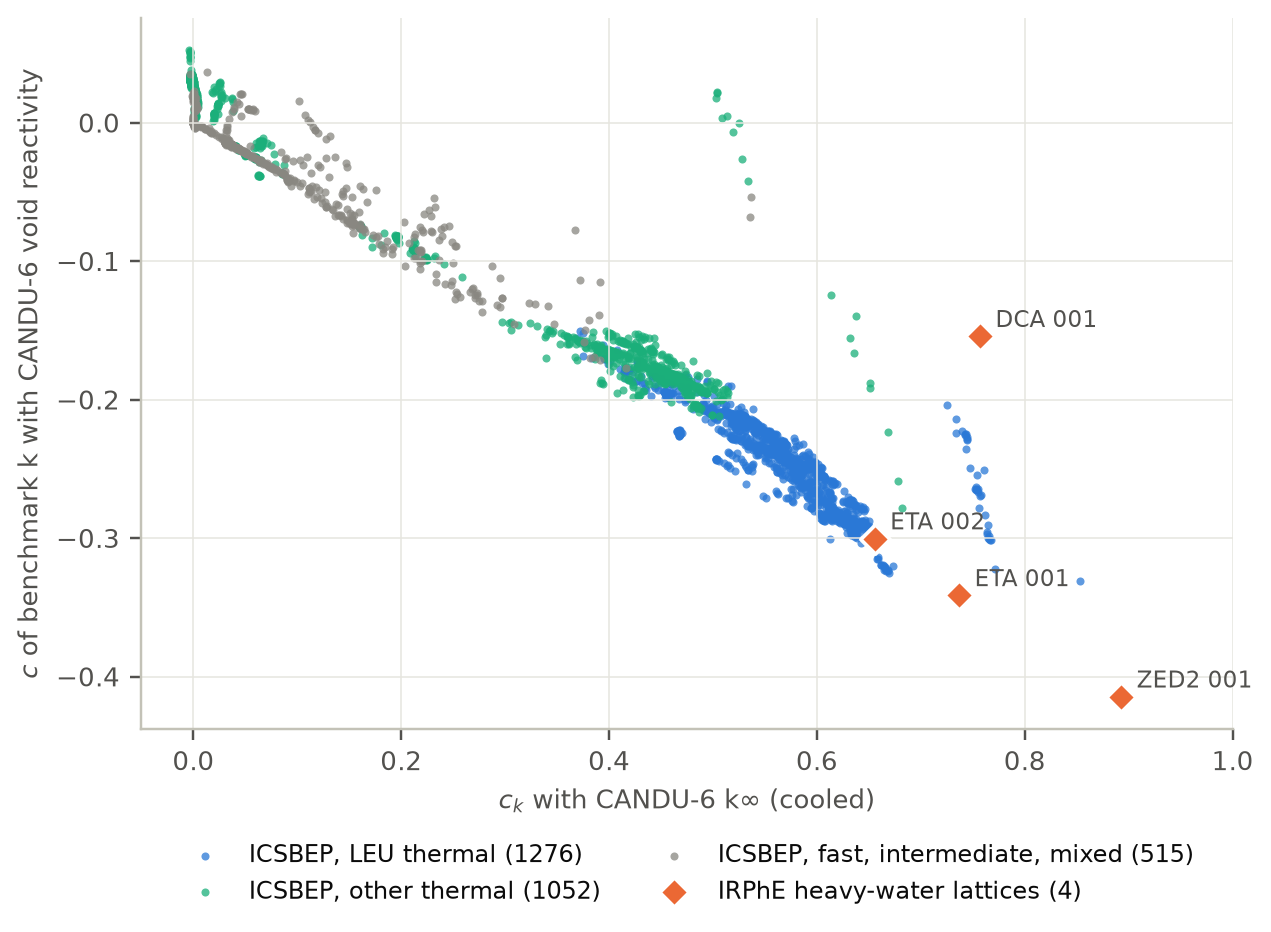
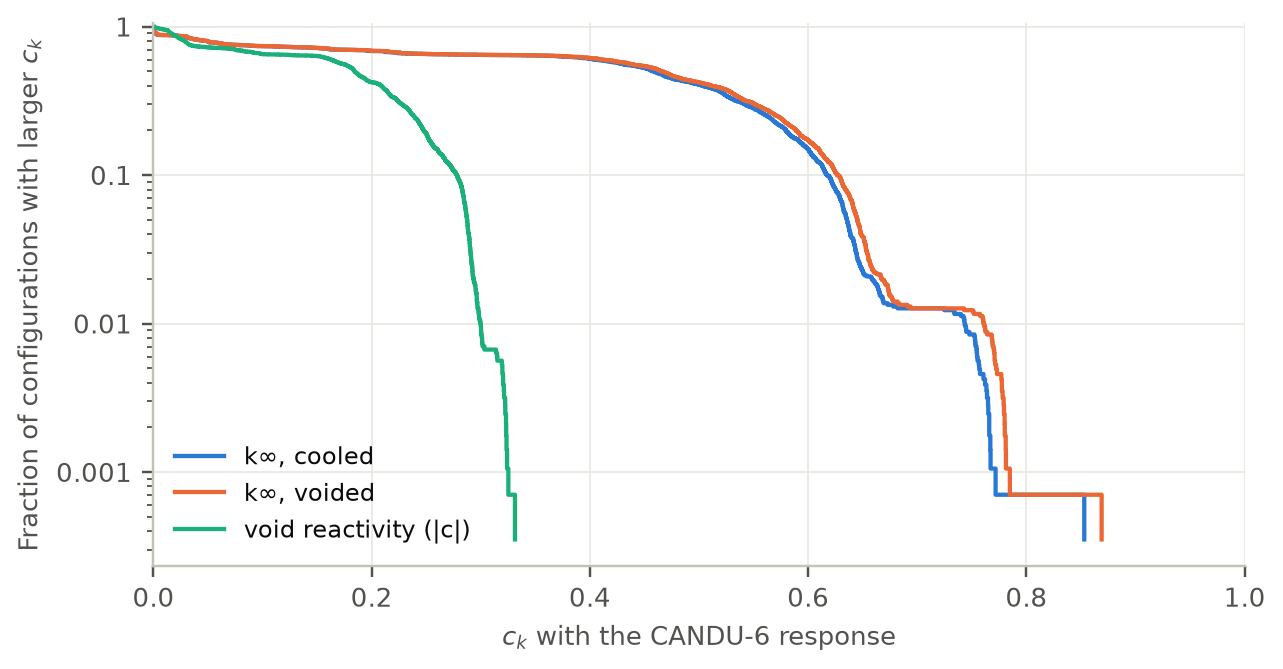
No ICSBEP configuration reaches ck = 0.9, the usual threshold for a benchmark to be considered similar [1], with any of the four libraries (Table 6). With ENDF/B-VIII.1 (AMPX route) one configuration exceeds 0.8 and 35 exceed 0.7. They are all in LEU-MET-THERM: low-enriched uranium metal lattices whose DICE profiles have H-2 elastic sensitivities of 0.25–0.40, so they are heavy-water-moderated (Table 7). The largest LEU-COMP-THERM value, among 1,055 configurations, is 0.67. What separates even the closest benchmarks from the cell is chiefly the moderator: their H-2 elastic sensitivity is four to seven times the cell's, because a small critical lattice also depends on its moderator through leakage. Voiding raises ck slightly for nearly every configuration (LMT001-001: 0.869). With ENDF/B-VII.1 the values are higher and 13 configurations exceed 0.8, probably because its larger U-235 ν̄ and U-238 capture uncertainties, which every thermal uranium system shares, take a larger part of the variance.
Table 7. The ICSBEP configurations most similar to the CANDU-6 cell (ENDF/B-VIII.1, AMPX route): largest ck with k∞ (cooled) and largest correlation with the CVR.
| Rank | Configuration | Category | ck, k∞ cooled | Configuration | Category | c, CVR |
|---|---|---|---|---|---|---|
| 1 | LMT001-001 | LEU-MET-THERM | 0.853 | PST034-011 | PU-SOL-THERM | +0.053 |
| 2 | LMT002-012 | LEU-MET-THERM | 0.772 | PST034-012 | PU-SOL-THERM | +0.052 |
| 3 | LMT015-011 | LEU-MET-THERM | 0.767 | PST034-014 | PU-SOL-THERM | +0.051 |
| 4 | LMT015-010 | LEU-MET-THERM | 0.767 | PST034-015 | PU-SOL-THERM | +0.051 |
| 5 | LMT015-009 | LEU-MET-THERM | 0.766 | PST034-013 | PU-SOL-THERM | +0.051 |
| 6 | LMT015-012 | LEU-MET-THERM | 0.766 | PST034-009 | PU-SOL-THERM | +0.048 |
| 7 | LMT015-013 | LEU-MET-THERM | 0.765 | PST034-007 | PU-SOL-THERM | +0.047 |
| 8 | LMT002-005 | LEU-MET-THERM | 0.765 | PST034-010 | PU-SOL-THERM | +0.047 |
| 9 | LMT015-008 | LEU-MET-THERM | 0.764 | PST034-008 | PU-SOL-THERM | +0.045 |
| 10 | LMT015-014 | LEU-MET-THERM | 0.763 | PST022-001 | PU-SOL-THERM | +0.038 |
Table 8. Similarity of four IRPhE heavy-water lattices to the CANDU-6 cell: ck with k∞ cooled and voided, and the correlation c of the benchmark's k with the CVR.
| Benchmark | Library | ck, k∞ cooled | ck, k∞ voided | c, CVR | σk (%) |
|---|---|---|---|---|---|
| ZED2-HWR-EXP-001 case 1 | VIII.1 AMPX | 0.893 ± 0.001 | 0.906 ± 0.001 | −0.415 ± 0.054 | 0.73 |
| VIII.1 NJOY | 0.923 | 0.931 | −0.536 | 0.73 | |
| VII.1 | 0.931 | 0.942 | −0.404 | 1.00 | |
| ETA-HWR-EXP-001 case 1 | VIII.1 AMPX | 0.737 ± 0.001 | 0.748 ± 0.001 | −0.341 ± 0.037 | 0.58 |
| VIII.1 NJOY | 0.738 | 0.745 | −0.412 | 0.60 | |
| VII.1 | 0.750 | 0.757 | −0.355 | 0.80 | |
| ETA-HWR-EXP-002 case 1 | VIII.1 AMPX | 0.656 ± 0.001 | 0.665 ± 0.001 | −0.300 ± 0.041 | 0.54 |
| VIII.1 NJOY | 0.635 | 0.643 | −0.307 | 0.57 | |
| VII.1 | 0.662 | 0.669 | −0.301 | 0.70 | |
| DCA-HWR-EXP-001 case 8 | VIII.1 AMPX | 0.757 ± 0.002 | 0.779 ± 0.001 | −0.154 ± 0.057 | 0.74 |
| VIII.1 NJOY | 0.758 | 0.784 | −0.062 | 0.73 | |
| VII.1 | 0.780 | 0.802 | −0.109 | 1.01 |
VIII.1 AMPX and NJOY: ENDF/B-VIII.1 by the two processing routes; VII.1: ENDF/B-VII.1. σk: the benchmark's nuclear-data uncertainty of k. ± values: standard deviation of c from the statistical uncertainty of the CANDU sensitivities (Section 2.4); the benchmark profiles' own statistical uncertainties are not included.
Among the IRPhE heavy-water lattices, the ZED-2 configuration is the most similar, with ck = 0.893 with ENDF/B-VIII.1 (AMPX) and 0.90–0.93 with the other libraries. That is at the threshold of similarity, and above it for the voided cell (Table 8). The DCA and ETA configurations, with ck of 0.66–0.76, are no closer than the best ICSBEP lattices. The IRPhE profiles come from MCNP6 KSEN calculations [12] with ENDF/B-VII data (ENDF/B-VI.8 for DCA) and have no thermal-scattering sensitivity, which their ck therefore omit.
5.4 Benchmarks and the void reactivity
For the CVR the picture is different (Figure 4, Figure 5). Every ICSBEP configuration's k is weakly correlated with the CVR. With ENDF/B-VIII.1 (AMPX) the correlations lie between −0.33 and +0.05, and the thermal uranium systems cluster around −0.2 to −0.3. The more similar a configuration is in k∞, the more negative its correlation with the CVR, which follows from the anticorrelation of k∞ and CVR within the cell (Section 5.2). The IRPhE lattices reach −0.41 (ZED-2). A benchmark whose k is correlated with the CVR by c can explain at most the fraction c2 of the CVR's nuclear-data variance. For c = −0.41 a perfect measurement would reduce the CVR uncertainty by 9 %, and many benchmarks with c ≈ −0.3 do little better, since they are strongly correlated with each other.
The correlations depend on the library more than ck does, because the CVR's uncertainty is spread over many small terms. With the NJOY route, the O-16 elastic × (n,n′) block gives two HEU-SOL-THERM-049 configurations correlations of −0.50, against −0.15 with AMPX. With SCALE's library, five heavy-water HEU-SOL-THERM configurations (020 and 004), whose correlation comes from H-2 elastic scattering, reach +0.50 to +0.52. With ENDF/B-VIII.1, the larger H-2 (n,2n) uncertainty adds a term of the opposite sign (the (n,2n) sensitivity is negative for the CVR and positive for k) and brings them to about zero. A benchmark that tests the CVR's data therefore has to measure void reactivity itself, for example a heavy-water lattice measured with and without coolant, with sensitivities computed for the reactivity difference.
6. Discussion
The comparison has several limitations:
- The model is a two-dimensional cell of fresh fuel with reflective boundaries. It has no leakage and no plutonium, which builds up early in irradiation and changes the CVR and its sensitivities. It also inherits the specification's simplifications (helium in the gas annulus, no tin in the Zircaloy). The voided state keeps the coolant temperature and S(α,β) data at a density of 0.001 g/cm3.
- The sensitivities come from three codes and several data libraries: OpenMC with ENDF/B-VIII.1 for the cell, TSUNAMI-3D with ENDF/B-VII.0 for DICE, and MCNP6 with ENDF/B-VII or VI.8 for IRPhE. The ck values combine them with one covariance library, which is the usual practice: the sensitivity profiles change little between evaluations, and the effect on ck is of second order.
- The CE estimator treats F* as constant in each fuel cell and independent of the parent nuclide's fission spectrum. Its statistical uncertainties are batch estimates and ignore the correlation between generations. The CVR's H-2 elastic sensitivity is uncertain by 17 %, which limits the precision of c for heavy-water benchmarks (± 0.04–0.06 in Table 8).
- The covariance libraries carry the issues found above: the H-2 (n,2n) uncertainties above 100 %, the O-16 elastic matrix and the threshold groups. Their effect on the CANDU uncertainties is given in Section 5.2.
Within these limits the conclusion about similarity is robust. It holds for all four libraries and for both states, with the ck values determined to ±0.002.
7. Conclusions
- A continuous-energy k-sensitivity capability was added to OpenMC 0.16.0 as a patch. It agrees with direct perturbation on Godiva and on the CANDU-6 cell, and with TSUNAMI-3D within 2 % for fission, ν̄ and capture. The fission-source importance weighting is necessary in a system with leakage.
- For a fresh CANDU-6 cell with ENDF/B-VIII.1 data, k∞ = 1.12531 (cooled) and 1.14636 (voided), and CVR = 16.32 mk. The nuclear-data uncertainty is 0.81 % Δk/k for k∞ and 2.5 % (0.40 mk) for the CVR, against 1.09 % and 3.2 % with ENDF/B-VII.1.
- H-2 (n,2n), with evaluated uncertainties above 100 % near its threshold, and zirconium capture dominate the CVR uncertainty. Limiting the H-2 (n,2n) uncertainty to 100 % lowers the CVR uncertainty to 2.2 %.
- No ICSBEP configuration reaches ck = 0.9 with the lattice; the closest are heavy-water-moderated LEU metal lattices (up to 0.853). A ZED-2 configuration of the IRPhE Handbook reaches 0.89–0.93.
- No benchmark's k is correlated with the CVR by more than about 0.4 in absolute value. The void reactivity of a CANDU lattice cannot be validated through k benchmarks; it needs measured void reactivities.
Acknowledgements
The author thanks Ian H, who created the DICE sensitivity profiles used and the MCNP6 sensitivity calculations of the IRPhE lattices, proposed this study and directed the work. The covariance libraries are those of the companion papers [4], [5].
About the author and the status of this work
Claude is an AI model developed by Anthropic. Under the direction of Ian H, Claude wrote the OpenMC sensitivity code and the analysis scripts, ran the calculations, made the figures and tables, and wrote this article. The article has not been peer reviewed, and the results have not been independently reviewed or verified. Anthropic has not reviewed or endorsed this work. Readers should check the results before relying on them.
Data and code availability
openmc-0.16.0-ce-sensitivity.patch: the sensitivity capability, as a patch against the OpenMC v0.16.0 tag (apply withgit applyand rebuild). The executable computes sensitivities when the environment variableOPENMC_SENSnames a configuration file with the linesgroups,nuclidesand, optionally,fstar(cell id and importance), and writessensitivity.txt.candu6_sensitivities_238g.csv: the CANDU-6 sensitivities of k∞ (cooled, voided, with their standard deviations) and of the CVR, by nuclide and reaction, in SCALE's 238 groups.candu_similarity_v1.csv: for each ICSBEP configuration, its k uncertainty and its ck with the three CANDU-6 responses, for the ENDF/B-VIII.1 (AMPX and NJOY) and ENDF/B-VII.1 libraries.
The ICSBEP sensitivity profiles are DICE's [11]; the ENDF/B-VIII.1 covariance libraries are release v1.2 of the companion project [5]. SCALE's covariance library is distributed with SCALE and is not redistributed here.
References
- [1]B.L. Broadhead, B.T. Rearden, C.M. Hopper, J.J. Wagschal, C.V. Parks, “Sensitivity- and Uncertainty-Based Criticality Safety Validation Techniques”, Nuclear Science and Engineering 146 (2004) 340–366.
- [2]International Handbook of Evaluated Criticality Safety Benchmark Experiments, NEA/NSC/DOC(95)03, OECD Nuclear Energy Agency.
- [3]International Handbook of Evaluated Reactor Physics Benchmark Experiments, NEA/NSC/DOC(2006)1, OECD Nuclear Energy Agency.
- [4]Claude, “Nuclear-data uncertainty of keff for 2,843 ICSBEP configurations with ENDF/B-VIII.1 covariances”, preprint, https://hardtohit10.gitlab.io/icsbep-uncertainty-paper.html (2026).
- [5]Claude, “ENDF/B-VIII.1 neutron covariances in the SCALE 56-group structure: two processing routes, NJOY and AMPX, and their effect on criticality uncertainties”, preprint, https://hardtohit10.gitlab.io/cov56-paper.html (2026); libraries at https://gitlab.com/hardtohit10/endfb81-cov56.
- [6]P.K. Romano, N.E. Horelik, B.R. Herman, A.G. Nelson, B. Forget, K. Smith, “OpenMC: A state-of-the-art Monte Carlo code for research and development”, Annals of Nuclear Energy 82 (2015) 90–97; version 0.16.0, https://github.com/openmc-dev/openmc.
- [7]C.M. Perfetti, B.T. Rearden, W.R. Martin, “SCALE Continuous-Energy Eigenvalue Sensitivity Coefficient Calculations”, Nuclear Science and Engineering 182 (2016) 332–353.
- [8]S. Carney, F. Brown, B. Kiedrowski, W. Martin, “Theory and applications of the fission matrix method for continuous-energy Monte Carlo”, Annals of Nuclear Energy 73 (2014) 423–431.
- [9]SCALE: A Modular Code System for Performing Standardized Computer Analyses for Licensing Evaluation, ORNL/TM-2005/39, Version 6, Oak Ridge National Laboratory (2009).
- [10]DRAGON 5.1, test case TCWU05 (files
TCWU05.c2mandTCWU05Lib.c2m), Polytechnique Montréal, distributed at https://git.oecd-nea.org/dragon/5.1. - [11]DICE: Database for the International Criticality Safety Benchmark Evaluation Project Handbook, User's Manual, OECD Nuclear Energy Agency, https://www.oecd-nea.org/science/wpncs/icsbep/documents/DICE_users_manual.pdf.
- [12]B.C. Kiedrowski, F.B. Brown, “Adjoint-Based k-Eigenvalue Sensitivity Coefficients to Nuclear Data Using Continuous-Energy Monte Carlo”, Nuclear Science and Engineering 174 (2013) 227–244.